

Fauci hearing fact-check - Part III - the safety claims, the money, and the question nobody answered
Fifteen claims from five senators: the VAERS death numbers, the deaths-per-year chart, the $1.4 million to Wuhan, the humanized mice, the $900,000 prize, the Q clearance, and the mask reversal.

Each item opens with what was actually said. Quotes are from the C-SPAN caption transcript with video and clock timestamps; obvious captioner garbles are corrected in square brackets, and everything in bold is the specific assertion being checked.
Sen. Ron Johnson’s case, claim by claim.
Sen. Johnson · 00:51:43 video / 9:21:24 a.m. ET
“I was warned pretty early on about the dangers of the experimental gene therapy that you called a vaccine, but it really falls under the definition of gene therapy. Were you carefully monitoring the safety surveillance systems that were literally deluged with complaints? Currently worldwide there have been almost 1.7 million adverse events reported to the system. Of those, 39,000 were deaths. Of those deaths, 29% occurred within the date of vaccination. It happens to be the same percentage that a Rasmussen poll pointed out the American public believed they knew someone who died of the experimental gene therapy... When I published it and people had me on their shows, they would be censored by Facebook. They would be deplatformed, largely at the behest of the actions you took to make sure that this information wasn’t spread. This wasn’t disinformation. It was the truth.”
Contradicted. FDA’s gene-therapy guidance explicitly excludes vaccines: “This guidance does not apply to vaccines for infectious disease indications.” EU directive 2001/83/EC defines a gene therapy medicinal product and then states: “Gene therapy medicinal products shall not include vaccines against infectious diseases.” Comirnaty’s approval letter is signed by Marion Gruber, director of FDA’s Office of Vaccines Research and Review, not by the gene-therapy review office. mRNA is translated in the cytoplasm. There is no reverse transcriptase and no integrase.
The kernel. Moderna's own pre-pandemic SEC filing says, "Currently, mRNA is considered a gene therapy product by the FDA." But the next line of the same risk factor reads: "Unlike certain gene therapies that irreversibly alter cell DNA and could act as a source of side effects, mRNA based medicines are designed to not irreversibly change cell DNA." Moderna filed that in November 2018, more than a year before any mRNA vaccine existed, and the risk it was describing to investors was a perception problem. The company's later annual reports carry the parallel line about the European Union characterizing mRNA as a Gene Therapy Medicinal Product, and the EU directive quoted above is the carve-out that line is describing.
mRNA vaccines share a mechanistic family with gene therapy and are excluded from the category by an explicit regulatory carve-out that has a scientific rationale, no integration and transient expression.
The 1.7 million and the 39,000.
Contradicted as evidence of harm.
The figures are VAERS as tabulated by OpenVAERS, current through June 26, 2026: 1,677,227 reports and 39,182 death reports. Sen. Johnson’s numbers match to the digit. VAERS is a United States system rather than a worldwide database, and about half its reports are foreign events forwarded by manufacturers. The actual global total is far larger. VigiAccess, the public window onto the WHO-affiliated Uppsala Monitoring Centre’s global database, lists on the order of 5.8 million.
The United States gave more than 670 million doses between December 14, 2020 and March 1, 2023, skewing heavily toward the oldest and sickest first. American all-cause mortality is roughly 2.7 deaths per 100,000 people per day. Coincidence alone predicts on the order of 55,000 deaths in the three days after a dose, and more than that given the age skew. VAERS captured about 11,300 in that window, a fraction of what chance alone predicts, and that count includes foreign reports, so the American figure is lower.
The Rasmussen coincidence.
Overstated, and the two numbers count different things.
What Rasmussen is. Rasmussen Reports is a private American polling firm. It polls by automated telephone, with a recorded voice reading the questions, and by online panel. FiveThirtyEight dropped it from its polling averages in March 2024, saying it failed the site’s standards for pollsters.
Rasmussen’s December 2022 survey found 28% of American adults saying they know someone personally who died from COVID vaccine side effects, fielded December 28 to 30, 2022, 1,000 adults, margin of error 3 points. Asked again in October 2023, the figure was 24%, from 1,110 adults.
Sen. Johnson presented a VAERS percentage and a polling percentage landing near the same number as two independent measurements converging. They are not independent, and they do not measure the same thing. One is the share of death reports filed within three days of a dose. The other is the share of survey respondents who believe they personally knew someone who died. Public belief about vaccine deaths tracks what people are told, and it is not a second measurement of how many people died. This is evidence, however, of a significant lack of trust in institutions.
What the courts found about NIAID and social media.
Contradicted as to Dr. Fauci. Partly documented as a general phenomenon.
The case is Missouri v. Biden. Two states and a group of individuals sued, arguing federal agencies had pressured social media companies into taking their posts down, and a district judge ordered a long list of agencies to stop. On appeal, the Fifth Circuit took Dr. Fauci and NIAID off that list. The evidence showed “the NIAID did not have regular contact with the platforms or flag content,” and that at most Dr. Fauci and his officials “promoted the government’s scientific and policy views and attempted to discredit opposing ones,” which the court called ordinary government speech rather than a First Amendment violation. The order stood only against the White House, the Surgeon General, CDC, FBI, and CISA.
Then the Supreme Court threw the case out. In Murthy v. Missouri, decided 6 to 3 in June 2024, it held that the people suing had not shown their own posts came down because of anything the government did, so they had no right to bring the case. The justices added that the trial judge’s findings “unfortunately appear to be clearly erroneous.” That is a ruling about who may sue, not about whether the pressure happened. The Fifth Circuit wiped out the order that August.
Mark Zuckerberg’s August 2024 letter, the best single piece of evidence for the general grievance, says “senior officials from the Biden Administration, including the White House, repeatedly pressured our teams for months to censor certain COVID-19 content,” and then: “Ultimately, it was our decision whether or not to take content down, and we own our decisions.” The letter doesn’t mention Dr. Fauci, NIH, or NIAID.
Sen. Johnson’s own suspension was from YouTube, for seven days in June 2021, not from Facebook.
The FDA scientist who warned about hidden signals.
Sen. Johnson · 00:53:03 video / 9:22:44 a.m.:
“My investigation shows that March 1, [Dr. Peter Marks] was warned by Dr. [Ana Szarfman] that the algorithm they were using to analyze the data was going to [mask] safety signals. 26 days later... there were new algorithms that unmasked the safety signals, including sudden cardiac death, cerebral artery occlusion, basal ganglia stroke, Bell’s palsy, and pulmonary infarction.”
Partly verified.
What masking means. VAERS is a pile of reports about problems people had after a shot. To spot a problem you compare: is this event reported more often after this vaccine than after all the others in the pile? In 2021 the pile was mostly COVID vaccine reports, so comparing one COVID vaccine to everything else largely meant comparing it to the other COVID vaccines. If they all had the same problem, no flag appeared. And a flag is not an injury. It means an event is reported more often than the math expected.
Dr. Ana Szarfman worked at FDA’s drug center. VAERS belongs to its biologics center. On March 1, 2021 she told the biologics director, Dr. Peter Marks, that the method in use “is not the state of the art.” She was lead author of the 2002 paper that brought it into FDA, and William DuMouchel, who built the math behind it, agreed with her.
She was right that masking is real. "Signaling COVID-19 Vaccine Adverse Events," in Drug Safety in 2022, found flags "may be undetected or delayed due to masking," and that masking "is much more likely to occur in COVID-19 vaccine signaling." Three caveats. Dr. Szarfman is one of eight authors, so it is not independent confirmation of her own position. Six of the eight work for Oracle Health Sciences, which sells the signal-detection software the paper recommends. And the paper says masking "is rare relative to all possible statistical associations."
Then, CBER’s Dr. Craig Zinderman asked Dr. Szarfman to “hold off on creating and sending data mining reports and analyses using COVID-19 vaccine [adverse event] data,” and Dr. Marks went to her boss warning that her work could “create erroneous conflicts that feed in to anti-vaccination rhetoric.” Separately, the CDC skipped a weekly check its own written procedures required. Those are real failures.
FDA didn't stop at flags. Studies of millions of people on Medicare, 3.4 million after a first round of shots and 6.2 million after a booster, "did not find an increased risk" for heart attack, low platelets, a serious clotting disorder, Bell's palsy or heart inflammation. A study of 99 million people in eight countries confirmed real risks: heart inflammation after all three vaccines it examined, and Guillain-Barré syndrome and a rare brain clot after a first dose of AstraZeneca.
At a separate April 2026 hearing, David Wiseman of Synechion, Inc. and Karl Jablonowski of Children’s Health Defense argued that FDA missed 96% of Pfizer flags and 91% of Moderna flags, that between 763 and 6,765 flags were lost, and that FDA was “completely blind.” Wiseman’s analysis is a ResearchGate posting that has not been peer reviewed, and the “49 examples of extreme masking” figure rests on FDA records that are not public.
To say 96% of flags were missed, you have to know how many there were. Nobody does. The paper compares flag counts from methods run on different slices of the data, differing by country, date range, which products they are measured against, where the cutoff sits, and whether the same event flagged four weeks running counts once or four times. A gap between those counts could be due to masking or just that the settings were different.
“Completely blind” is contradicted by their own data. The same system produced the heart inflammation finding in young men, the clotting finding that got the Johnson & Johnson vaccine pulled, and the Guillain-Barré finding.
What Dr. Nath’s 23 patients showed.
Sen. Johnson · 00:55:01 video / 9:24:42 a.m.:
"That same... month, March of 2021, an employee at NIH, Dr. [Nath], led a team of researchers diagnosing and treating individuals that had never had COVID who were severely injured by the genetic therapy injections. Dr. [Nath] told the individuals to stay quiet... There was a concerted effort. I will enter this in. It appears inside of NIH to quash his publishing of that study. It was finally put on a server, while telling no one, until I think about may of 2022... They didn't want to publish that because... publishing it would create vaccine hesitancy."
Partly verified on the research and the internal resistance. Unsupported on the allegation.
In May 2022, Dr. Avindra Nath of the National Institute of Neurological Disorders and Stroke and his colleagues posted a 23-patient preprint describing new neuropathic symptoms within a month of vaccination. Twelve of the 23, or 52%, had objective evidence of small-fiber neuropathy. Of those given oral corticosteroids, 58% improved completely or nearly completely within two weeks, against 9% of the untreated at twelve weeks. It was never published after peer review.
NIH Director Dr. Francis Collins called the approach “very troubling,” writing that “collecting anecdotes and then trying to build a case isn’t scientifically compelling and will have the main consequence of feeding vaccine hesitancy.” Lawrence Tabak, then NIH’s principal deputy director, wrote to Dr. Collins: “I don’t understand why Walter [Koroshetz, Director of NINDS] does not shut this down.” Dr. Collins was right that a 23-patient uncontrolled series cannot establish causation. Dr. Nath and his co-authors said so themselves: “the lack of a control group precludes attributing a causative role despite the temporal association.”
There are no emails, memos, or witness statements to demonstrate that Dr. Nath told patients to stay quiet.
“Who had never had COVID” is also unsupported. Prior infection was not an exclusion criterion and prior status is not reported.
Whether the vaccine caused Dr. Fauci's lung clot.
Sen. Johnson · 00:51:43:
“Your diary now shows that you actually suffered pulmonary infarction in June of 2021. I was just wondering what went through your mind that maybe that injection and those boosters that you took might have caused that.”
The event is verified. The inference is unsupported.
Dr. Fauci's diary entry for June 19, 2021 (PDF p. 782-783), describes a frightening day. He had chest pain two days earlier, so his doctor ordered a CT scan. A radiologist called to say the scan showed a spot on his right lung that looked like cancer. "I felt like I got hit like by a Mack truck," he wrote. Three more doctors reviewed the images and thought it was more likely inflammation. What they all agreed on was a smaller finding: a pulmonary infarction at the base of the right lung, where a piece of lung tissue had died because its blood supply was cut off. They told him to start Eliquis, a blood thinner, and repeat the scan in three months.
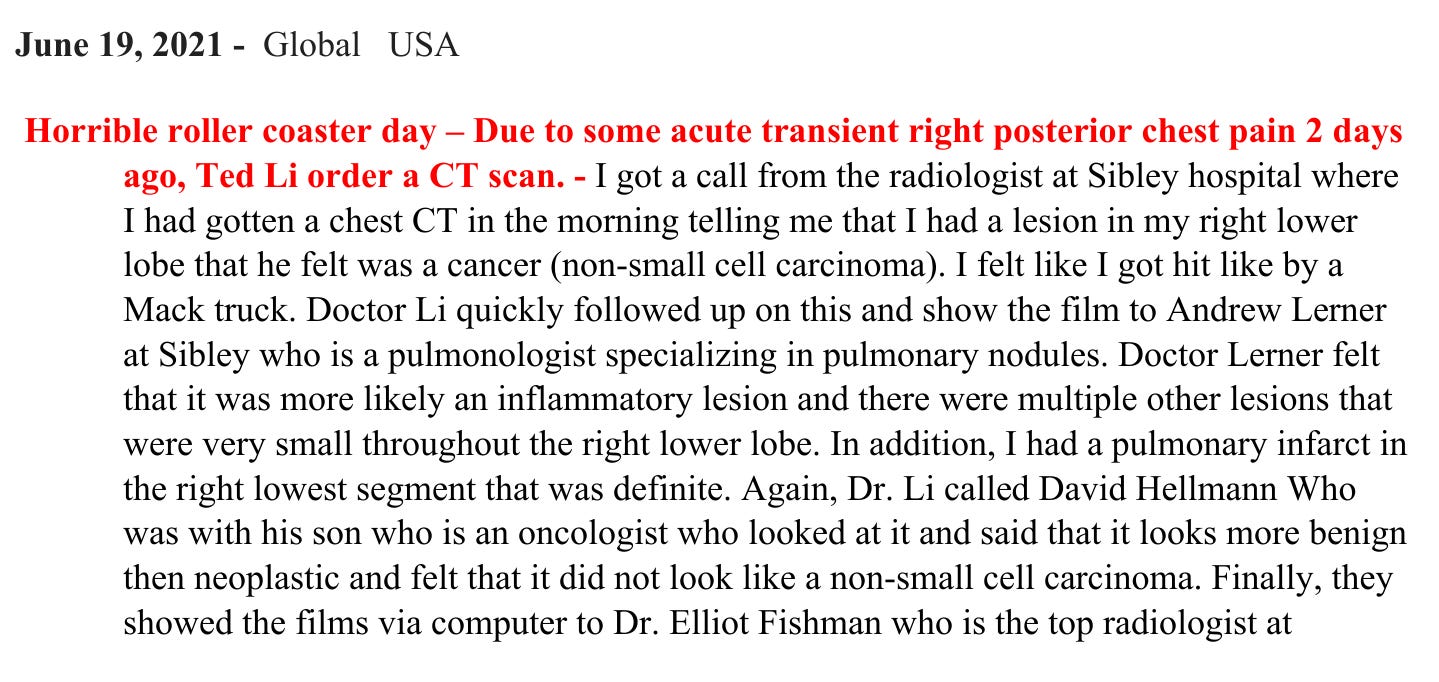

Dr. Fauci was 80. A lung infarction is usually caused by a pulmonary embolism, and the rate of venous clots climbs steeply with age, with embolism accounting for most of that climb. Clots in the veins are "a fairly common disease, particularly in older age."
The timing doesn’t fit a blood clot related to COVID vaccination. Dr. Fauci was vaccinated in December 2020, five to six months earlier. The widest window in which researchers still consider a vaccine a plausible cause is 42 days.
The biology doesn’t fit either. The one clotting problem linked to COVID vaccines is associated with the Johnson & Johnson and AstraZeneca vaccine, which are adenoviral-vector vaccines. They use a modified cold virus to carry the instructions for making COVID Spike protein into cells. Dr. Fauci received the Moderna mRNA COVID vaccine.
The deaths-per-year poster has no denominator.
Sen. Johnson · 02:40:15 video / 11:09:56 a.m. ET
“Let’s put my latest chart. Again, I was tracking adverse events on the experimental injection. I use this chart as comparison. We’ve got ivermectin, hydroxychloroquine. These are [INAUDIBLE], it does not prove causation but there is correlation. So ivermectin over 30 years of reports with 17 deaths per year. Hydroxychloroquine over 38 years of reporting, 142 deaths per year. [Remdesivir] over five and half years, 546 deaths per year. The COVID injection, almost 7000 deaths per year. Which is safest? What did the FDA freak... out about? Ivermectin.”
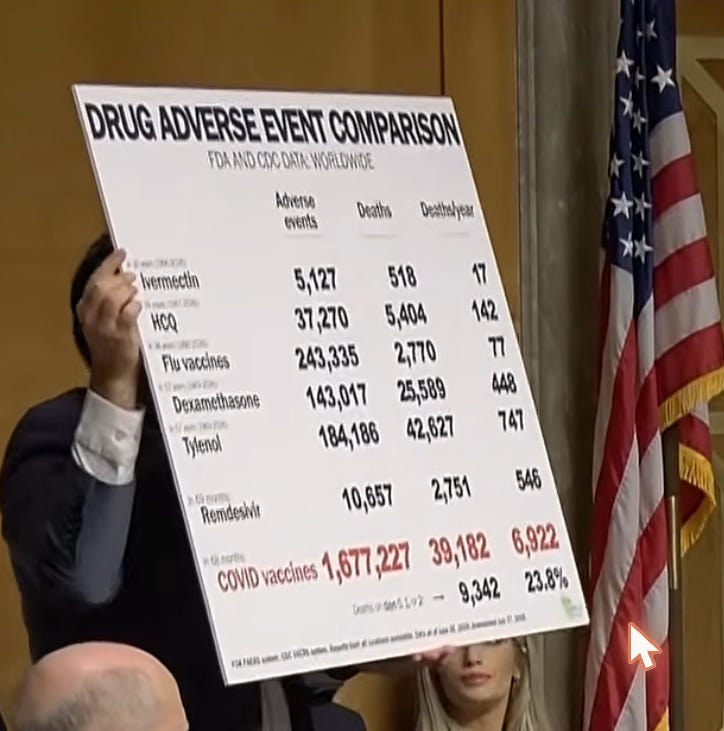
The poster above compared “deaths per year” for ivermectin, hydroxychloroquine, remdesivir, and “the COVID injection.”
The comparison does not work. Sen. Johnson said out loud that the numbers do not prove causation. Then he used them as if they did.
These numbers are counts of reports, not counts of deaths the drug or vaccine caused. Anyone can file a report. FDA’s guidance on its drug reporting system says the data “should not be used to determine the safety profile of one drug compared to another,” and “cannot be used to calculate the incidence of an adverse event.” VAERS’ data guide says “for any reported event, no cause-and-effect relationship has been established.”
There are no denominators. A count of deaths means nothing until you know how many people took the thing. Ten deaths among a hundred people is a disaster. Ten deaths among a million is ordinary. More than 670 million COVID shots went into American arms, and the oldest and sickest people got them first. Thousands die every week even in the absence of COVID or COVID vaccines.
The counting rules were not the same either. Anyone who gave a COVID shot was required to report a death that followed it. No such rule covered ivermectin or hydroxychloroquine. So one bar on that chart counts nearly everything, and the others count whatever somebody chose to send in.
Remdesivir has its own problem. It went almost only to people already in the hospital with COVID. Deaths after it are mostly deaths from COVID.
Here is the count when it is done properly. Studies that follow a known group of people, so the number who got the shot is known, found nine deaths caused by COVID vaccines. All nine came from clotting with low platelets after the Johnson & Johnson adenoviral-vector vaccine, which uses a modified cold virus to carry its instructions for making COVID Spike protein into cells. That vaccine was restricted and later pulled.
Reports did turn up myocarditis (i.e. heart inflammation) in young men who received the COVID mRNA vaccines. Researchers followed that lead and conducted studies with real denominators, and the risk turned out to be real.
Sen. Ernst on Dr. Fauci’s salary, the billion, and the Chinese institute.
Sen. Ernst (R-IA) · 02:04:05 video / 10:33:46 a.m. ET:
“Dr. Fauci, in 2022, you had a taxpayer-funded salary of $480,000 a year. You were, in fact, the highest paid federal employee in the entire federal government, even making more than the NIH Director and the president of the united states. According to now public documents, that was due in large part to your work on biodefense. Unreported is how NIAID spent the over $1 billion from 2009 to 2026 in biodefense and influenza federal contracts and sub contracts. My office uncovered records on usaspending.gov that show that NIAID paid out $515,418 in sub contracts to the Harbin Veterinary Institute in China, including $100,000 a few days after it opened a biolab in 2018.”
Dr. Fauci was paid $480,654 in 2022, per federal salary records. The president’s salary has been $400,000 since 2001, set by law.
“Highest paid federal employee in the entire federal government” is overstated. It holds only if you leave out the Tennessee Valley Authority, a federally owned corporation whose chief executive is paid several million dollars a year. Dr. Fauci was the highest paid person on the regular federal payroll.
“Due in large part to your work on biodefense” cannot be checked. NIH can pay certain scientists above the normal federal ceiling to recruit and keep them.
The comparison the hearing left out. $480,654 looks large next to other federal employees. CBO’s 2022 analysis found that federal workers with a professional degree or a doctorate earn about 22% less in total compensation than comparable private-sector workers.
Dr. Vivek Murthy’s disclosure shows what that compensation can look like. He filed it in February 2021, when he was nominated for a second term as surgeon general, and it reported at least $2.6 million earned since January 2020: more than $600,000 from Netflix, $410,000 in cash from Airbnb plus stock then worth roughly $402,000, $400,000 from Carnival, $292,500 from Estée Lauder, and $522,650 across about three dozen speeches.
Dr. Murthy earned about five times what Dr. Fauci made in a single year. This is why NIH has the authority to pay above the ceiling in the first place. Without it, the people at the top of a field often take the other offer.
NIH describes its Title 42 hiring authority, which lets it pay some scientists above the normal federal ceiling, as the flexibility “needed to attract and retain scientists with outstanding scientific, technical and clinical skills.”
What he earns now, since the hearing raised the subject. On July 1, 2023 Dr. Fauci started at Georgetown as a distinguished university professor, appointed to the medical school’s infectious disease division and the McCourt School of Public Policy. He also draws a federal pension, takes royalties on the McGraw-Hill internal medicine textbook he has helped edit since the 1980s, and published a memoir with Penguin Random House’s Viking imprint in June 2024. He speaks for a fee, including for the National Association of Chain Drug Stores, the insurance trade group AHIP, the Japan Medical Congress, and the trading firm WorldQuant. Two prizes came with cash: Columbia’s Calderone Prize at $50,000 and the National Academy of Medicine’s Lienhard Award at $40,000. The household's 2023 filing, submitted by his wife Dr. Christine Grady, records five deposits totaling $1.15 million whose sources the forms do not name. No senator asked about it.
Federal contract spending is published on usaspending.gov, including biodefense and influenza federal contracts and sub contracts. NIAID’s budget request to Congress breaks spending down by grant type, not topic. NIAID’s budget was $6.56 billion in fiscal 2025. Sen. Ernst’s figure covers seventeen years. “Over $1 billion” across seventeen years, at an agency spending six billion a year, is a floor. Under the Trump Administration, NIAID’s request for fiscal 2026 was $4.17 billion, a cut of more than a third.
NIAID did indeed pay out $515,418 in subcontracts to the Harbin Veterinary Institute, part of the Chinese Academy of Agricultural Sciences. USASpending shows five subawards totaling exactly $515,418, under NIAID’s influenza surveillance contract, with Emory University as the prime recipient. NIAID did not pay the Harbin Veterinary Institute directly.
The $100,000 is $104,667, and it landed eight days after China announced the Harbin Veterinary Institute biosafety laboratory on August 8, 2018. The Harbin Veterinary Institute was criticized in 2013 for mixing bird flu and human flu viruses, so the institute’s history is a fair thing to raise.
Sen. Hawley on the prizes and the money.
Sen. Hawley (R-MO) 01:45:55 video / 10:15:36 a.m. ET:
“It was a $900,000 cash award. $900,000 cash award. And he got it. Because he used federal employees to get it and this wasn’t the only award, was it, Dr. Fauci? In fact, you applied for and received at least eight other federal cash prizes on federal time using federal employees and federal resources... you used eight separate federal employees on federal time, using federal resources, to solicit cash awards. Isn’t that true?”
Sen. Hawley (R-MO) 01:49:16 video / 10:18:57 a.m. ET:
“...which is north of $12 million. You got over a million dollars in cash awards during COVID, during a 12-month, 24-month span during COVID... Now you’re worth more than $12 million. You’ve got a pension that in its first year paid out north of $400,000 a year. A million people dead, you’re getting rich.”
The numbers mostly hold, but none of the awards Sen. Hawley named is a federal cash prize.
The $900,000 is right. The Dan David Prize is $1 million. Winners give 10% of it to graduate scholarships. That leaves $900,000. The Dan David Prize is awarded by a private Israeli foundation based at Tel Aviv University.
Neither are the others he named. Sen. Hawley listed the Partnership for Public Service, a Smithsonian award, the National Academy of Medicine, and the CDC Foundation. The Partnership for Public Service, the National Academy of Medicine, and the CDC Foundation are private non-profits. The Smithsonian’s Great Americans Medal is not a cash prize.
The staff-time charge is the real one. Whether federal employees spent federal work hours preparing award nominations for their director is a legitimate question about the use of public resources.
The $12 million and the over $400K/year pension. Both figures come from OpenTheBooks, an advocacy group whose founder published the analysis. Federal financial disclosure forms report holdings in broad ranges rather than exact amounts, so any “net worth” built from them is an estimate with wide margins. The Office of Personnel Management has never released Dr. Fauci’s actual annuity. The pension figure that circulates, $414,667, is OpenTheBooks’ calculation from the federal retirement formula.
“A million people dead, you’re getting rich” links two things that are not linked. A retired federal scientist’s portfolio going up during a bull market is not evidence about a pandemic.
Did the NIH used subawards to hide Wuhan funding?
Sen. Ernst · 02:10:08 video / 10:39:49 a.m. ET:
“At my request, the government accountability office helped track down that $1.4 million of US taxpayer money that was sent to the Wuhan Institute of Virology, both by you, Dr. Fauci and through USAID. But first it passed through EcoHealth Alliance, which I helped to get defunded through the NDAA. Dr. Fauci, did you intentionally use subaward funding to obscure NIH funding of Chinese biolabs and coronavirus research?”
The figure is right. The question at the end assumes something the record does not support.
$1.4 million checks out. GAO found three subawards totaling $1,413,720 disbursed to the Wuhan Institute of Virology between 2014 and 2021.
She is right that it came from two places. NIAID’s bat coronavirus grant sent $598,611 to the Wuhan institute. USAID’s PREDICT program sent the rest, and some of that arrived as a subaward of a subaward, a layer further down than the reporting rules require anyone to publish.
A subaward is the ordinary way a federal grant reaches a partner organization. Hundreds of NIH grant holders use one in any given year, and it is written into the grant documents from the start. Nobody invented it for Wuhan.
But there is a real reporting failure inside her question, and it is not the one she asks about. Federal rules require grant holders to post their subawards to a public database. EcoHealth Alliance did not always do it. That is a documented compliance failure by the grant holder, not a concealment scheme by NIH, and it is the reason the money took a GAO inquiry to trace.
The mechanism she is asking about ended more than a year before the hearing. NIH abolished foreign subawards in May 2025 and replaced them that September with a structure that gives each foreign partner its own grant number and its own reporting duty to NIH.
The mouse shipment.
Sen. Ernst · 02:12:38 video / 10:42:19 a.m. ET:
“Dr. Fauci, we have learned that US coronavirus researchers at UNC shipped ‘humanized mice to China’ by around 2017 for use in their dangerous coronavirus work.”
This is correct, but it doesn’t mean what the sentence implies.
The shipment happened. As reported by the MIT Technology Review in 2021, Ralph Baric’s lab at the University of North Carolina sent transgenic mice carrying the human ACE2 receptor to the Wuhan Institute of Virology.
NIH grant documents obtained by The Intercept put the mouse experiments in the grant year running June 2017 to May 2018.
What a humanized mouse is. To get into a cell, a coronavirus has to grab a protein on the cell's surface called ACE2. Think of it as a doorhandle. The mouse version of that doorhandle is shaped differently from the human version, so SARS-like coronaviruses can’t get a grip and infect an ordinary mouse. So researchers breed mice that carry the human doorhandle instead. These animals are standard equipment across virology, used to test vaccines and treatments as much as to test viruses.
And what went into these ones is the real finding. Researchers at Wuhan built hybrid viruses by putting the outer spike of newly found bat coronaviruses onto the body of a virus called WIV1. According to former Principal Deputy Director Lawrence Tabak in October 2021, one hybrid made the mice sicker than the original virus did and killed six of eight of them.
The grant required EcoHealth Alliance to tell NIH right away if a virus grew ten times better than expected. EcoHealth did not.
NIH says the WIV1 family is too far from SARS-CoV-2 for these particular experiments to have started the pandemic, and the published genomes support that. NIH also says the work did not meet its definition of gain-of-function research at the time, because those bat viruses had not been shown to infect people. That second point describes the rules as they stood in 2017. It does not say the experiments were safe. (More on this in Part 2 of my fact-check.)
Did NIAID bribe the Proximal Origin authors?
Sen. Ernst · 02:11:38 video / 10:41:19 a.m. ET:
“NIAID awarded multimillion dollar grants to a number of scientists shortly after they wrote publicly in the origins paper that the COVID virus likely came from nature... In 2023, Representative Jordan insinuated that you basically gave a $9 million bribe in the form of a NIH grant to NIH-funded virologists to say the virus likely was from nature. Dr. Fauci, yes or no, did you reward the Proximal Origin authors by giving them NIAID grants or contracts?”
The grant is real, but the timeline still doesn’t support a bribe.
NIAID award U01AI151812 funds the West African Research Network for Infectious Diseases, about $9 million. Its principal investigators are Kristian Andersen of Scripps, Robert Garry of Tulane, and Pardis Sabeti of the Broad Institute. Andersen and Garry are two of the five authors of Proximal Origin.
Applications were due June 28, 2019. Independent peer reviewers scored it in November 2019. NIAID’s advisory council recommended funding it in January 2020. Every one of those steps came before the February 1, 2020 phone call that the bribery story is built around, and before Proximal Origin was drafted in February 2020 and published March 17, 2020.
The notice of award did not go out until May 21, 2020. Between the council’s recommendation and that notice, the decision sat inside NIAID, and an institute director has some discretion at the margins. The Intercept made this point in 2023, and it is why “the reviewers had already decided” is not a complete answer.
The score and the council recommendation were already on the record before the call. The team is not new: Andersen, Garry, and Sabeti have worked together on Lassa fever in Sierra Leone and Nigeria for more than a decade, through the Viral Hemorrhagic Fever Consortium. And the center’s subject is Lassa fever and disease surveillance across West Africa.
Why Bill Gates had a Q clearance.
Chair Paul · 02:52:35 video / 11:22:16 a.m. ET, in the closing.
“confirms Anthony Fauci’s tenure that Bill Gates was given security clearance from 2014 to 2021.”
The clearance is real, but it’s not an NIH clearance. The letter is from the Department of Energy. It reports a Q access authorization granted June 11, 2014 and terminated December 6, 2021.
A Q authorization is a nuclear credential. DOE’s own explanation describes it as the department’s equivalent of a Top Secret clearance, and it is the level required for access to Restricted Data, meaning nuclear weapons and special nuclear material information. NIAID does not issue one, hold one, or have any say over who gets one.
Reporting on the letter says DOE recorded the clearance as reciprocal, meaning another federal agency had already vetted Mr. Gates and DOE recognized that agency’s decision. DOE policy requires this: a clearance at the same level from any authorized federal agency must be recognized by the others. The letter does not name the original agency.
Mr. Gates founded the nuclear reactor company TerraPower in 2006 and chaired it through the entire clearance period. Whether that is the explanation is not established, and nobody in the room asked.
Dr. Fauci directed NIAID from 1984 to 2022. Any seven-year span between those years falls inside his tenure. “During Fauci’s tenure” is true of the 2014 Winter Olympics too.
DOE asked the committee to keep the letter confidential and marked it not for public release. Chair Paul read it into the public record on July 29, 2026.
What “empiric” means, and whether it is lying.
Sen. Ashley Moody (R-FL) · 02:18:57 video / 10:48:38 a.m. ET
Sen. Moody: “Public has to be able to trust the people giving them instructions. That trust depends on candor. Would you agree with that, Dr. Fauci?”
Dr. Fauci: “On the advice of counsel I respectfully decline to answer based upon my rights under the Fifth Amendment to the Constitution.”
Sen. Moody: “When the evidence is uncertain, officials need to say so. When recommendations are based on assumptions rather than hard data, they need to say so. So when they get something wrong, they need to own it. And when the trust is lost, the consequences extend far beyond any single pandemic. The next time public health officials genuinely need Americans to listen, millions of people may simply ignore them. Or not believe them.”
The candor charge holds on the masks. It is overstated on the six feet.
The masks. On March 8, 2020, on CBS News’ 60 Minutes, Dr. Fauci said “right now in the United States, people should not be walking around with a mask.” On April 3, 2020, CDC recommended cloth face coverings. Four months after that, at a Washington Post event in July 2020, he explained the original advice differently: “Back then, the critical issue was to save the masks for the people who really needed them because it was felt that there was a shortage of masks.”
“When you told the American people there was no reason to wear a mask, what was your principal objective, giving them an honest assessment of the medical evidence or discouraging them from consuming a scarce supply of masks?” asked Sen. Moody.
Two things were true in March 2020. The evidence on community masking was thin, and the supply was short.
In July 2020, he also gave a third reason: officials “didn’t realize at all the extent of asymptomatic spread.” That is a fact about the virus that nobody had in March and most people had by April, and changing advice when something like that lands is what the job requires.
The six feet. In his April 5, 2020 CBS News’ Face the Nation interview, Dr. Fauci urged people to “physically separate six feet away,” which she contrasted with against his January 2024 testimony (p. 183 to 184): “It sort of just appeared. I was not aware of studies that, in fact, that would be a very difficult study to do... Just an empiric decision that wasn’t based on data.”
He didn’t say distancing doesn’t work. The best evidence available at the time, a WHO-commissioned meta-analysis of 172 studies, found lower transmission at a meter or more. The three-versus-six comparison came later, from a Massachusetts cohort of 537,336 students that found no difference where masking was universal. And Dr. Fauci did not issue the six-foot guidance. The CDC did.
What “empiric” means, and whether it is lying. An empiric decision is a judgment made from experience and mechanism when the direct evidence does not exist. Physicians make them all day. You start empiric antibiotics before the cultures come back, because waiting 48 hours for certainty kills the patient. You pick a dose from pharmacology and analogy when no trial has compared 40 mg to 60 mg. Six feet came from droplet-fall experiments done in the 1930s and decades of infection-control convention.
So the answer to “what do you do when the data are imperfect” is to act on the best available reasoning and say that is what you are doing. The obligation is to label it.
Lying means asserting what you believe to be false. Dr. Fauci did not lie about six feet. He believed distance helped, and it does.
Agencies can be required to publish, alongside any guidance, the evidence tier it rests on and what would change it. CDC already does this internally for ACIP recommendations using the GRADE framework. Nothing stops Congress from requiring it on the face of public-facing guidance.
What happens next.
The committee will vote on whether to certify contempt. That vote does not by itself refer anything to a prosecutor: the full Senate has to adopt the resolution and clear a 60-vote threshold first.
Sen. Johnson has separately promised a subpoena for a closed-door deposition. The perjury statute on the May 2021 testimony expired in May 2026.
None of that addresses the question Sen. Moody asked. The fix she was circling, requiring agencies to publish the evidence tier behind any public guidance and what would change it, needs a bill, not a contempt vote. No one has introduced it.