


Each item opens with what was actually said. Quotes are from the C-SPAN caption transcript with video and clock timestamps. Everything in bold is the specific assertion being checked.
The ferret experiment and what Sen. Paul left out.
Chair Rand Paul · 00:38:53 video / 9:08:34 a.m. ET
“This might be the most important we get to today, 50% mortality for humans. The good news about animal viruses is that it doesn’t infect humans well. Doesn’t go human to human very well. With the money that you provided to [Ron Fouchier], [they made] purposeful mutations that didn’t just affect birds but also mammals and went ferret to ferret [in] an aerosolized manner. People saw this and were aghast.”
Partly verified.
NIAID money is real: Herfst et al., Science 2012 carries NIAID contract HHSN266200700010C through the Center for Research on Influenza Pathogenesis, on which Fouchier’s Erasmus MC lab was a subcontractor.
Why anyone would do this. H5N1 lives in wild birds and poultry. It infects people who handle infected birds, rarely, and when it does the illness is often severe. What it has never done is pass efficiently from one person to another.
Whether that barrier is permanent or temporary is the question that governs pandemic planning, and surveillance alone doesn't answer it. You can sequence every H5N1 sample on earth and still not know which genetic changes would matter, because you do not know what to look for.
The experiment was built to produce that list, and it did. Find the mutations that let the virus travel through air between mammals, and surveillance labs know which changes to flag in the next poultry outbreak. In an op-ed in The Washington Post, Dr. Fauci made exactly that case: the new data “can inform influenza preparedness and help delineate the principles of virus transmission between species.” Herfst’s group also reported that their transmissible virus stayed sensitive to oseltamivir, sold as Tamiflu, and that the antibodies raised by existing H5N1 vaccines still recognized it. That last test is the standard way to check whether a vaccine would hold: take blood serum from a vaccinated host, which is full of antibodies, and see whether they recognize the new virus. They recognized it twice as well as they did the original, though antibody binding in a dish is not the same as protection in a person. If this virus ever appeared in nature, the antiviral would work on it, and the existing vaccine looked likely to.
"Purposeful mutations" is half right. Three changes were built into the virus deliberately, by rewriting its genes. The rest appeared on their own, over ten rounds of passing the virus from one ferret to the next and letting it adapt. The paper's own summary: "as few as five amino acid substitutions (four in HA and one in PB2) may be sufficient to confer airborne transmission." Four of those five sit in the protein the virus uses to latch onto cells, and one in a protein it uses to copy itself. Airborne transmission happened, and the authors called it "less robust, with less and delayed virus shedding compared with pandemic A/H1N1 virus."
Here is what Sen. Paul left out, and it is the single most important omission in his gain-of-function case. From the paper's abstract: "None of the recipient ferrets died after airborne infection with the mutant A/H5N1 viruses." In the body: "although the airborne-transmissible virus is lethal to ferrets upon intratracheal inoculation at high doses, the virus was not lethal after airborne transmission." The deaths people remember came from squirting a million infectious doses directly into the trachea, a route the authors described as one that does "not represent the natural route of infection."
Paul cited the 50% figure moments before describing the ferret result. The two numbers answer different questions. The 50% is how often people die once infected with H5N1, and those people caught it from birds, not from each other. The experiment asked whether the virus could travel through the air between mammals. It could, and it killed none of the ferrets it reached.
On the 50%. As a reported figure it holds: WHO counts 964 confirmed human H5N1 cases and 466 deaths since 2003, 48.3%. This number has been contested since 2012, because WHO counts only laboratory-confirmed cases, which are overwhelmingly hospitalized severe cases in countries with thin surveillance. The Congressional Research Service concedes this point: “It is widely understood that this reported mortality rate may not reflect the true historical mortality rate in humans.” Of the 46 US cases reported through October 2024, 45 with animal exposure were all mild, none hospitalized, none dead.
Also on the ferret model. Dr. Fauci's op-ed called the ferret "the best animal model for human influenza infection" and that "it is not clear whether this laboratory virus would behave in humans as it does in ferrets." We need better animal models to study human influenza infection and vaccines.
What the experiment settled. Before this work, nobody could say whether H5N1 was capable of airborne spread between mammals, or which genetic changes would get it there. Afterward there were answers to both: it is, and as few as five substitutions will do it. Surveillance could not have produced that. You cannot flag a mutation you have not yet learned to look for. What the experiment did not settle is how dangerous such a virus would be to people, which is the question Sen. Paul's case turns on, and there the ferret result splits: lethal by intratracheal inoculation, but lethal to none of the animals it reached through the air.
What Dr. Fauci wrote about gain-of-function.
Chair Paul · 00:39:08 video / 9:08:49 a.m. ET
“This is when the debate came about and he wrote in support of this in The Washington Post. You said that even if a pandemic should occur, the knowledge is worth the risks.“
Fair as a paraphrase of a different document.
The op-ed is real: Dr. Anthony Fauci, Gary Nabel and Francis Collins, “A flu virus risk worth taking,” The Washington Post, December 30, 2011, but the sentence Sen. Paul read is not in it." Fauci, Nabel, and Collins defended the research, which would later be categorized as gain-of-function: “Given these uncertainties, important information and insights can come from generating a potentially dangerous virus in the laboratory.”
But they also said: “The question is whether benefits of such research outweigh risks. The answer is not simple. A highly pathogenic bird flu virus transmissible in humans could arise in ways not predicted by laboratory studies. And it is not clear whether this laboratory virus would behave in humans as it does in ferrets.” They said: “Safeguarding against the potential accidental release or deliberate misuse of laboratory pathogens is imperative.” The op-ed never contemplated an actual pandemic as an acceptable price.
But ten months later, Dr. Fauci wrote: “In an unlikely but conceivable turn of events, what if that scientist becomes infected with the virus, which leads to an outbreak and ultimately triggers a pandemic? ... Scientists working in this field might say — as indeed I have said — that the benefits of such experiments and the resulting knowledge outweigh the risks.“ He also wrote: “The influenza virus research community is to be commended for implementing a voluntary moratorium on “gain-of-function” experiments related to the transmissibility of highly pathogenic H5N1 influenza virus. As a key funder of influenza virus research, the National Institute of Allergy and Infectious Diseases, a component of the U.S. National Institutes of Health, strongly supports the continuation of this moratorium pending the resolution of critical policy issues related to the rationale for performing and reporting such experiments.”
What “gain-of-function” has officially meant, and for how long.
Chair Paul · 00:08:38 video / 8:38:19 a.m. ET
“That you could define gain of function in one way in which this was not gain of function, in which all of the common sense of the world be thrown out, all of the idea that the mice were dying in the virus was more transmissible did not matter because you had a technical definition that allowed you to fund it.”
Partly verified. A narrow technical definition governed. NIH's position was that it excluded the Wuhan work. The narrow definition came out of a White House policy process and a recommendation from the government’s own biosecurity advisory board, not from NIAID, and that same board asked in 2023 that it be widened.
“Gain of function” in ordinary use means any laboratory change that gives an organism a new or stronger ability. Most of it is routine and harmless. In federal policy the phrase was meant to pick out a much smaller set: experiments that could make a dangerous pathogen more contagious or more deadly.
Whether a safety rule covers a given experiment depends entirely on which words the rule uses. Those words have changed six times in thirteen years.
2011 to 2012: a different name. The Fouchier and Kawaoka ferret experiments were not called gain-of-function at the time. They were called “dual use research of concern,” meaning legitimate research that could also be misused. The 39-scientist pause letter of January 2012 described pausing work that “enhances the transmissibility of highly pathogenic avian influenza viruses in mammals,” and never used the phrase.
Late 2012: the label attaches. NIH applied it retroactively, to the same two experiments, in “A Proposed Framework for Guiding HHS Funding Decisions about Highly Pathogenic Avian Influenza H5N1 Gain-of-Function Research,” November 27, 2012. That document and the HHS framework that followed in February 2013 made “gain-of-function” the governing term. It has not had a stable federal definition since.
October 17, 2014: a pause that doesn’t define what it pauses. After a run of federal laboratory accidents (DC anthrax, forgotten smallpox vials, and an H5N1 cross-contamination), the White House stopped funding a class of experiments. The document was titled a pause on “gain-of-function research,” describing it as research “that reasonably may be anticipated to confer attributes to influenza, MERS, or SARS viruses such that the resulting virus has enhanced pathogenicity and/or transmissibility (via the respiratory route) in mammals.” Work on viruses as they occur in nature was exempt, and agency heads could grant exceptions.
NIH sent 18 letters to 14 universities telling them to stop. Years later the Congressional Research Service reported that it “was unable to identify with certainty which of the 36 initial projects were ultimately paused.”
May 2016: narrowed, still undefined. The National Science Advisory Board for Biosecurity (NSABB), the federal panel that advises on this, created a narrower category instead of defining the broader one. Its first finding: “There are many types of GOF studies and not all of them have the same level of risks. Only a small subset of GOF research, GOF research of concern, entail risks that are potentially significant enough to warrant additional oversight.”
January 2017: the phrase is dropped entirely. New White House guidance, known by the acronym P3CO, for potential pandemic pathogen care and oversight. A “potential pandemic pathogen” was defined as being a germ dangerous enough to start a pandemic. To qualify it had to clear two bars at once: likely to spread easily among people and likely to make them seriously ill or kill them. This definition was “meant to capture the activities that were addressed in the NSABB Recommendations as ‘gain-of-function research of concern.’”
An enhanced potential pandemic pathogen was defined as one that was made that way in a laboratory. The guidance was explicit that a naturally occurring virus never qualified, however dangerous it was: “wild-type pathogens that are circulating in or have been recovered from nature are not enhanced PPPs, regardless of their pandemic potential.” Surveillance work and vaccine manufacturing were exempted on the same reasoning.
December 19, 2017: the pause lifts. HHS issued its version of the framework and NIH restarted funding the same day. HHS was the only federal agency that ever built a review process, and in the seven and a half years it ran, the Government Accountability Office (GAO) found four projects were sent up for department-level review. Three were modified. One was not funded.
December 19, 2017 to May 5, 2025 is seven years and four and a half months.
January 2023: the advisory board says the definition is too tight. In its final report, the same panel called the definitions “too narrow,” warned that requiring a pathogen to be both “highly” transmissible and “highly” virulent “could result in overlooking some research,” and recommended three changes: lower the bar to “moderately or highly,” require only one of the two conditions rather than both, and scrap the blanket exemptions for surveillance and vaccine work.
May 6, 2024: adopted, with a new name. Those changes went into a new policy that replaced the 2012 dual-use policy, the 2014 institutional dual-use policy, and the 2017 framework. It coined a fourth term, “pathogen with enhanced pandemic potential,” covering work that increases spread or severity “or disrupt[s] the effectiveness of pre-existing immunity.” It was written with a year’s lead time, to take effect May 6, 2025.
May 5, 2025: superseded one day early. President Trump’s Executive Order 14292 replaced it the day before it was due to start. The 2024 policy never governed a single grant. The executive order brought back “dangerous gain-of-function research” (DGOF) and defined it as work on an infectious agent or toxin “with the potential to cause disease by enhancing its pathogenicity or increasing its transmissibility.” It suspended that research and ordered a replacement written within 120 days, by September 2, 2025.
July 20, 2026: the replacement. HHS announced it on July 28, the day before this hearing. The policy prohibits federally funded DGOF outright and makes “potential DGOF” fundable only after review by a government-wide Independent Third-Party Review Body. The policy also bars funding any life sciences research involving an “entity of concern,” including research conducted in a country of concern or performed abroad by a designated institution or individual.
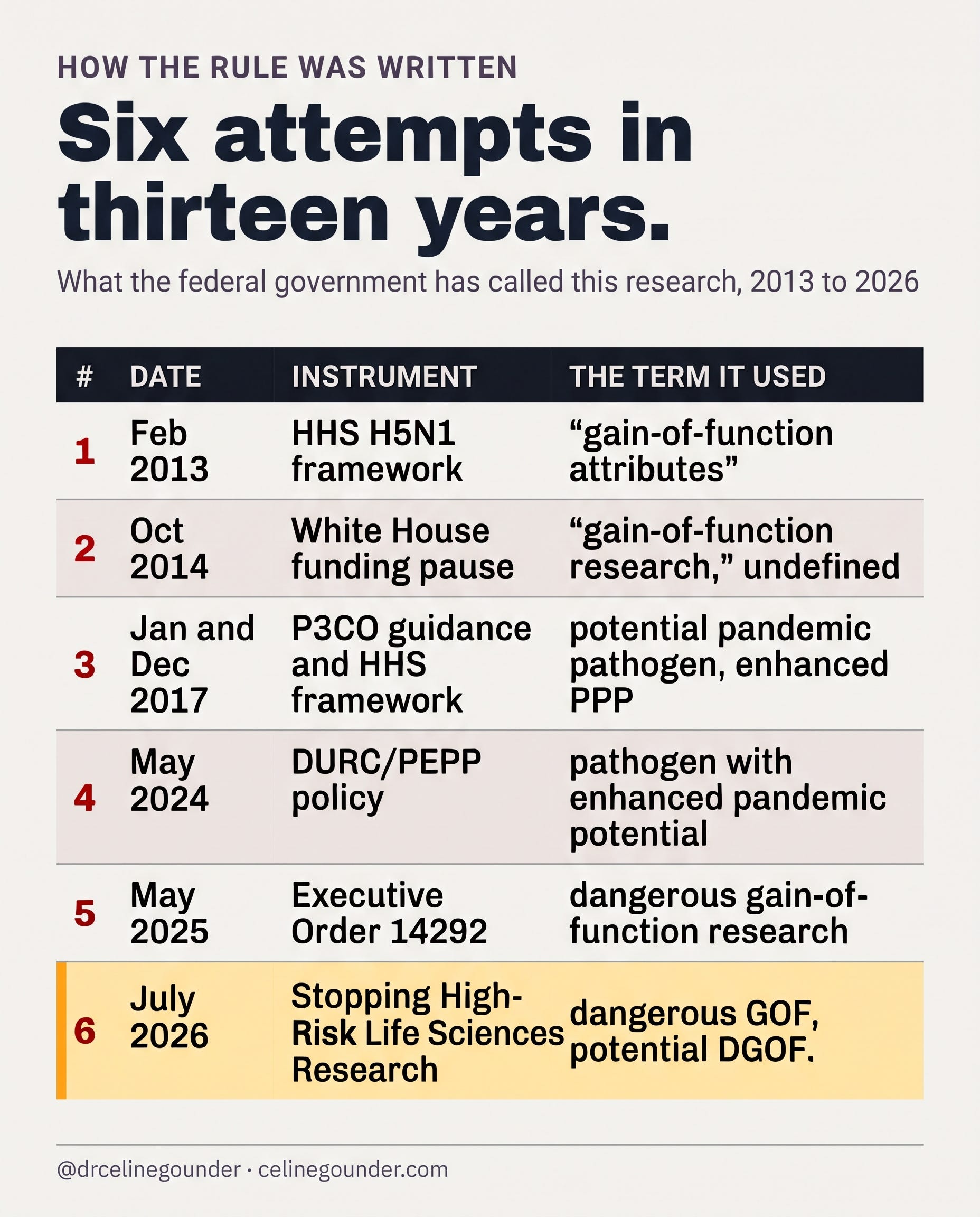
Six attempts in thirteen years, using four different technical terms. And for the eight years from January 2017 to May 2025, the phrase at the center of every public argument about this research appeared in no federal regulation.
The three scientists Sen. Paul called as witnesses.
Verified. All three are real, hold the credentials he described, and hold the positions he attributed to them. Two qualifications.
Sen. Paul named three scientists who oppose dangerous gain-of-function research: Dr. David A. Relman, Richard H. Ebright, and Kevin M. Esvelt.
Dr. Relman has said: “I am opposed to high-risk experiments and, in particular, those that seek to create novel, dangerous pathogens that cannot be justified by well-founded expectations of near-term, critical benefits for public health.” Sen. Paul dropped the qualifier that follows: “I want to be clear: I am not opposed to laboratory work on dangerous pathogens, especially if they are known to exist in nature.”
Ebright, in sworn testimony to the same committee’s subcommittee in August 2022: “the risk-benefit ratio for the research almost always is unfavorable and in many cases is extremely unfavorable.”
In an October 7, 2021 Washington Post op-ed, Esvelt wrote: “I implore every scientist, funder and nation working in this field: Please stop. No more trying to discover or make pandemic-capable viruses... No more experiments likely to disseminate blueprints for plagues.”
Esvelt’s worry was that the recipe would get out. He was less worried that a virus would escape a laboratory than that the instructions for building one would get into the wrong hands. Commercial gene synthesis and laboratory reconstruction of viruses were already possible in 2011. What has changed is their accessibility and scale, and the emergence of AI systems that may lower the expertise needed to design or troubleshoot dangerous biological constructs.
Synthetic biology + AI. On June 4, 2026, a letter organized by the Foundation for American Innovation and the Institute for Progress asked Congress for “mandatory nucleic acid synthesis screening, including recordkeeping, in the United States” and said Congress “should act this session,” applauding “legislative efforts currently underway.” “AI systems are improving rapidly, and alongside incredible benefits to science and medicine, there is a real possibility that the knowledge barriers which have historically prevented bad actors from obtaining biological weapons will meaningfully erode,” the letter said. Signatories included Sam Altman of OpenAI, Dario Amodei of Anthropic, Demis Hassabis of Google DeepMind, Eric Horvitz of Microsoft, Mustafa Suleyman of Microsoft AI, dozens of life sciences and national security experts, and executives from two of the companies that would be regulated, Twist Bioscience and Ansa Biotechnologies.
The letter named no specific bill. The vehicle in the Senate is the Biosecurity Modernization and Innovation Act of 2026, S. 3741, introduced in February by Sen. Tom Cotton and Sen. Amy Klobuchar.
Why NIH funding was in Wuhan at all.
Chair Paul · 00:25:48 / 8:55:29 AM:
“The American people would like to understand your reasoning, your rationale for why you chose to fund the research in Wuhan... Can you explain to the committee why you chose to fund this dangerous research in China?”
Partly verified. NIAID money did reach the Wuhan Institute of Virology. "You chose to fund" is an inaccurate description of how it got there.
Start with the size and the direction of the money. The grant was R01AI110964, “Understanding the Risk of Bat Coronavirus Emergence.” NIAID awarded it to EcoHealth Alliance, a nonprofit in New York, with Peter Daszak as principal investigator, and paid out about $3.75 million over five years. An American organization held the grant. It then passed some of the money to partner institutions through what NIH calls a subaward, which is a contract the grant holder signs with a collaborator. HHS’s inspector general itemized each subaward: $598,611 to the Wuhan Institute of Virology (WIV), plus $201,221 to the Wuhan University School of Public Health. About $800,000 over five years, or 21% of the total award.
The reason NIH gave is geography. The grant says the project aimed to “understand what factors increase the risk of the next CoV emerging in people by studying CoV diversity in a critical zoonotic reservoir (bats), at sites of high risk for emergence (wildlife markets) in an emerging disease hotspot (China).” The 2019 renewal explained why a second round of funding was justified: “bats in southern China harbor an extraordinary diversity of SARSr-CoVs, some of which can use human ACE2 to enter cells,” and “at one site diverse SARSr-CoVs exist that contain every genetic element of the SARS-CoV genome.” This site was a single cave complex in Yunnan Province, sampled over years, and described in PLoS Pathogens in 2017: “all of the building blocks of SARS-CoV genome... could be found in the genomes of different SARSr-CoV strains from this single location.” The horseshoe bats carrying the closest known relatives of the 2002 SARS virus live in southern China. Sampling them means field teams, provincial permits, and repeat visits to caves in Yunnan. In EcoHealth’s reporting to NIH, WIV is listed as the “Principal Laboratory for all Research in China”.
The policy rationale for that choice predated NIAID’s grant to EcoHealth Alliance by nearly a decade. The Bush administration’s National Strategy for Pandemic Influenza, issued in November 2005 after SARS, stated: “The most effective way to protect the American population is to contain an outbreak beyond the borders of the U.S.” The revised International Health Regulations, adopted that year, required countries to strengthen their capacity to detect and respond to outbreaks and called for international assistance to help lower-resource countries meet those obligations. USAID’s PREDICT program, which received about $200 million from 2009 to 2020, was created to “pre-empt or combat, at their source, newly emerging diseases of animal origin.” Through EcoHealth Alliance, PREDICT supported bat-coronavirus surveillance involving the Wuhan Institute of Virology for several years before the NIAID grant began.
Arguments for funding such work overseas. The strains in each year’s US flu shot are chosen out of a network of 151 national influenza centers in 127 countries. The two Ebola drugs, Inmazeb and Ebanga, were approved on the strength of a trial NIAID ran with the Congolese health ministry in North Kivu, because that is where the patients were. And the same surveillance model applied in Saudi Arabia found evidence of MERS in a fecal pellet from a bat roost in Bisha, which turned out to carry a fragment identical to the virus in the index patient who lived nearby.
Arguments against funding such work overseas. Edward Holmes, Andrew Rambaut and Kristian Andersen, three of the five authors of the March 2020 Proximal Origin paper, argued in Nature in 2018 that cataloguing wildlife viruses does not work on its own terms. New RNA virus variants “appear every day,” so surveys “would need to be done continuously,” and the exercise would surface thousands of candidates “each with a low probability of causing an outbreak.” They wanted the money spent on “proactive, real-time surveillance of human populations.”
Federal rules assigned primary day-to-day subrecipient monitoring to EcoHealth. The inspector general traced the problem to rules that bind every federal agency, which are “designed to have a prime grant recipient monitor the activities of a subrecipient, rather than requiring the grant-awarding agency, in this case NIH, to conduct active monitoring of subrecipients.” So NIH watched EcoHealth, and EcoHealth was supposed to watch Wuhan. When WIV stopped supplying documents after the outbreak, NIH had no lever. The GAO found that NIH had never asked the State Department for help, because it “does not have a formal process” for that.
Were appropriate biosafety measures in place at the WIV lab? The most repeated safety charge is that the Wuhan chimera work ran at biosafety level 2, roughly what a hospital lab uses for routine specimens, rather than the higher containment used for viruses that grow in human cells. EcoHealth’s grant application, as summarized by the inspector general, described WIV as “an accredited biosafety level 3 (BSL-3) laboratory” with its own biosafety committee and animal care committee.
A chimera is a virus assembled in a lab from parts of two different viruses. You take the backbone of one virus — the bulk of the genome, the machinery it uses to copy itself and build new particles — and swap in the spike protein from another. The spike is the part on the surface that latches onto a human cell and lets the virus in. So you’re asking one question: what can this spike do, with everything else held constant? Researchers do it because you often can’t grow the bat virus itself, and because holding the rest of the genome fixed is the only way to know the spike is what made the difference.
The BSL-2 claim goes back to a MIT Technology Review article from June 2021. No American agency has ever inspected that laboratory. What makes the report hard to wave off is who is quoted in it: Ralph Baric.
Baric runs the coronavirus laboratory at the University of North Carolina at Chapel Hill. He built the reverse-genetics systems that let researchers assemble a coronavirus from its component parts, which is the technique the entire chimera argument rests on, and he co-authored the 2015 SHC014 paper with Shi Zhengli. He is the American end of this collaboration, not a critic of it, which is what makes his answer on containment matter: “I would never argue that WIV1 or SHC014 should be studied at BSL-2, because they can grow in primary human cells.” He has described his own chimera work in Chapel Hill as running at BSL-3, with powered air-purifying respirators, Tyvek suits, aprons, booties and double gloves.
Shi directs the Center for Emerging Infectious Diseases at the Wuhan Institute of Virology, the laboratory that received the EcoHealth subaward. She spent years sampling bats in caves across southern China and was a lead author on the work that traced the 2002 SARS virus back to horseshoe bats, which made her the field’s leading authority on bat coronaviruses and got her nicknamed “bat woman” in the Chinese press. She supplied the SHC014 spike sequence used in the 2015 Chapel Hill experiment and is a co-author on that paper. Asked about containment, Shi said she followed Chinese rules “similar to those in the US,” and that safety requirements “are based on what virus you are studying.” EcoHealth’s answer was that it “must follow the local laws of the countries in which we work.”
NIH’s July 8, 2020 letter, quoted in the audit, says NIH had received reports that WIV “had been conducting research at WIV’s facilities in China that posed serious biosafety concerns and, as a result, created health and welfare threats to the public in China and other countries,” and suspended the grant on that basis. HHS’s memo went further, saying NIH’s conclusion that WIV “likely violated protocols of the NIH regarding biosafety is undisputed.” WIV never produced the records that would dispute it, but there was no inspection to support this.
In January 2025, arguing to HHS that it should keep its federal eligibility, EcoHealth committed to ensuring that “all field and laboratory work is conducted at appropriate biosafety levels in compliance with, or exceeding, U.S. federal regulations.” HHS debarred the organization anyway, for five years, making it ineligible to receive funding through May 14, 2029.
NIH no longer funds foreign subawards. On May 1, 2025 NIH stopped recognizing foreign subawards entirely, and in September 2025 it replaced them with a structure in which the foreign partner gets its own grant number, its own award letter, and reports its own spending directly to NIH. Foreign research continues. NIH Director Dr. Jay Bhattacharya’s August 2025 statement added two tests any overseas site now has to pass: a “clear scientific rationale to be conducted in a foreign country rather than in the United States,” and “direct potential to generate knowledge applicable to... the health of Americans.”
DEFUSE was rejected and never funded.
Chair Paul · 00:08:38:
“In 2018 the same group of scientists and their collaborators submitted the DEFUSE proposal, which involved the insertion of a cleavage site into the coronavirus. DARPA rejected it [as] too dangerous.“
Partly verified.
The proposal was led by EcoHealth Alliance with UNC, Duke-NUS, and the WIV and stated: “We will introduce appropriate human specific cleavage sites and evaluate growth potential.”
DARPA did not say “too dangerous.” Its rejection findings say the proposal “does not mention or assess potential risks of Gain of Function (GoF) research” and “fails to present a DURC risk mitigation plan.” They left the door open to funding parts of it with a mitigation plan attached.
DEFUSE was never funded.
The furin cleavage site, and what it does and does not prove.
Chair Paul · 00:08:38:
“When COVID was sequenced early on in 2020, within days scientists discovered that lo and behold it had a novel cleavage site just as had been proposed in the DEFUSE project. This was either an extraordinary coincidence, or a smoking gun.”
The premise holds, but the inference doesn’t follow. This is an ongoing scientific dispute.
SARS-CoV-2 carries a 12-nucleotide insertion creating a furin site at the S1/S2 junction, and no other known sarbecovirus has one. Sarbecoviruses are the narrow group that includes SARS-CoV-2, the 2002 SARS virus, and the bat viruses in this argument. Across the wider coronavirus family the feature is common.
What does not follow: DEFUSE proposed inserting sites into WIV1, WIV16, and SHC014 backbones. SARS-CoV-2 descends from none of them. The category of modification was proposed. The specific virus, the specific insertion sequence and the specific junction were not.
Against engineering: the site is a suboptimal furin substrate. Furin is a human enzyme that cuts proteins at a specific short sequence, and the closer a virus’s sequence matches furin’s preferred pattern, the more efficiently it gets cut. SARS-CoV-2’s is a mediocre match, which is not what someone inserting a cleavage site on purpose would build.
Furin sites have also arisen independently across many coronaviruses. Bailey Lubinski and Gary Whittaker make the fuller version of this case in The Lancet Microbe, arguing that the site's acquisition and its later fine-tuning both track natural selection, and concluding that it "is no smoking gun."
In support of engineering: the total absence of a furin cleavage site across the subgenus, and the fact that a 2018 American proposal named this class of modification in these viruses.
Was Dr. Fauci’s May 2021 testimony a lie?
Chair Paul · 00:08:38:
“On May 11, [2021] you told the Senate the NIH has never, ever, and does not now fund gain of function research in the Wuhan Institute of Virology. When I gave you the opportunity to correct the record... he responded that you had never before lied to Congress. We were then told that only the government’s narrowest regulation of definition counted here.”
The quotation is verified. The charge of lying is unsupported on this record.
Was gain-of-function research being conducted at the WIV? NIH’s position was that the bat coronaviruses had not been shown to infect people, and that the experiments were not reasonably expected to make them spread more easily or cause worse disease in humans, so no review was triggered based on the policies in place at that time.
That does not mean those viruses cannot infect human cells. When Ralph Baric’s lab put the SHC014 spike protein on a SARS backbone in 2015, the resulting virus grew in human airway cells at levels “equivalent to epidemic strains of SARS-CoV.” That experiment was done at UNC Chapel Hill. A second chimera, built under the EcoHealth grant on a WIV1 backbone, and the two get confused repeatedly.
NIH’s position on that second chimera is laid out in former Principal Deputy Director Lawrence Tabak’s October 20, 2021 letter, which reported that mice infected with it “became sicker than those infected with the WIV1 bat coronavirus,” and said this did not meet NIH’s definition because those bat viruses “had not been shown to infect humans.”
Under the broad scientific meaning of “gain of function,” the experiment produced a gain in phenotype. NIH’s denial relied on the narrower regulatory category governing enhanced potential pandemic pathogens. That definitional conflict makes Fauci’s categorical wording vulnerable, but it does not by itself establish that he knowingly lied to Congress.
And it doesn’t mean nobody was watching. NIH had written a condition into the grant requiring EcoHealth to report immediately if a virus grew ten times better than expected. Tabak’s letter concedes EcoHealth “failed to report this finding right away, as was required by the terms of the grant.” NIH did not receive that notice for about two years.
What “the market was the amplifier” actually claims.
Sen. Lankford · 01:11:19 video / 9:41:00 a.m. ET
“January 26 of 2020, before we had even our first tragic death of coronavirus in the United States, you wrote that it now appears that the genomic data of the first infection was early December and was not connected to the market, the big rumor that was out there. The wet market in China. Market was not the source, the amplifier.“
Sen. Scott · 01:30:51 video / 10:00:32 a.m. ET
“This email [was] sent the same day, the exact same day you write an internal document, ‘now we know the market was not the source, it was the amplifier.’ Would you call the origins of COVID-19 a substantive issue?”
Chair Paul, introducing the video montage · 02:31:11 video / 11:00:52 a.m. ET
“For years, Anthony Fauci has been the public face of saying this but he kept saying it’s the marketplace, it’s the marketplace... In January in private he wrote that it looks like the market was a super spreader event; it didn’t originate there. Then for years and years we got dishonesty.”
Sen. Paul’s claim, that Dr. Fauci said the market publicly while privately knowing better, is contradicted. However, Dr. Fauci’s public certainty may have run ahead of his private deliberation.
Reservoir. The population where a pathogen persists indefinitely on its own. For SARS-related coronaviruses, horseshoe bats. For MERS, dromedary camels.
Intermediate host. The species where the pathogen adapts or through which it reaches people. Palm civets for SARS. Camels for MERS. The intermediate host for SARS-CoV-2 has yet to be identified.
Index case. The first identified human case. Not the first human case, and not the spillover event.
Amplifier. A setting whose density, contact structure and duration turn a handful of introductions into an epidemic. The pathogen does not begin there. It multiplies its reproductive advantage there. Amplification is a property of the venue, not of the virus.
Saying “the wet market was the amplifier, not the source” places the wet market in the fourth category and puts the first three upstream. It says nothing about whether the upstream event was a spillover or a laboratory accident. That is why the next sentence in the same diary entry matters, and neither Sen. Lankford, Sen. Scott, nor Sen. Paul read it into the record: “Having said that, somewhere the virus jumped from animals to humans.”
The Metropole Hotel, Hong Kong, February 2003. A physician from Guangdong stayed one night on the ninth floor. Thirteen cases were tied to the hotel initially, and those seeded Canada, Vietnam and Singapore. The hotel was the amplifier and the global dispersal hub. The source was bats via civets in Guangdong live-animal markets, months earlier.
MERS in hospitals. MERS barely transmits in the community and explodes in healthcare settings. One returning traveler to South Korea in 2015 led to 186 MERS cases, almost entirely through spread in emergency departments and multi-bed wards, generating an epidemic curve that looked like sustained human spread yet was pure amplification. The reservoir was camels in the Arabian Peninsula.
Was Dr. Fauci lying? On November 27, 2021 on Face the Nation, he said: “It may not have originated in the market, but it certainly could have.” That is close to agnostic and it is compatible with his diary. Worobey et al., Science 2022 is titled “the early epicenter of the COVID-19 pandemic,” and its abstract concedes “there is insufficient evidence to define upstream events, and exact circumstances remain obscure.” Meanwhile, Crits-Christoph et al., Cell 2024 claims its findings are “consistent with market emergence” and offers “a shortlist of potential intermediate hosts... to prioritize for serological and viral sampling.” Pekar et al. inferred at least two separate introductions associated with the market, lineages A and B, weeks apart. That pattern fits a venue with recurring animal contact better than it fits a single lab-related release.
The real tension. The gap is between the February 1, 2020 call, where by his own notes most participants thought deliberate insertion was possible and "we could not let this go," and his public statement to National Geographic three months later that the evidence was "very, very strongly leaning toward this could not have been artificially or deliberately manipulated." In between, the Proximal Origin paper was written.
What the Livermore assessment concluded.
Sen. Lankford · 01:13:02 video / 9:42:43 a.m. ET
“The Lawrence Livermore National Laboratory in May of 2020 put out a classified document that has only recently been unclassified that had this statement: we assess all the necessary conditions for the accidental release of a laboratory modified coronavirus that recognizes human cell receptors were present at the Chinese Wuhan Institute of Virology in mid to late 2019. ... My question to you was going to be did you have access.”
Verified, but incomplete.
Dated May 27, 2020, the document was declassified June 18, 2026. Large portions are still redacted. It is the document the Wall Street Journal reported on in June 2021.
What Sen. Lankford did not read. The report concluded nothing about engineering or leakage. It assigned equal weight to three scenarios: natural emergence, laboratory modification then accidental release, and accidental release of a naturally occurring virus.
Sen. Lankford's question was narrower and fairer than his framing: Was Dr. Fauci given unredacted access to it? That is a legitimate question about whether the government's leading public voice on origins was being briefed on the government's own contrary analysis. The document was dated three weeks after Dr. Fauci’s National Geographic interview.
What none of this settled, and who can act.
Every claim discussed here concerns events between 2011 and 2022. The rule governing such work was rewritten on July 20, 2026, and nobody in the hearing room mentioned it.
Executive Order 14292 suspended dangerous gain-of-function research in May 2025 and ordered a replacement policy within 120 days. That deadline was September 2, 2025. HHS announced the new policy on July 28, 2026, the day before Dr. Fauci testified.
The new policy prohibits dangerous gain-of-function research outright rather than reviewing it, and creates a middle tier, “potential DGOF,” permitted only after review by an independent third-party body. That body does not exist yet.
And more news coverage…
“Infectious disease expert on Fauci’s Senate hearing face off with lawmakers,” NPR, July 30, 2026