


Everyone agrees she's qualified. That's not the question.
Democrats and Republicans agreed on something this week. That alone should make you suspicious.
President Trump nominated Dr. Erica Schwartz to lead the Centers for Disease Control and Prevention. She has a medical degree, a law degree, and a master’s in public health, all from Brown University. She served as Deputy Surgeon General during Trump’s first term. She has a military career. Admiral Brett Giroir, her former boss, called her credentials “impeccable” and her integrity “unquestioned.” Dr. Georges Benjamin, the CEO of the American Public Health Association, called her “well-trained and a competent physician leader.” Major General Dr. Paul Friedrichs described her as “smart” and “collaborative.”
That is a lot of bipartisan goodwill for a nominee in 2026. It is also, possibly, beside the point.
The real question is what Dr. Schwartz would actually be directing. The last CDC director lasted weeks before being forced out in August. Two other top posts at the agency have been vacant for months. Grant funding has slowed to a trickle. Almost 300 CDC staff have been on administrative leave for over a year — paid not to work. And the agency’s core public health functions have been quietly rerouted through HHS leadership, which means through Secretary Robert F. Kennedy Jr.
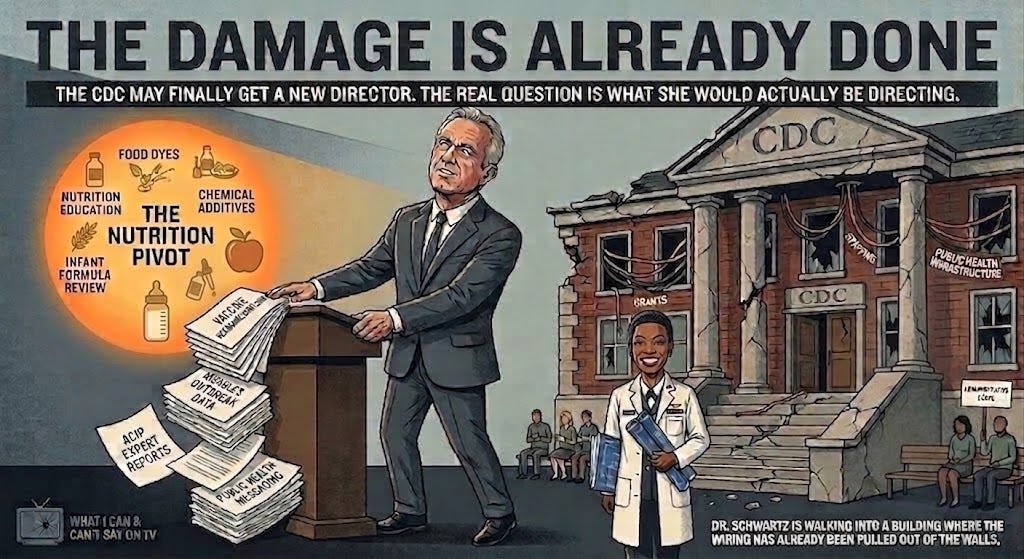
Dr. Schwartz is walking into a building where the wiring has already been pulled out of the walls.
The 13-page silence
Yesterday, Kennedy spent more than five hours testifying before two congressional committees — the House Ways and Means Committee in the morning and the House Appropriations health subcommittee in the afternoon. His prepared written testimony ran 13 pages. It covered nutrition, drug prices, food dyes, infant formula, biosimilar drugs, fraud prevention, tribal health services, rare disease screening, and the modernization of a payroll system.
It did not mention vaccines. Not once.
This is the Health and Human Services Secretary. The United States is in the middle of its worst measles outbreak in decades. There have been more than 2,500 cases in 2025 and already over 1,700 in 2026. Three people have died. Utah alone has more than 600 active cases. 85% of those patients were unvaccinated. National MMR vaccination coverage has fallen to 92.5%, below the 95% threshold needed to keep measles from spreading through a community.
Kennedy wrote 13 pages about his department’s work, but left all of it out.
The omission is not an accident. It is a strategy.
What he says vs. what he did
When lawmakers forced the issue, Kennedy said the right things. In the afternoon hearing, Rep. Madeleine Dean walked him through the numbers: 285 measles cases in 2024, over 2,500 in 2025, 1,714 already in 2026. Three deaths, including two children in Texas and an adult in New Mexico, all unvaccinated.
Then she asked: Is the MMR vaccine safe and effective?
“Yes,” Kennedy said.
Is getting the vaccine safer than getting measles?
“Yes,” he said.
In the morning hearing, Rep. Linda Sanchez asked whether the child who died from measles in Texas might have survived if he had been vaccinated.
“It’s possible, certainly,” Kennedy said.
So the Secretary of Health and Human Services agrees, under oath, that vaccines are safe, effective, and save lives. Here is what he has done with that knowledge.
He fired all 17 members of the CDC’s Advisory Committee on Immunization Practices. When Rep. Dean asked him about it, he called them the “entire corrupt vaccine board.” These are the experts who reviewed the science and set the vaccine schedule that kept measles, rotavirus, hepatitis, and other diseases in check for decades. Kennedy replaced the committee with appointees a federal judge later ruled were “distinctly unqualified” due to their lack of vaccine experience.
Under his direction, the CDC removed its universal vaccine recommendations for children covering seven immunizations, including rotavirus, flu, COVID, and hepatitis A and hepatitis B. Rotavirus, which causes severe vomiting and diarrhea in babies and can lead to dangerous dehydration, is now circulating at unusually high levels in young children, according to the CDC’s own data.
Kennedy’s HHS suspended the CDC’s pro-vaccine public messaging campaign. When Rep. Sanchez pressed him on whether President Trump approved that decision, Kennedy refused to answer. She asked repeatedly. He responded each time by saying he wanted to “correct misinformation” — without ever answering the question.
The CDC’s vaccine communication infrastructure went dark on his watch. The advisory committee that guided immunization policy for decades was fired. The universal childhood recommendations were pulled. And his written testimony to Congress, the document that defines his priorities for the public record, treated vaccines as though they did not exist.
He says they work. His policies say they don’t matter.
The nutrition pivot
Kennedy’s testimony was not empty. It was full of things he wanted to talk about instead.
New dietary guidelines. Removing petroleum-based food dyes. Expanding nutrition education in medical schools. Reviewing infant formula. Addressing the GRAS loophole for food additives. Most Favored Nation drug pricing. Healthcare price transparency.
Some of these are popular. Some have bipartisan support.
This is the point. The MAHA agenda is being rebuilt around issues that poll well and away from the one that does not. A recent Data for Progress survey found that only 1 in 6 voters identify with “Make America Healthy Again.” When voters learned about Kennedy’s actual record as Secretary, support dropped 18 points among soft supporters and 17 points among independents. 92% of voters trust nurses. 90% trust their own doctor. 40% trust Kennedy.
The testimony is a document designed to be found by anyone searching for the word “vaccine” and come up empty. The political strategy is clear: keep doing anti-vaccine policy, stop saying anti-vaccine things, and talk about food dyes instead.
What the new CDC director inherits
This is the agency Dr. Schwartz would take over.
She would inherit a CDC that has lost its vaccine advisory committee, its universal childhood vaccine recommendations, and its public messaging infrastructure on immunization. She would report to a Secretary who agrees under oath that vaccines save lives and then refuses to say whether the president approved ending the campaign that told parents to vaccinate their children.
People who have worked with Dr. Schwartz say she pushes back. Giroir confirmed she disagreed with him during COVID and made decisions regarding the drive-thru testing initiative over his objections. Friedrichs said she understands “how ugly DC politics can be.” Benjamin said her challenge will be “to find the way to effectively influence the current leadership of HHS to be evidence and science-based.”
That is a polite way of saying the problem is not who runs the CDC. The problem is who runs the person who runs the CDC.
The previous director was forced out for putting science above the Secretary’s personal beliefs. The vaccine advisory committee was fired for being, in Kennedy’s word, “corrupt.” The policy changes that have driven measles outbreaks, falling vaccination rates, and rotavirus surges were made before Dr. Schwartz’s name was ever announced.
A qualified director can rebuild morale. She can get grants moving again. She can staff vacant positions and modernize aging systems. What she cannot easily do is reverse the policy direction of the Secretary she reports to — the one who just delivered 13 pages of testimony to Congress about everything except the public health crisis unfolding on his watch.
The gold standard
Kennedy’s testimony used the phrase “gold standard” twice. “Gold-standard care starts with gold-standard science,” he wrote. Trump’s Truth Social post announcing the Schwartz nomination said the new CDC leadership would “restore the GOLD STANDARD OF SCIENCE at the CDC.”
Here is what gold-standard science looks like right now at the CDC: a vaccine advisory committee fired and replaced with unqualified appointees, childhood vaccine recommendations pulled for seven diseases, a pro-vaccine messaging campaign suspended, and a Secretary who agrees vaccines work when asked under oath but structures his entire public testimony to avoid the subject.
The nomination of a credible director is how you make a gutted agency look like it is being rebuilt. The credentials are real. The bipartisan praise is real. The question is whether any of it changes the policy direction that has already produced the worst measles outbreak in a generation, the return of rotavirus, and a 13-page testimony that reads like vaccines were never invented.
Kennedy told Rep. Horsford to “calm down” when pressed on healthcare costs. “Healthcare is personal to my constituents,” Horsford replied. “Do not tell me to calm down.”
Three people are dead from measles. Rotavirus is surging in infants. The vaccination rate has fallen below the threshold that keeps outbreaks from spreading. The Secretary agrees this is a problem. He just doesn’t mention it unless someone makes him.
Gold standard.
Maybe we should give them a chance. Unusual to me or actually maybe it shouldn’t be because it’s a sign of the time that a bipartisan action is casted under the shadow of suspicion go figure.