


Precaution started in environmental law, not disease control.
What a rigorous precautionary approach would actually look like.
Citizens are exempt. The virus is not.
The U.S. government issued a Title 42 order this week barring non-citizens from entering the country if they have been in the Democratic Republic of Congo, Uganda, or South Sudan within the past 21 days. The justification is precautionary: an Ebola outbreak is spreading in eastern Congo, the WHO has declared a Public Health Emergency of International Concern, and there is no vaccine or specific treatment for this species.
But U.S. citizens traveling from those same countries are exempt.
This is where the precautionary principle, one of the most important ideas in public health, runs into its most persistent problem. The principle says: when a serious threat exists, and scientific uncertainty remains, take protective action before you have complete evidence. The question is who gets protected, and who bears the cost.
Precaution started in environmental law, not disease control.
The idea entered international law through environmental regulation, not infectious diseases. The 1992 Rio Declaration put it simply: if a threat is serious, do not wait for perfect evidence before acting.
The European Commission built a more structured version in 2000. Any precautionary action must be proportionate, non-discriminatory, consistent, and subject to review. The principle is not a blank check to do anything in the face of uncertainty. It is a framework for acting carefully with built-in limits.
In infectious disease, the same logic runs through the International Health Regulations. The IHR allows countries to go beyond WHO recommendations when evidence is incomplete, but only if the measures are based on science, no more restrictive than necessary, applied fairly, and reviewed within 3 months.
Four examples of precaution applied by passport.
The pattern across modern outbreaks is consistent. When a new disease threat emerges abroad, governments reach for border controls. Those controls are applied more aggressively to non-citizens than to citizens, even when both groups carry the same epidemiological risk.
During COVID, the U.S. used Title 42 to expel nearly 3 million migrants and asylum seekers at the southern border. The policy was signed over the objections of CDC’s experts. For every asylum seeker expelled, roughly 100 other travelers were admitted at the same borders. Experts have called it a misuse of public health authority.
The HIV travel ban lasted from 1987 to 2010, 22 years. HIV-infected non-citizens were barred from entering the United States. During that entire period, HIV was spreading domestically among U.S. citizens. No equivalent restriction applied to citizens. UNAIDS concluded in 2004 that the ban had no public health justification.
TB screening is mandatory for all immigrants applying for permanent residence. U.S. citizens are not screened. The screening requirement is tied to immigration status, not epidemiological risk.
In November 2021, the U.S. banned the entry of non-citizens from eight southern African countries after the Omicron COVID variant was identified. By the time the ban was announced, Omicron was already circulating in Western Europe, Canada, and likely the United States. No restrictions were placed on travelers from European countries where the variant had also been confirmed. The ban targeted exclusively African nations. It was rescinded a month later as futile.
The costs of caution do not fall evenly.
The most important objection to how precaution has been applied is not that it is wrong to act under uncertainty. It is that the costs of “being cautious” fall unevenly.
Border restrictions, detention, and being shut out of health services — these burdens land on people with the least political power, while citizens get reassurance. As the Infectious Diseases Society of America said this week about the current Ebola order: “Public health policies that single out non-U.S. citizens won’t prevent viruses from crossing our borders.”
The IHR require non-discrimination. The Siracusa Principles, which govern how countries can limit human rights during emergencies, say restrictions must be strictly necessary, proportionate, time-limited, and non-discriminatory. A travel ban that applies to non-citizens but exempts citizens from the same areas fails that standard, unless the government can show that citizenship is relevant to the risk of infection. It is not.
Legal scholars have spotted the structural problem. Public health is governed by state police power. Immigration is governed by federal power. When public health reasoning is used to justify immigration restrictions, neither legal framework does a good job of protecting individual rights. Courts have long been reluctant to second-guess immigration decisions, even when the stated reason is medical. That creates a gap where precaution can operate without the checks that limit it everywhere else.
Precaution that harms public health is not precaution.
Scholars call this the “inversion problem.” The precautionary principle should also apply to public health actions themselves. A travel ban that disrupts outbreak response, scares health workers away from deploying, punishes countries for reporting honestly, or drives affected communities away from clinics creates its own harms. Those harms have to be weighed against whatever uncertain benefit the ban provides.
The evidence on travel bans is consistent across outbreaks. The Wuhan quarantine delayed COVID spread within China by three to five days. Broader international restrictions delayed the first peaks by up to five weeks, but could not stop the virus from spreading. For Ebola in 2014, travel restrictions cut the risk of imported cases by less than 1%. And those same bans disrupted food supply, healthcare access, and aid delivery in affected countries, making the outbreak harder to control.
A Cochrane review found little evidence that border closures reduced SARS-CoV-2 spread. Border controls worked best in island nations that combined them with strong domestic measures. Everywhere else, the returns were weak.
What does work? Post-arrival quarantine, applied equally to all travelers regardless of passport, cut transmission by 96-100% in the studies that tested it. Seven-day quarantine with testing on day five achieved 97-100% risk reduction. These measures do not discriminate on the basis of citizenship. And they actually work.
What a rigorous precautionary approach would actually look like.
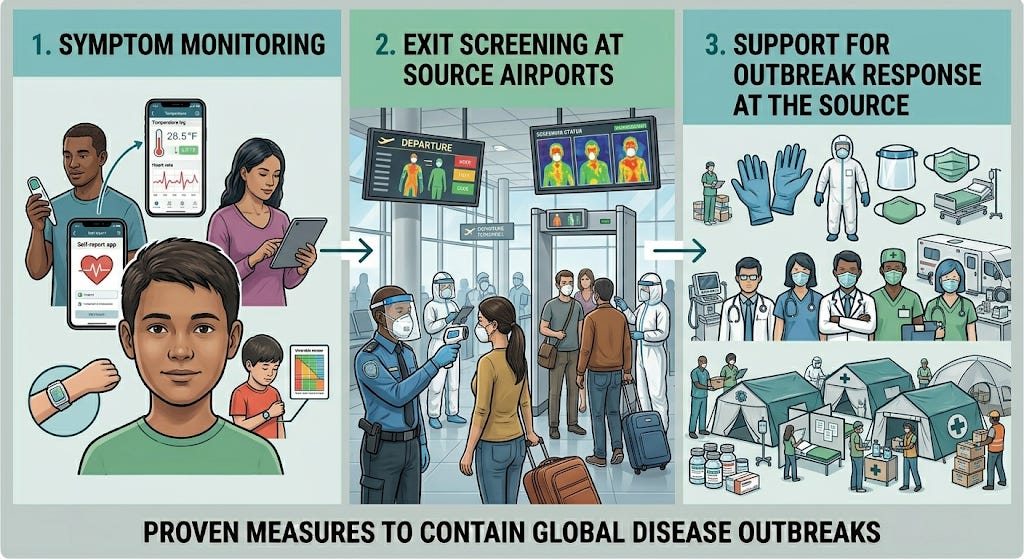
A rigorous precautionary approach to this outbreak would look different. It would apply symptom monitoring and post-arrival quarantine to all travelers from affected areas, regardless of citizenship. It would invest in exit screening at airports in the DRC and Uganda. It would support the outbreak response at its source — the single most effective way to prevent international spread. It would avoid rhetoric that attaches the disease to a nationality.
The precautionary principle is a useful idea. It becomes dangerous when “who gets protected” and “who pays the price” sort along lines of citizenship, race, or nationality rather than actual exposure.