


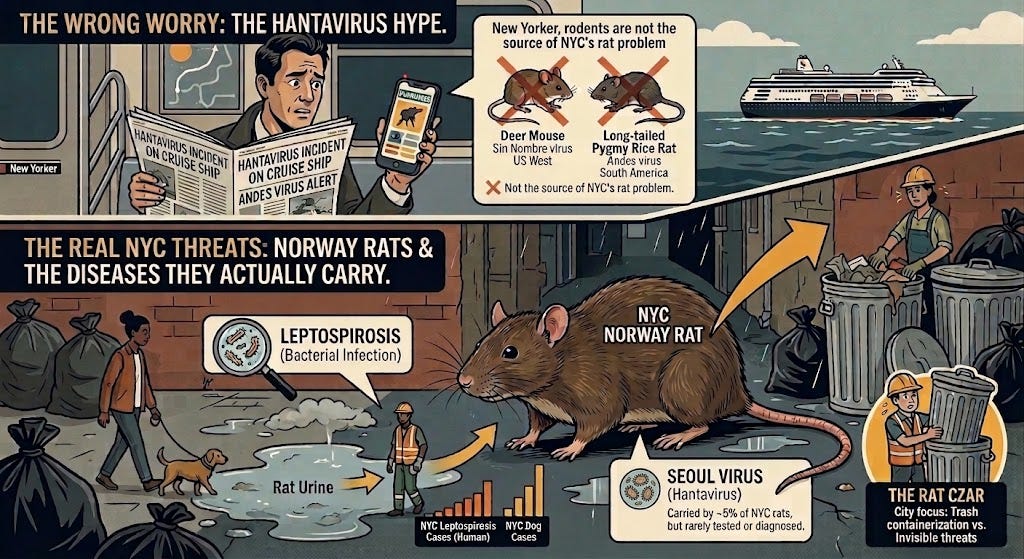
Three million rats, wrong headlines
New York City is home to roughly 3 million brown rats. They chew through walls, swim up toilets, and occasionally make the news for biting toddlers. They are disgusting enough that the city created an entire government position, The Rat Czar, to fight them. And if you asked most New Yorkers what disease they should fear from rats, right now, a fair number would say hantavirus.
They’d be wrong because they’re worried about the wrong virus carried by the wrong rodent.
The only hantavirus that spreads between people
The word “hantavirus” is in the news right now because of the MV Hondius, a Dutch cruise ship that left Ushuaia, Argentina, in early April. A passenger likely picked up Andes virus from rodent exposure during a road trip through South America before boarding. He developed symptoms at sea. Then other passengers got sick. As of mid-May, there are nine confirmed cases and three deaths. The CDC classified it as a level 3 emergency response. People in multiple U.S. states are being monitored.
What makes Andes virus alarming is that it’s the only hantavirus known to spread person to person. Other hantaviruses — like Sin Nombre, which caused the 1993 Four Corners outbreak — spread only through rodent droppings. The Andes virus can pass between people through close, sustained contact, including likely through the air in poorly ventilated spaces. Symptoms can take up to 42 days to appear, which is how a single infection on a cruise ship turned into an international incident.
Different rat, different virus
But none of that has anything to do with New York City’s rats.
Sin Nombre virus lives in deer mice, a rural western rodent. Andes virus lives in long-tailed pygmy rice rats in South America. NYC’s rats are Norway rats, a completely different genus. The biology is strict: each hantavirus co-evolves with one specific rodent host. Wrong rodent, no virus.
The one you’ve never heard of
NYC’s rats do carry a hantavirus. It’s just not the one in the headlines. Seoul virus, first identified in brown rats in New Orleans in the 1980s, causes a milder illness — kidney problems rather than lung failure. Most infections appear to cause mild symptoms or none at all. A study of urban brown rats in Helsinki found hantavirus in about 5% of rats tested. Similar circulation likely occurs in New York. But Seoul virus isn’t routinely tested for, so infections in people mostly go undiagnosed.
The City, in other words, watches the rat you can see while largely ignoring the virus the rat actually carries.
What the rats are actually spreading
The rat-borne disease that is surging in New York isn’t a virus at all. It’s leptospirosis, a bacterial infection spread through rat urine. From 2001 to 2020, New York City averaged about 3 cases per year. In 2023, there were 24. In 2024, there were 33. Nationally, reported cases have an 85% hospitalization rate and a 10% case fatality rate. Leptospirosis can cause kidney failure, liver damage, and severe lung bleeding. It spreads when people touch water, soil, or surfaces contaminated with infected rat urine, which, in a city of 3 million rats, is a broad category. High-poverty neighborhoods with the most rats carry the highest risk.
My dog Zizou is vaccinated
Isn’t just a human problem. In 2024, 33 dogs in New York City were diagnosed with leptospirosis. Cases peaked in August, when puddles sit longest and rats are most active. Dogs pick up the bacteria the same way people do, through contact with contaminated water or soil. A walk through a wet sidewalk in a rat-heavy neighborhood is enough. The American Animal Hospital Association now lists the leptospirosis vaccine as core for dogs, not optional. Most NYC dog owners don’t know that yet.
What the Rat Czar didn’t fix
The Rat Czar’s office focused on containerizing trash and rat birth control. Rat sightings dropped about 20%. The Rat Czar herself quietly left the job in September 2025. Yet, leptospirosis cases, in people and dogs, kept climbing.