Five million tickets sold, zero dollars for disease preparedness.
The 2026 FIFA World Cup starts Wednesday. More than five million tickets have been sold across 16 cities in three countries over 39 days. As my investigation for Sports Illustrated found, the federal government allocated $625 million on World Cup security and nothing on public health. No host city received additional federal funding for disease preparedness. The CDC hasn’t done a risk assessment for the tournament.
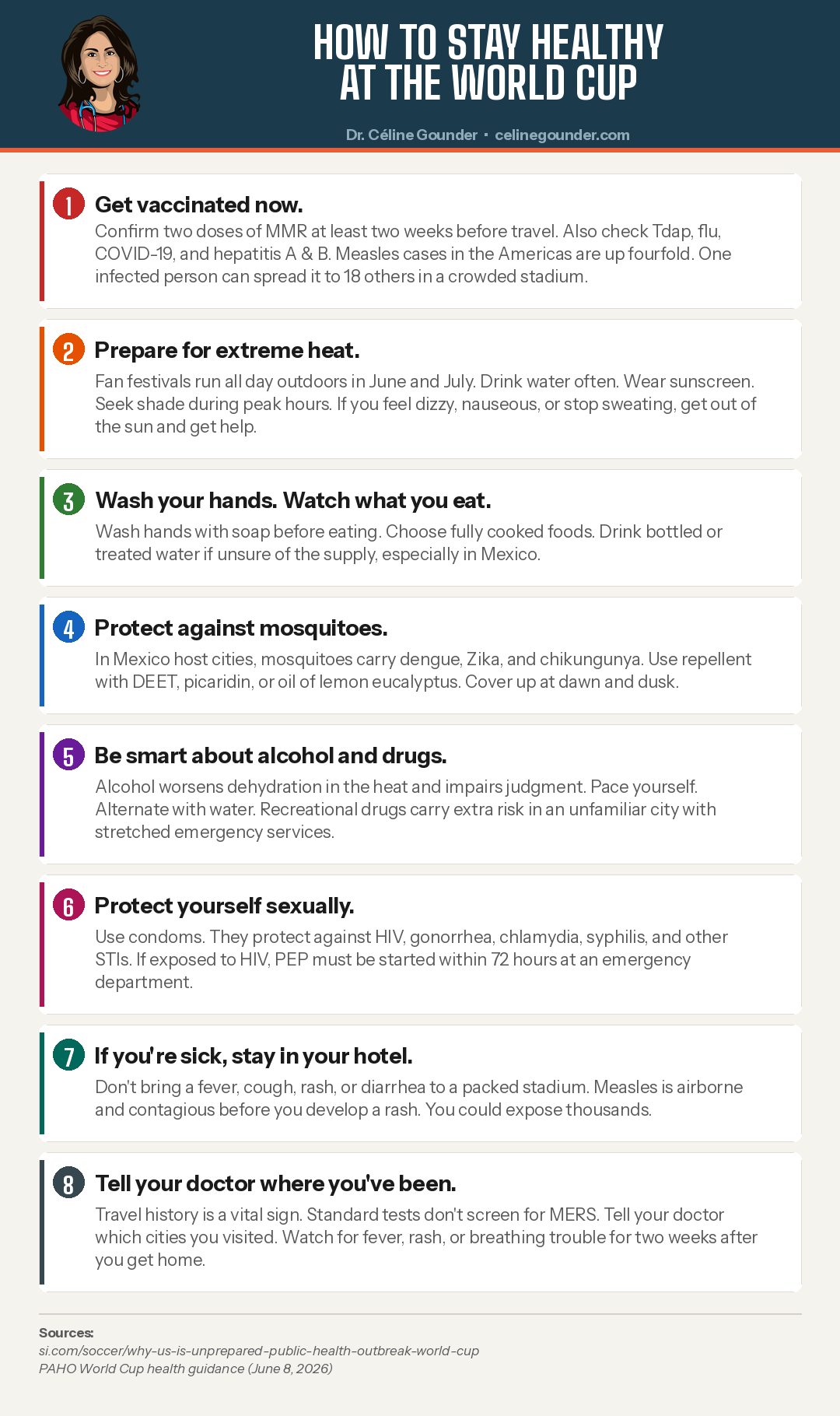
That means protecting yourself is largely up to you. Here’s what to do: guidance from me and the Pan American Health Organization (PAHO).
The MMR vaccine is your best defense at a mass gathering.
This is the single most important thing you can do. Measles cases in the Americas are up fourfold this year, and measles has already been detected in Kansas City wastewater. Kansas City is hosting six matches. A single infected person can spread measles to up to 18 unvaccinated people. A packed stadium or fan zone is a perfect setting.
PAHO recommends confirming you’ve had two doses of the MMR vaccine, ideally at least two weeks before you travel. Also, check that you’re up to date on Tdap (tetanus, diphtheria, pertussis), influenza, COVID-19, and hepatitis A and B vaccinations.
Prepare for the heat.
These matches and fan festivals run all day outdoors in June and July. In 2024, extreme heat killed over 1,300 Hajj pilgrims. Stay hydrated. Drink water, not just beer. Wear sunscreen. Seek shade during the hottest hours. If you feel dizzy, nauseous, or stop sweating, get out of the sun and get help. Heat illness can become dangerous fast.
Wash your hands. Watch what you eat.
This sounds basic because it is. Norovirus hit the athletes’ village at the Milan-Cortina Winter Olympics just four months ago. Wash your hands with soap and water often, especially before eating. Choose foods that are fully cooked. Drink bottled or treated water if you’re unsure about the local supply, particularly in Mexico.
Protect against mosquitoes.
If you’re attending matches in Mexico, mosquitoes can carry dengue, Zika, and chikungunya. Use insect repellent with DEET or picaridin. Wear long sleeves and pants when you can, especially around dawn and dusk. Here’s a separate post on mosquito-borne infections in the US, Mexico, and Canada.
Be smart about alcohol and substances.
Alcohol worsens dehydration, especially in the heat. It also impairs your judgment in crowded, unfamiliar settings. Pace yourself. Alternate alcoholic drinks with water. Know your limits. Recreational drugs carry additional risks: you don’t know what’s in them, you’re in an unfamiliar city, and emergency services may be stretched thin during tournament events.
Protect yourself sexually.
Large international events bring millions of people together, and sexual activity increases. Use condoms. They protect against HIV, gonorrhea, chlamydia, syphilis, and other sexually transmitted infections. If you think you may have been exposed to HIV, post-exposure prophylaxis (PEP) is available at emergency departments and various clinics, but it must be started within 72 hours.
If you feel sick, stay at home or in your hotel.
Do not go to a packed stadium or fan zone with a fever, rash, cough, or diarrhea. You could spread an infection to thousands of people. This is especially true for measles, which is airborne and contagious before you even develop a rash.
Tell your doctor where you’ve been.
This may be the most important piece of advice after vaccines. If you see a doctor during or after the tournament, tell them which cities you visited and which events you attended. Travel history can be the difference between catching something early and missing it entirely. Standard diagnostic tests don’t screen for diseases like MERS. A doctor won’t order the right test if they don’t know where you’ve been.
Watch for symptoms after you get home.
Some infections don’t show up right away. Measles symptoms appear 7 to 14 days after exposure. Dengue, Zika, and mpox can develop on a similar timeline. If you get a fever, rash, or trouble breathing in the weeks after the tournament, see a doctor and tell them where you’ve been.
The federal government left public health preparedness to the host cities, and many of them are stretched thin. But the basics — vaccines, hygiene, hydration, common sense — are still in your hands.