


The 2026 World Cup brings fans to stadiums across three countries: the United States, Canada, and Mexico. But besides thinking about which matches to catch and where to eat, there’s something else worth keeping on your radar: mosquitoes.
Mosquitoes carry serious viruses. Some cause mild symptoms. Others can land you in a hospital. The good news: knowing what to watch for and how to protect yourself makes a huge difference.
The Main Threats
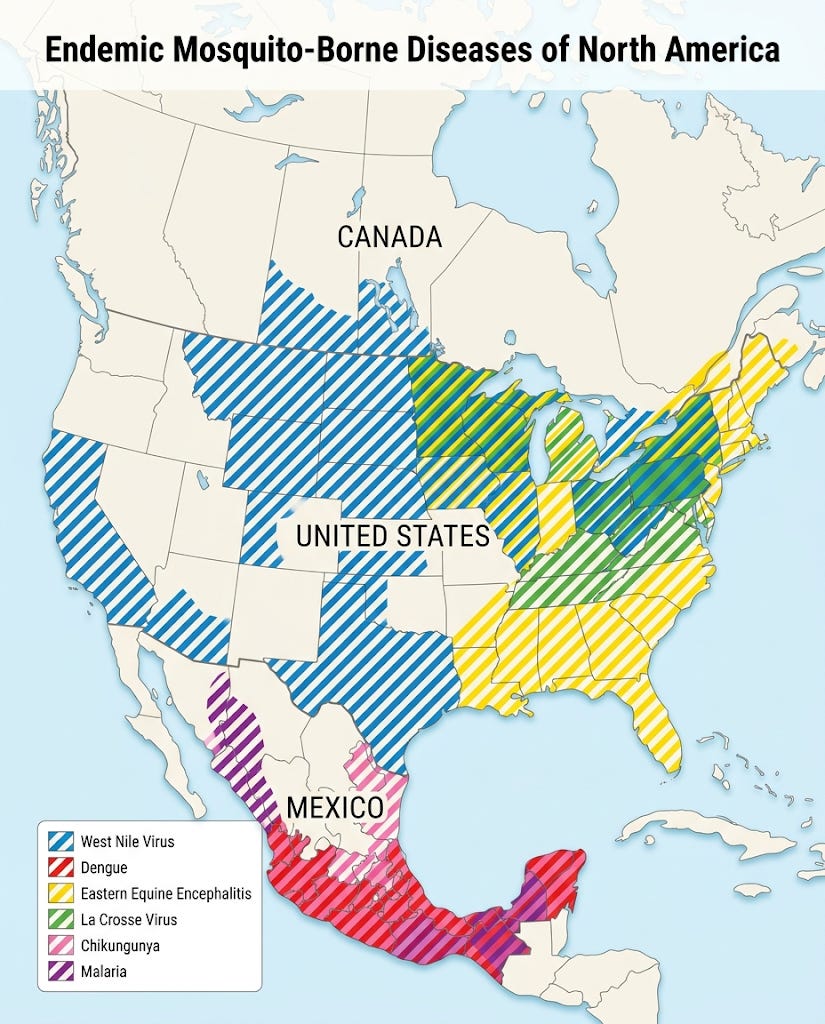
Dengue is the biggest concern if you’re heading to Mexico. The virus is endemic across central and southern Mexico, especially along the Pacific and Gulf coasts and in the southeast. Cases have risen sharply in recent years, jumping from 29 per 100,000 people in 2022 to 279 per 100,000 in 2024 according to epidemiological surveillance data.
Dengue causes fever, headache, muscle pain, and rash. Most people recover in a week or two, but about 1 in 20 cases become severe and life-threatening. There’s no specific treatment, so prevention is everything.
West Nile Virus is spread across all 48 U.S. states and parts of Canada, with the highest rates in the Great Plains — states like North Dakota, South Dakota, and Nebraska. Most people infected have no symptoms at all. But some develop fever, body aches, or fatigue. Rarely, it causes serious neurological disease.
Eastern Equine Encephalitis (EEE) is less common but serious. It’s found along the Atlantic Coast, Gulf Coast, and Great Lakes regions. Only about 1 in 150 infected people get sick, but when they do, roughly a third die or face lasting brain damage.
La Crosse Virus primarily hits the Appalachian region and upper Midwest. It causes fever and headache, mostly in children under 16.
How to Protect Yourself
The steps are straightforward but important:
Use insect repellent. Apply EPA-approved repellents containing DEET or picaridin to exposed skin and clothing. Reapply after swimming or sweating. Higher concentrations (20-30% DEET) last longer — up to 5 hours.
Cover up. Wear long sleeves, long pants, and socks, especially during dawn and dusk when mosquitoes are most active. Light colors help you spot mosquitoes before they bite.
Stay in screened areas. Mosquitoes can’t get through window screens or closed doors. Your hotel room is safer than a patio.
Avoid standing water. Mosquitoes breed in puddles, birdbaths, flower pots, and gutters. If you’re staying somewhere with poor drainage, ask the property to fix it.
Watch the forecast. Mosquito activity peaks in warm, wet weather. Check the forecast and plan outdoor activities accordingly.
When to See a Doctor
Seek medical care if you develop fever, severe headache, muscle pain, rash, or neurological symptoms like confusion or weakness, especially if you’ve traveled recently. Tell your doctor where you’ve been.
Most mosquito-borne infections clear on their own, but catching them early helps. Dengue, in particular, can turn serious fast. If you’re in a high-risk area and get symptoms, don’t wait.
Sources:
Centers for Disease Control and Prevention
DeVita, T. N., Morrison, A. M., Stanek, D., et al. (2025). Public health response to the first locally acquired malaria outbreaks in the US in 20 years. JAMA Network Open, 8(1), e2535719.
Goldman, T., & Hamer, D. H. (2024). Current status of La Crosse virus in North America and potential for future spread. American Journal of Tropical Medicine and Hygiene, 111(2), 322-330.
Gould, C. V., Staples, J. E., Guagliardo, S. A. J., et al. (2025). West Nile virus. JAMA, 333(14), 1375-1387.
Mendoza-Cano, O., Danis-Lozano, R., Trujillo, X., et al. (2024). Spatial patterns and clustering of dengue incidence in Mexico: Analysis of Moran’s index across 2,471 municipalities from 2022 to 2024. PLoS ONE, 19(4), e0305048.
Staples, J. E., & Gould, C. V. (2025). Eastern equine encephalitis in the US. JAMA, 333(16), 1603-1614.