



The World Cup kicks off on Wednesday. My husband should be covering it.
Grant Wahl fell in love with soccer during the 1994 World Cup, the last time the United States hosted the tournament. He covered his first World Cup final for Sports Illustrated in 1998, when France beat Brazil, and he covered every tournament after that for the next quarter century. We named one of our dogs after Zinedine Zidane.
Grant died at the 2022 World Cup in Qatar. He was 49. The 2026 tournament — on American soil, in the country whose soccer culture he did more to shape than almost any journalist — was what twenty-five years of work had been building toward.
I didn’t come to soccer on my own. That was all Grant.
In 2014, I went to Guinea during the Ebola outbreak in West Africa. I was gone for two months. Grant kept everything running at home without complaint. He described what I did as “my World Cup,” the highest compliment he knew how to give.
Both are back now. The tournament opens on June 11th. And the Ebola outbreak in eastern Congo has reached more than 350 confirmed cases and at least 60 confirmed deaths, making it the third worst Ebola outbreak on record. The World Health Organization has declared a global emergency. There is no vaccine or specific treatment for this species of Ebola. Contact tracing has improved but is still reaching fewer than half the people who need to be monitored. Treatment centers have been burned to the ground. The outbreak may have started as early as January, months before it was detected.
Both of these worlds are colliding again, and I am standing in the middle of them without him.
Grant is not here for this World Cup.
Grant’s career had a throughline that went beyond soccer. He used the game — its institutions, its money, its spectacle — to ask who profited and who bore the cost.
In 2022, he traveled to Qatar and spent days visiting FIFA-designated hotels, talking to migrant workers. The country had promised labor reforms. Grant went to see whether the reforms reached the people they were supposed to help. He found passports still confiscated. Recruitment fees still extracted. Workers who built the infrastructure for the tournament still treated as invisible.
On November 21st of that year, he put on a rainbow soccer t-shirt and walked into the U.S.-Wales match. His brother Eric is gay, and Grant had written about LGBTQ rights in soccer for years. Security guards stopped him, held him for about 25 minutes, seized his phone, and told him the shirt was not allowed. He would not take it off. A commander eventually apologized. So did FIFA. In the piece he wrote about it afterward, Grant asked what would happen to a Qatari citizen wearing that shirt once the press and the cameras were gone.
That was how he operated. He put himself where official promises met reality and recorded the distance between the two.
I keep thinking about that distance.
On May 18th, the U.S. government issued a Title 42 order suspending entry for anyone who had been in the Democratic Republic of Congo, Uganda, or South Sudan in the prior 21 days. Four days later, it extended the order to lawful permanent residents (green card holders) for the first time in the statute’s history. The government’s rationale, in the Federal Register: some permanent residents maintain “stronger ties to families and communities outside the United States,” so they can more easily be kept out. That same day, the WHO Emergency Committee explicitly recommended against flight suspensions and entry denials.
The public health case for categorical travel bans is weak. They reduce disease importation risk by less than 1%. They push border crossings into informal routes with no screening. They obstruct the movement of health workers and supplies into the outbreak zone. Rwanda has closed its border with Congo, severing the main corridor for getting international aid in. The outbreak area is increasingly sealed off. People still move. They just move where no one is watching.
The administration also built a quarantine facility for Americans in Kenya rather than bringing them home to any of the 13 specialized biocontainment units the U.S. built for exactly this situation. A Kenyan court blocked it. Two people were killed in protests outside the gates. The CDC’s own workers’ union called the policy “a sharp departure from every previous administration.”
The DRC’s national soccer team, which is based in Europe, arrives in Houston on June 12th. La Línea de la Concepción in southern Spain has already refused to host their warm-up match, citing Ebola concerns.
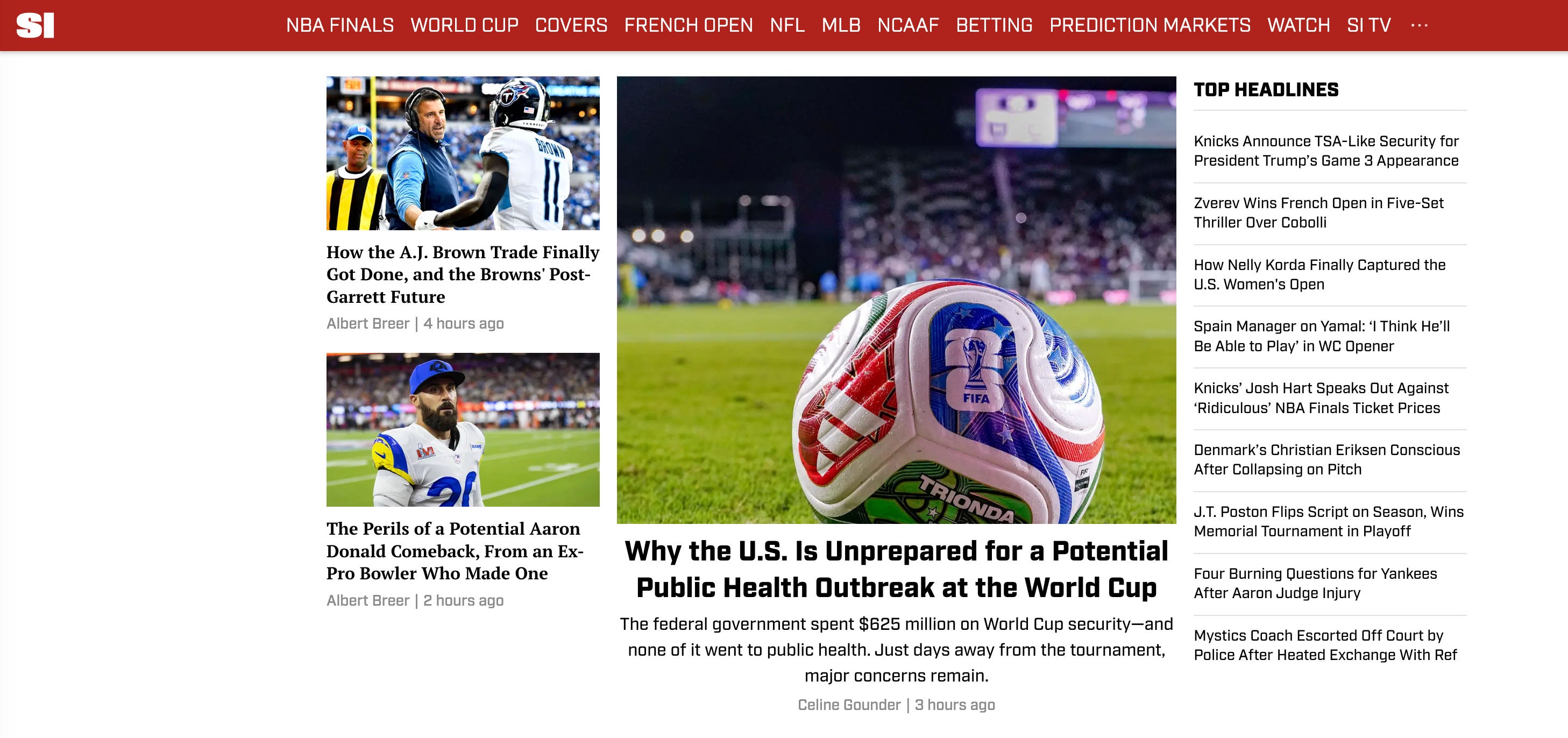
All of this is framed as public health. But my investigation for Sports Illustrated found that the federal government spent $625 million on World Cup security — law enforcement, background checks, cybersecurity — and allocated nothing for disease preparedness. Not one host city has received additional federal funding for public health. The CDC has not produced a risk assessment for the tournament. The White House Task Force created to coordinate the World Cup has not delivered a single biological threat briefing to the Senate Homeland Security Committee. Measles has already appeared in Kansas City wastewater. Kansas City is hosting six matches. Georgetown University stood up its own health surveillance operation for the tournament in the absence of federal leadership. The United States has also withdrawn from the WHO, dismantled USAID, and left the CDC without a Senate-confirmed director for all but 28 days of this administration.
In the DRC, where U.S. funding covered 70% of health supplies, nearly 3,000 doctors and nurses have been dismissed. Some have turned to farming to survive. The former head of USAID disaster response told The New York Times that the outbreak would not have been missed for so long if those programs were still in place.
Grant spent his career watching powerful institutions say one thing and do another. Qatar told the world its stadiums were open to all. Grant wore a t-shirt and was detained at the gate. FIFA said workers were protected. Grant talked to the workers and found the protections hadn’t reached them.
A government acting in the public interest would not host the largest mass-gathering event in its history without dedicated disease-preparedness measures.
Grant did not live to see this World Cup. He left no words on the 2026 Ebola outbreak or the Title 42 order, and I will not invent them for him. But I spent twenty years watching him work. He went where the story was, and he told the truth about what he found there. He is not here to cover this, but I know he would want this story covered.
Grant is missed so much.