


What pathogens did Darya Shipilova work on?
Darya Shipilova died on October 2nd, at 28, in a hospital in Shelekhov, outside Irkutsk. Rospotrebnadzor, the agency that runs Russia's anti-plague institutes and its disease surveillance, says she died of pneumonia of unknown cause, that extended testing found no microorganisms connected to her professional activity, and that she was vaccinated and immune to the dangerous infections she worked with.
At least some of her work is public.
She’s a co-author, third of seven, on a conference abstract published in the proceedings of the XVIII Pokrovsky Congress, Russia’s annual national infectious disease meeting, which took place in Moscow this spring. The abstract was not peer-reviewed. The authors tested different antibiotics on Yersinia pestis bacteria to see what would kill them. The strains were sensitive to all of the antibiotics they tried: streptomycin, amikacin, gentamicin, doxycycline, kanamycin, chloramphenicol, cefotaxime, ciprofloxacin, and azithromycin.
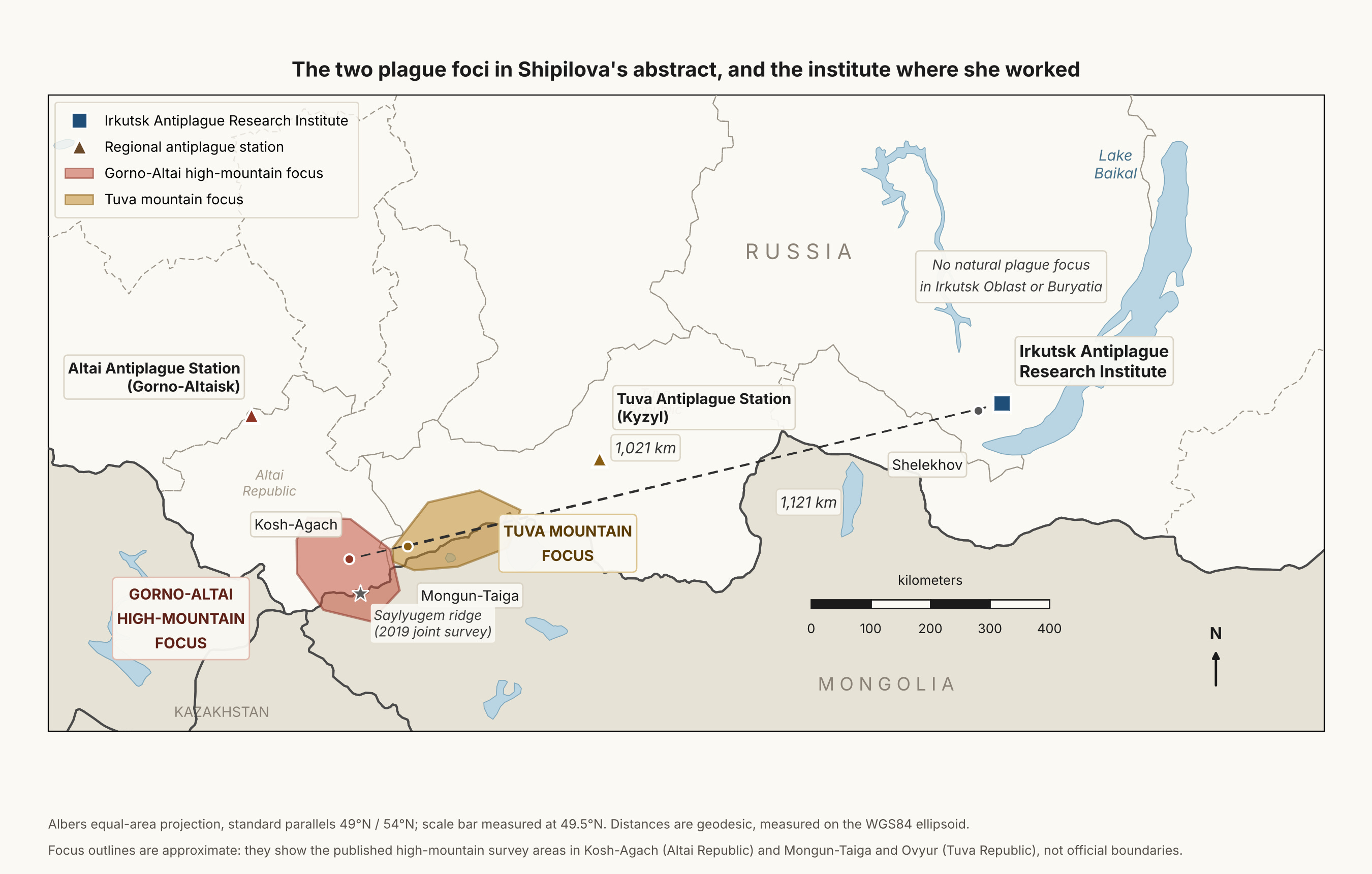
The Irkutsk Institute’s director, Sergey Balakhonov, is one of 20 authors on the 2026 national plague forecast. It reports that in 2025 plague turned up in animals in three of Russia’s eleven natural foci, and her abstract names two of the three. The Altai animal outbreak was in Kosh-Agach district, the Tuva one in Mongun-Taiga. Russian teams isolated thirteen strains of plague bacteria that year, and twelve belong to a lineage called 4.ANT. Balakhonov also co-authored a 2025 paper that describes the 4.ANT strains in the Tuva focus as highly virulent and capable of causing human disease.
What’s a plague focus?
A natural plague focus is a place, not a pathogen. Yersinia pestis keeps circulating there among wild rodents and their fleas on its own, with no human cases required, sometimes for centuries. Russia has eleven. A focus is where Yersinia pestis persists and could spill into people. It says nothing about antibiotic resistance, vaccine protection, or how sick the organism would make you.
What circulates in Gorno-Altai and Tuva.
The Tuva mountain focus was found in 1964 and hasn’t gone quiet since. Between 1964 and 2009, Russian teams isolated 1,497 strains there. 95% of them came from one animal, the long-tailed ground squirrel, and its fleas.
From 1961 to 2011, the only organism recorded in the Gorno-Altai focus was Y. pestis subspecies altaica, which kills laboratory mice and doesn't kill guinea pigs. Most of the cultures came from Mongolian pikas and their fleas, and in fifty years not one person there got the plague. Russian scientists rated its epidemic potential as low. But when the main subspecies spread through grey marmot colonies, people started getting infected. One case in each of 2014, 2015, and 2016, all in Kosh-Agach district, all in people who had been butchering poached marmots. All three were bubonic. All three survived.
Russia has recorded no human plague since 2017, none since those three cases. Both subspecies keep circulating, and the 2026 forecast expects outbreaks among the animals in Gorno-Altai from both.
Who collects the strains?
Russia inherited the Soviet anti-plague system, a standing network of regional stations and research institutes whose job is to watch the foci: zoologists, entomologists, field epidemiologists, and laboratory staff, organized to catch a change in the animals before it reaches people. One station is assigned to each focus.
Gorno-Altai belongs to the Altai Antiplague Station in Gorno-Altaisk. Tuva belongs to the Tuva Antiplague Station in Kyzyl. Both sit roughly 1,000 kilometers from Irkutsk, in other republics. On the field papers they appear as co-author institutions alongside the Irkutsk Institute.
In a 2019 survey of the Saylyugem focus along the Mongolian border, a joint Russian and Mongolian team worked out of a laboratory mounted on a truck. They walked 2,668 square kilometers, tested 282 mammals and 261 ectoparasites, and pulled 47 strains from grey marmots and their fleas. They found plague in 63% of the fresh carcasses and raptor prey remains they examined.
The person who traps the marmot, the laboratory that identifies the isolate, and the scientists who later sequence its genome are usually three distinct teams. The Irkutsk Institute types and stores the strains that the stations in Gorno-Altaisk and Kyzyl collect.
Nothing on the record puts her in the field. University of Idaho professor Scott Minnich, who has peer-reviewed papers from Irkutsk, told me the Irkutsk Institute publishes environmental studies of natural plague reservoirs, and tracking of how local strains vary.
Shipilova finished a residency in clinical laboratory diagnostics in 2024. She worked in the plague microbiology unit at least through January 2025, Lyudi Baikala reported in an account Meduza republished. Clinical laboratory diagnostics is a bench specialty.
She could have been exposed at the Irkutsk Institute, on a field expedition, or in the community. WHO sent its verification request under the International Health Regulations following media reports of an accidental lab exposure. Russia’s written response reports a community-acquired infection.
She was also out of Irkutsk five weeks before she fell ill. According to the Irkutsk Institute’s news page, Shipilova took part in international rapid-response exercises at Russia’s national anti-plague Institute, “Microbe,” in Saratov with two other young specialists from the Irkutsk Institute. It doesn’t say what the exercises involved.
The 2024 monograph, and what is in it.
Her only other publication is a 2024 monograph from the Irkutsk Institute, edited by Balakhonov and written with sixteen colleagues. It’s about making the vaccines for plague, tularemia, and anthrax work better. These are all live weakened strains, including Yersinia pestis EV, the one Russian lab workers get. The researchers immunized mice, waited 21 days, then infected them with a virulent strain. At a reduced dose, the plague vaccine alone protected 60% of those mice.
What vaccination does and doesn’t establish.
Rospotrebnadzor says she was vaccinated and immune to the dangerous infections she worked with. A former classmate who trained at the institute says it required the plague vaccine even of students on placement.
Her monograph says the weakened germ in vaccines like this one can still cause disease. The shot causes side effects. It can also leave the person who gets it primed to overreact to the next dose.
Javier Pizarro-Cerdà, who heads the Yersinia unit at the Institut Pasteur in Paris and directs the WHO’s collaborating centre for Yersinia, told Science that former Soviet countries give this vaccine roughly every year, because protection fades fast. He also said there’s less evidence it works against pneumonic plague than against bubonic. Western countries stopped using plague vaccines decades ago over side effects and questions about whether they worked.
Maria Van Kerkhove, WHO’s epidemic and pandemic preparedness lead, said Shipilova “would have had training and vaccinations against some of these pathogens,” and that WHO is seeking more information on that.
How laboratory exposures happen.
In March, as the congress opened, the Microbe Institute accepted for publication a review of biosafety in work with infected laboratory animals. The review reports that working with infected animals is the biggest risk in handling dangerous pathogens. The usual way in is a break in the skin: a bite, a scratch, a needle stick, or a scalpel cut during an autopsy. Shipilova’s monograph describes experiments on infected mice, although it doesn’t say who handled them.
Nobody has established how she was exposed. Reports of a broken test tube trace back to a single Telegram post by one Russian journalist, which Science reports has not been confirmed. Shipilova’s mother, who works in medicine herself, told Lyudi Baikala that the tubes can’t be broken or spilled, even hypothetically, and that the lab is that well protected. A classmate told Sibir.Realii said she couldn’t imagine what would have to happen for infection to be possible.
What counts as an especially dangerous infection?
V.A. Vishnyakov is the seventh author on Shipilova’s abstract and head of the isolation unit at the Irkutsk Institute. He was also the sole author of another conference abstract arguing that Russia has no objective scientific definition of “especially dangerous infection.” The existing criteria, he wrote, can be arbitrarily interpreted and have no objective assessment. He proposed a ten-point scale to replace them.
He wrote that in March, and in October, Rospotrebnadzor classified a death at his institute as pneumonia of unknown cause.
The questions Rospotrebnadzor hasn’t answered.
We still don’t know what killed Shipilova.
We know she worked on Yersinia pestis from two foci where the organism is circulating in the animals.
Rospotrebnadzor says nearly 5,000 laboratory tests found no dangerous pathogens. It hasn’t said whose samples those were, or what the tests were looking for.
Which experiments were hers. The monograph has seventeen authors and attributes no section to any specific person.
Whether she ever handled live cultures of anything but plague. The monograph establishes what the laboratory was working on, but not what she touched.
What the Saratov exercises involved. Which agents the scenario involved, whether she did laboratory work or field sampling, and whether live cultures were in the building at all.
Which department she worked in after January 2025. Lyudi Baikala puts her in plague microbiology at least until then.
Which vaccines she received, and when. Russia’s vaccination guidelines recommend the plague, tularemia and brucellosis vaccines for those working with live cultures of those particular pathogens. This would tell us what she was working on.
What did the nearly 5,000 tests look for, and in whom? What did the extended studies on her own samples test for? Was there an exposure, and if so, when did she report it, and what was she given, and when?
A note on the Russian sources. Lyudi Baikala is an Irkutsk outlet. Russia blocked its website in 2022 and detained its founders, who have since left the country, and its reporters inside Russia still work anonymously. Meduza publishes from Latvia. Sibir.Realii is a project of Radio Free Europe/Radio Liberty. Moscow has designated both Meduza and RFE/RL "undesirable organizations," a label that makes it a crime in Russia to cooperate with them or pass them information. In April 2024, a Russian court sentenced a man to penal labor for giving Radio Liberty a street interview. That's why the Institute staff quoted aren't named.