


Flu season started early this year.
Flu season started early this year. In the week ending September 26th, flu accounted for 0.44% of emergency department visits nationwide. That’s nearly triple the 0.16% at the same point last year, and the share has risen every week since August.
The CDC still calls activity “low nationally, but … increasing,” and every state was still at its lowest activity level in late September. The early rise is concentrated in a few places. Hawaii leads at 3.25% of ED visits, followed by Alaska and Washington. San Francisco reported its first flu death of the season on October 1st.
Almost all of it is H1N1. Of the 55 samples that public health labs typed in late September, 96.4% were that subtype. Taiwan, where flu season overlaps ours, reported 219 severe cases and 44 deaths in the week ending October 5th, more than in any week of its past season, and H1N1 accounted for about 91% of its flu A cases.
An early start doesn’t predict a bad winter. It does mean many people will meet this year’s virus soon, so how well the shot matches it matters now.
Last season’s mismatched shot still cut hospitalizations.
Not as well as it usually does. Last season was driven by an H3N2 strain called subclade K, which made up 93% of the H3N2 viruses the CDC characterized. Subclade K emerged after scientists had already picked the strains for the 2025-26 vaccine, so the shot was built for a different H3N2.
The shot still helped. The CDC’s interim estimate, from about 142,000 patients across three networks, put vaccine effectiveness at roughly 30% to 40% against outpatient visits and hospitalization. Protection against flu B, which matched better, ran about 63% to 66% in adults.
In a study published in September, researchers at the VA in St. Louis followed veterans who did and didn’t get a flu shot at a primary care visit. Vaccinated veterans had 22% fewer flu-related ED visits and hospitalizations combined, and 32% fewer flu hospitalizations. In absolute terms, that’s about five fewer ED visits or hospital stays for every 10,000 people vaccinated.
When the virus drifts away from the vaccine, the shot still lowers your risk, but by less.
Has the virus changed again?
H1N1 hasn’t stood still, though. Jesse Bloom’s lab at the Fred Hutchinson Cancer Center tested 355 blood samples against 148 recent flu strains this summer. It found newer H1N1 strains carrying a mutation called G155E that antibodies block less well. The drop was biggest in people younger than about 25. The study is a preprint and hasn’t been peer-reviewed.
Bloom included blood from Australians who got the 2026 Southern Hemisphere vaccine, which carries the same H1N1 strain as the US shot. Vaccination still raised their antibodies against the G155E strains, though for some people the rise was smaller. In an email, he called the vaccine “partially mismatched” but “close enough to somewhat boost neutralizing antibody titers” against those strains. He described the G155E effect as “a quantitative decrease in titers rather than complete escape” from the vaccine.
Antibody levels in a lab aren’t the same as protection in people. The first real estimate of this season’s effectiveness usually comes in February. Until then, last season’s data are the best guide, and they show a partially matched shot still cut flu hospitalizations by roughly a third.
The first mRNA flu shot in the US.
It’s the first mRNA flu vaccine licensed in the US. The FDA approved Moderna’s shot in August for adults 50 and older, with full approval for ages 50 to 64 and accelerated approval for 65 and older. Accelerated approval means Moderna still has to confirm the benefit in that older group. Moderna told me the shot is available at more than 13,000 locations.
Most flu shots are made from inactivated virus grown in eggs. mFlusiva instead delivers genetic instructions that tell your cells to make the flu’s surface protein, so your immune system learns to recognize it. Because it isn’t grown in eggs, it can’t pick up the mutations that sometimes creep into egg-grown H3N2 strains. Cell-based and recombinant flu shots share that advantage.
How mFlusiva compares with a standard flu shot.
In one large trial, yes. Moderna’s study enrolled about 40,800 adults 50 and older and compared mFlusiva with Fluarix, a standard-dose shot. Over the season, 2.0% of people who got mFlusiva caught flu, compared with 2.8% who got Fluarix. That’s a 26.6% relative reduction. Among people 65 and older, the numbers were 1.9% and 2.6%.
For every 1,000 people who get mFlusiva instead of a standard shot, about 8 fewer catch flu in a season.
More side effects, a higher price, and no high-dose comparison.
It hurts more. In a subset of about 6,000 trial participants, about 66% had a sore arm after mFlusiva, compared with 30% after the standard shot. About 45% reported fatigue, compared with 20%. Severe reactions, meaning symptoms bad enough to stop normal activities, hit 6.4% of people after mFlusiva and 1.0% after the standard shot. Most of those were whole-body symptoms such as fatigue and aches.
Serious side effects look rare. In the big trial, serious adverse events that investigators judged vaccine-related occurred in 3 of about 20,350 people on mFlusiva and 2 of about 20,350 on the standard shot. One large trial can’t rule out rare problems, which is what post-marketing surveillance is for.
Nobody has tested it against the high-dose shots older adults already get. For people 65 and older, the CDC prefers high-dose, adjuvanted, or recombinant shots, because they work better than standard-dose ones. Moderna compared mFlusiva only with a standard-dose shot. A Moderna-funded modeling study estimates mFlusiva might beat high-dose by about 12%. The FDA’s approval letter makes that comparison a condition of the 65-and-older approval. It requires a randomized trial of mFlusiva against high-dose in that age group, scheduled to start August 31, 2026, finish in July 2029, and report by May 2030. A separate study comparing antibody responses with high-dose is due by the end of 2028. Until then, older adults are choosing without a head-to-head answer.
It costs more. Moderna’s list price is $149.56 a dose. Medicare sets its own payment rates, which are $171.21 a dose for mFlusiva, $122.52 for high-dose, adjuvanted or recombinant shots, and as little as $23.89 for standard ones.
Who should consider the mRNA flu shot?
Adults 65 and older.
mFlusiva is one of four enhanced options. The medical societies’ joint guidance lists high-dose, adjuvanted, recombinant “or mRNA” for this group and ranks none above the others. The American Academy of Family Physicians took the lead on that recommendation. Its chief medical officer, Dr. Margot Savoy, told me the AAFP didn’t compare the enhanced shots with one another because there wasn’t enough data. She said the evidence review “alone is insufficient to elevate the vaccine to preferred for 65 years and older,” so the academy “also considered access issues” in listing it. In practice, a pharmacy with mFlusiva and no high-dose shot can still give an older adult something better than a standard dose.
Adults 50 to 64.
AAFP calls mFlusiva an “acceptable option” that “may provide enhanced protection compared to a standard flu vaccine” for this age group. This is the group where the trial’s comparison actually applies, because most people this age get a standard shot. It’s also the group whose insurance coverage is least certain.
Flu shots during pregnancy.
No mRNA flu vaccine is licensed or recommended in pregnancy, according to the American College of Obstetricians and Gynecologists. A standard or recombinant flu shot is recommended in any trimester.
Adults under 50.
mFlusiva isn’t approved for you.
Whatever your age, the CDC advises getting vaccinated by the end of October, and that applies no matter which shot you choose.
Will your insurance pay for the mRNA flu shot?
Ordinarily, the CDC’s Advisory Committee on Immunization Practices would weigh exactly these tradeoffs in public, and its vote would decide who pays. Under the Affordable Care Act, private plans must cover, with no copay, any shot the committee recommends and the CDC director adopts. Medicare is the exception, because Congress wrote flu vaccine into the statute.
That committee can’t vote. On June 9, 2025, Health Secretary Robert F. Kennedy Jr. removed all 17 members and named his own. On March 16, 2026, Judge Brian Murphy of the federal district court in Massachusetts stayed 13 of those appointments in AAP v. Kennedy, along with the panel’s votes back to June 2025, because he found the panel was likely seated in violation of the Federal Advisory Committee Act. HHS appealed on April 29. The committee hasn’t met since December 2025, and the CDC’s flu page doesn’t mention mRNA.
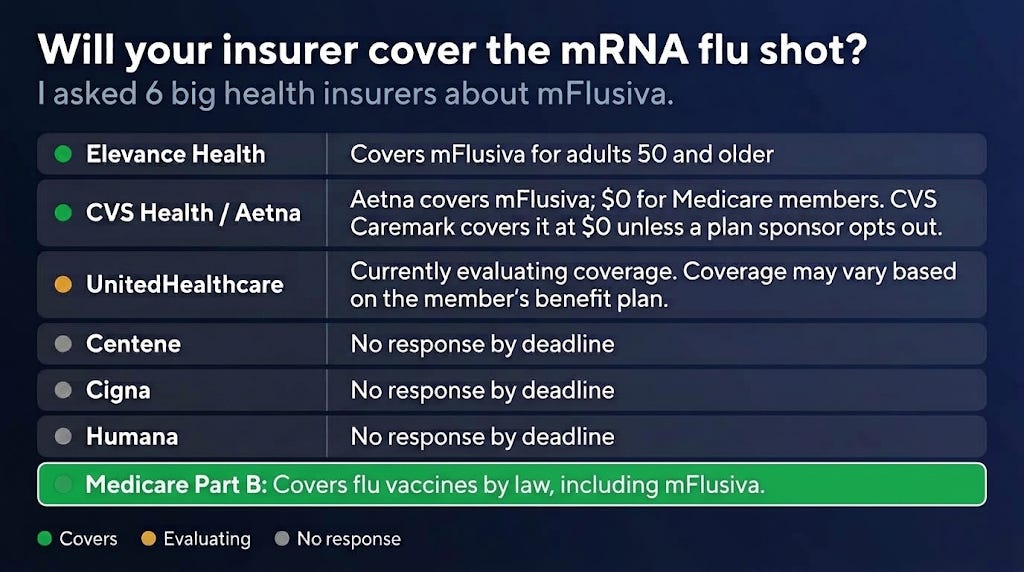
So each insurer decides on its own. Over the past two weeks, I asked six of the biggest whether they’ll cover mFlusiva. Elevance said it covers the shot for adults 50 and older. CVS Health said Aetna covers it, at no cost for Medicare members, and that its CVS Caremark program generally covers it at $0 unless a client opts out. UnitedHealthcare said it is “currently evaluating coverage.” Centene, Cigna, and Humana didn’t respond by my deadline. Moderna told me it is “seeing broad coverage for mFLUSIVA across commercial plans,” but that for people 50 to 64, “coverage varies by individual health plan.”
The insurance trade group AHIP has promised its members will cover “all ACIP-recommended immunizations with no cost-sharing” through the end of 2027. But that doesn’t apply to self-funded employer plans, which cover 67% of workers with employer-based insurance.
If you’re on Medicare, you’re covered by law. If you’re 50 to 64 with private insurance or Medicaid and want mFlusiva, call your plan before you make an appointment. Standard flu shots are still covered either way.
Restoring a lawful ACIP is “entirely within the government’s control,” Dr. Andrew Racine, president of the American Academy of Pediatrics, which brought the suit, told me. Meanwhile, Judge Murphy’s ruling left the committee “unable to carry out its core responsibilities,” Secretary Kennedy says.