


What killed Daria Shipilova?
We still don’t know what caused the pneumonia that killed Daria Shipilova, the young lab assistant who died in Siberia earlier this month. She worked at the Irkutsk Anti-Plague Institute, which studies Yersinia pestis plague and other deadly infectious diseases. Rospotrebnadzor, the agency that runs Russia's anti-plague institutes and its disease surveillance, calls her death pneumonia of unknown etiology.. Russia separately told WHO that no case of Yersinia pestis plague has recently been registered in Irkutsk oblast.
What do the International Health Regulations require?
WHO saw the first news reports of Shipilova’s death on October 2nd and asked Russia for more information the next day, under the International Health Regulations. Article 10 gives a country 24 hours to acknowledge such a request. It gives 24 more hours to hand over the public health facts it has.
Russia replied on October 6th, three days after WHO asked. Shipilova’s illness at first looked like an acute respiratory viral infection, the catch-all that covers everything from a common cold to a severe case of COVID or influenza, Russia told WHO, according to WHO spokesman Christian Lindmeier. WHO also asked which germ caused the pneumonia. Lindmeier says Russia did not answer.
Who checked the Irkutsk Institute?
The Irkutsk Institute has its own Commission on Biosafety Compliance. It looked into Shipilova’s death and found no mishap in handling pathogenic microorganisms. Dr. Anna Popova, the head of Rospotrebnadzor, sent a panel of experts, which backed the Commission’s findings.
Extensive testing of Shipilova’s samples “did not detect any microorganisms associated with her professional duties.” That wording leaves two possibilities open: a pathogen the Institute studies but Shipilova was not assigned to, or a pathogen the Institute does not study at all. It also says nothing about what the tests did find. Russia has not told WHO what testing was done, or what the tests found.
Rospotrebnadzor employed Shipilova, runs the Irkutsk Institute, ran the tests, and sent the panel that cleared Rospotrebnadzor.
Professor Sonia Ben Ouagrham-Gormley studies the old Soviet anti-plague network at George Mason University. “We can’t really trust that they will be truthful,” she said of the agency. “The test will be whether they involve the WHO in the investigation.” WHO has offered technical support and is still waiting for a response.
Why hospitalize 189 contacts?
Rospotrebnadzor ruled out any laboratory accident, but also said that “given the nature of the employee’s work, a full range of anti-epidemic measures was immediately implemented.” Those measures put 189 of about 197 contacts in the hospital for daily testing. Russia has since told WHO that medical observation of all identified contacts is complete and that it found no high-threat pathogens among them.
WHO said on October 6th that it has asked Russia to clarify three things: the cause of the severe pneumonia, the pathogen that prompted the public health measures, and media reports of a second employee with pneumonia of undetermined cause. Rospotrebnadzor said the same day that it had recorded no infectious disease among the institute’s staff in 10 days.
“Timely, complete and transparent information sharing under the International Health Regulations is essential to clarify conflicting reports,” posted WHO Director-General Tedros Adhanom Ghebreyesus.


What three plague and bioweapons experts had to say.
Professor Henry Heine spent his career at the United States Army Medical Research Institute of Infectious Diseases (USAMRIID) testing drugs against Yersinia pestis plague. Asked what could kill a Yersinia pestis plague patient on treatment, Professor Heine said, “Of course resistance is a possibility. More likely is that therapy was initiated too late.”
The CDC tells clinicians to start antibiotic treatment based on suspicion and not wait for test results. Doctors initially took her illness for severe COVID. They sent her to the hospital’s COVID center, the Irkutsk outlet IRK.ru reported. There they put her on a ventilator. “Regardless of what the infection was caused by, that indicates to me that it was too late,” said Professor Heine.
“An agent alone, even if virulent, cannot serve as a weapon,” Professor Ben Ouagrham-Gormley wrote in Barriers to Bioweapons. She does not rule out a bioweapons-related incident, although she thinks it unlikely. The old Soviet program worked on drug resistance, and the know-how is still in Russia.
How an official finding got overturned from inside.
Professor Scott Minnich studies microbes at the University of Idaho. From October 2003 to May 2004, he served in Iraq as a subject matter expert for the Defense Intelligence Agency. He was attached to the Iraq Survey Group, the team hunting Iraq’s weapons. The group sent him to inspect two truck trailers that American troops had captured after the invasion. The administration offered them as proof of the mobile germ labs Secretary of State Colin Powell described to the UN Security Council in February 2003. A CIA and DIA assessment that May called one a mobile production plant “despite the lack of confirmatory samples.”
Each trailer held one reaction vessel of about 600 liters, with no sampling ports, no way to pump in oxygen, and no way to harvest what was inside. A fermenter is the vessel you need to grow bacteria in quantity. These were not fermenters, he said.
A British team had said the same for months without being heard, Minnich said. They went back out together and found lye and aluminum filings in one vessel. That pairing makes hydrogen. The Iraq Survey Group’s final report called the trailers “almost certainly designed and built for the generation of hydrogen,” filling weather balloons for artillery wind readings.
Professor Minnich was contradicting the CIA and DIA assessment while working for one of the two agencies that wrote it.
In Irkutsk, the Commission sits inside the Institute. The panel came from Rospotrebnadzor, which oversees the Institute. Neither has published its findings, and nobody outside Russia has seen the lab, the samples or the records.
Nobody will say what the United States can still see.
The United States left WHO on January 22, 2026. The CDC says the country now “coordinates with WHO solely in a limited fashion to effectuate our withdrawal”.
The International Health Regulations are a separate treaty from WHO membership. The State Department and HHS rejected the 2024 amendments to the Regulations in July 2025. Those amendments, they wrote, “were set to become binding on the United States regardless of our withdrawal from the WHO.”
The Regulations give every country a National IHR Focal Point, an office that must be reachable at any hour to send and receive outbreak notifications. HHS still has that role, and we do not know how the U.S. withdrawal from WHO has affected U.S. participation in the IHR.
Those outbreak notifications arrive on the Event Information Site, a secure page focal points can read before the public gets anything. It is unclear whether the United States still has access to it.
I asked the State Department for comment again today:
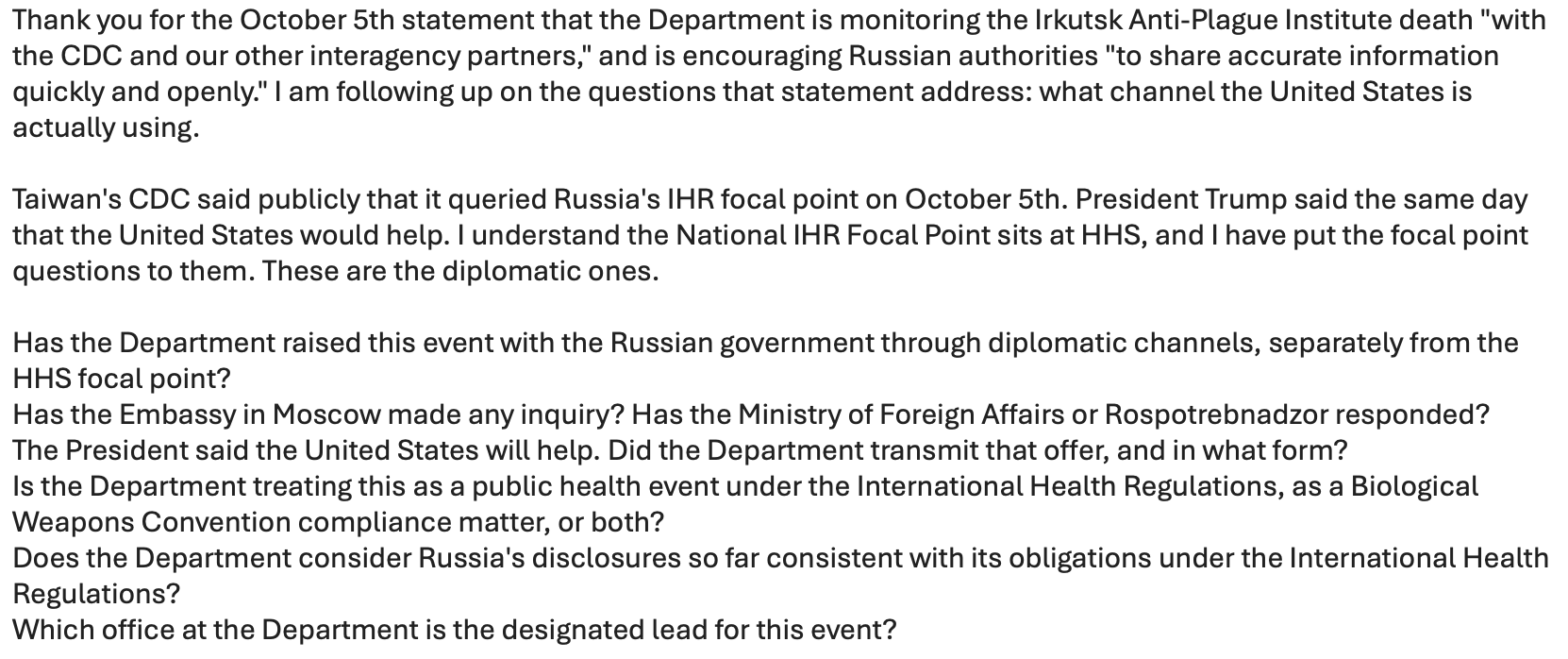
And their response:

I also followed up with HHS:
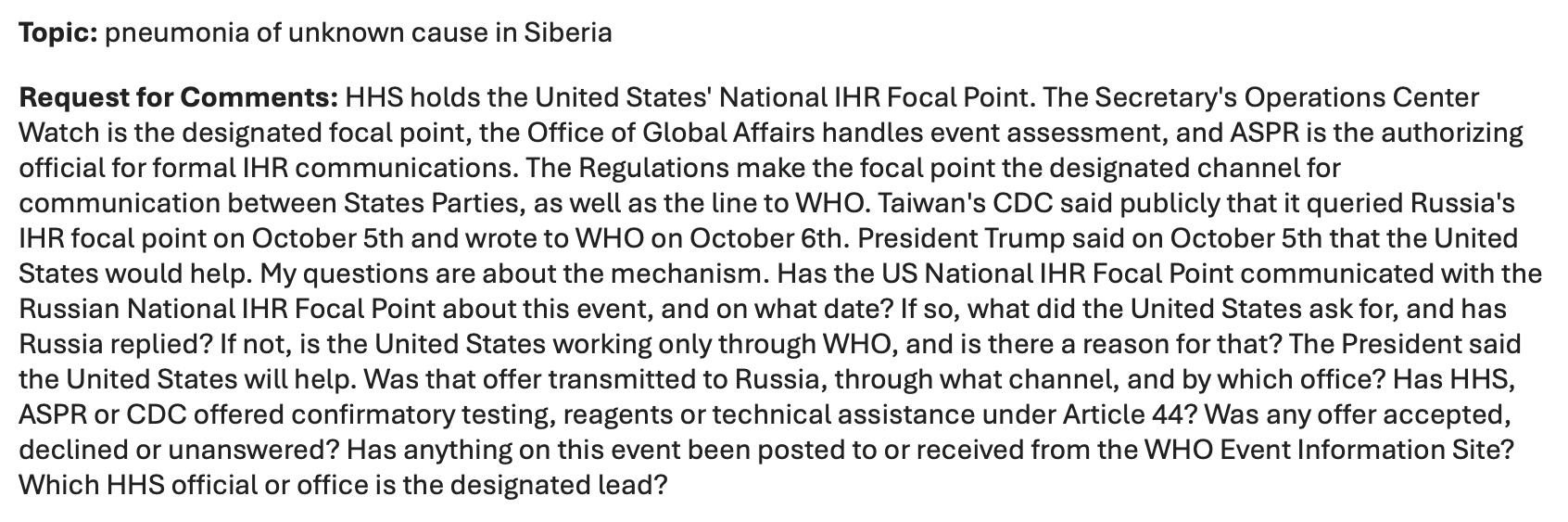
And their response:
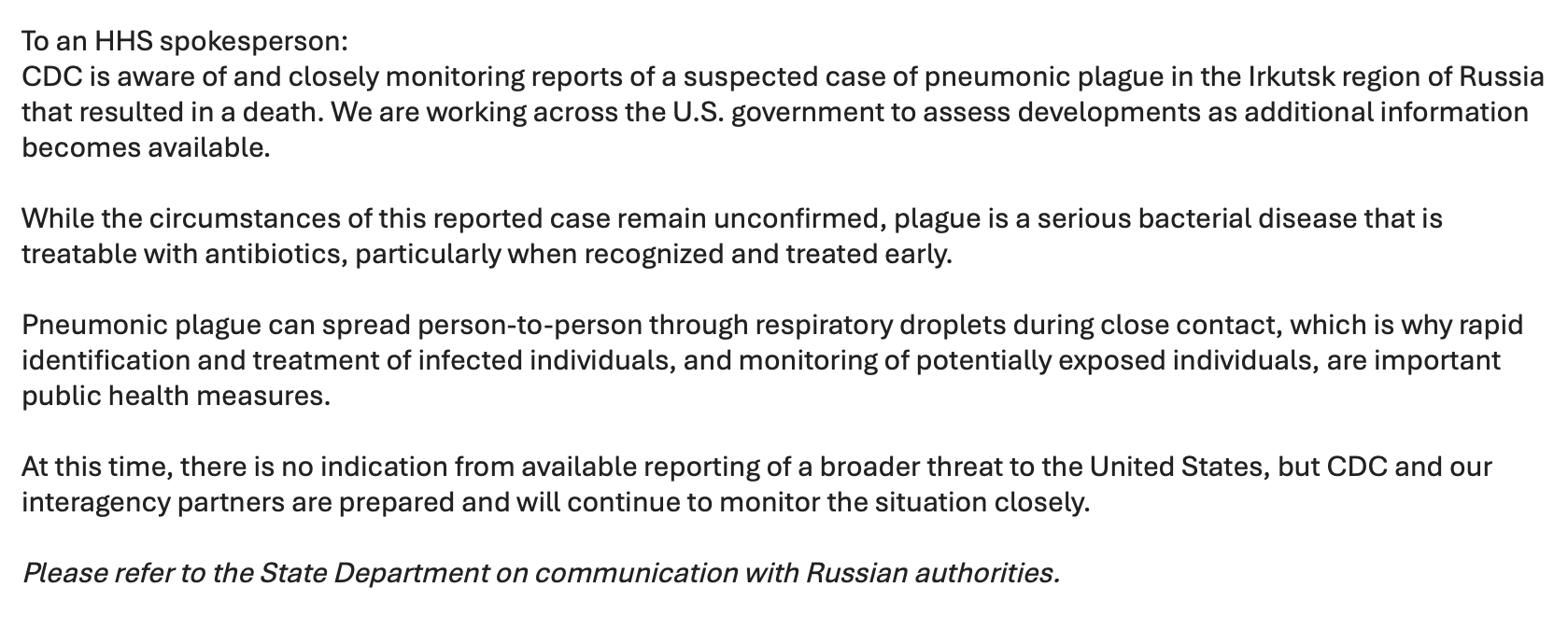
HHS answered none of my questions and referred me to the State Department. The State Department partially answered two of my six questions. Neither agency would say whether Russia has answered, and the State Department would not say whether Russia's disclosures satisfy the treaty.