


No cause of death has been released.
Daria Shipilova, a 28-year-old laboratory assistant at Russia’s Irkutsk Anti-Plague Institute, fell ill in late September, was hospitalized with severe pneumonia, and, according to a WHO spokesperson, died on October 2nd. Russian officials have not released her cause of death. HHS Press Secretary Emily Hilliard called this "reports of a suspected case of pneumonic plague," but this hasn't been confirmed. Nobody has reported which tests were run, on which samples, at which lab, or on what date. No additional cases have been reported. A national reference laboratory holding almost two thousand strains of Yersinia pestis should be able to sequence an isolate in days, but Russia has released nothing.
It's been reported that on September 25th, Shipilova allegedly broke a test tube containing Yersinia pestis, the bacterium that causes pneumonic plague. Plague takes a higher exposure to infect than tularemia does. We have no further details about Shipilova's specific duties or which organisms she handled. Russia’s health agency says tests on her samples found nothing tied to her work. We don’t know if she was vaccinated against plague. WHO recommends Yersinia pestis vaccination for high-risk groups including laboratory personnel. Nobody has said what antibiotics Shipilova was given, or which ones failed. That answer separates a late presentation from the wrong first drug from a resistant strain.
What does “plague” actually mean here?
“Plague” can mean two different things, and the institute’s name carries the looser meaning.
Frank Snowden, an emeritus professor of history at Yale, writes in Epidemics and Society that the word plague has become shorthand for catastrophe itself. That is the old, wider meaning, the one in “a plague of locusts.” The narrow meaning is infection with Yersinia pestis bacteria, which can cause bubonic plague, pneumonic plague, or septicemic plague, and was the cause of the Black Death across Europe in the Middle Ages.
Maj Gen (ret) Paul Friedrichs was a senior director for biodefense on the National Security Council. He describes the Irkutsk Anti-Plague Institute as “a well-known public health lab which has been around since the 1930s doing research into endemic” disease found in Siberia, Central Asia, and the Far East. That work includes tularemia, brucellosis, anthrax, cholera, tick-borne encephalitis, and hantavirus, as well as Yersinia pestis plague. Much of this work involves surveillance of rodent populations and the development of diagnostics and vaccines for infectious diseases circulating among rodents. The Irkutsk Anti-Plague Institute has, for example, developed a live tularemia vaccine.
Across Siberia and Central Asia, Yersinia pestis circulates among wild rodents. The last case Russia reported before this one was a 10-year-old boy with bubonic plague in the Altai region in 2016.
Because tularemia infects at a much lower dose, lab-acquired tularemia is historically far more common than lab-acquired Yersinia pestis. A USAMRIID team reviewing the worker-illness records of the United States’ offensive biological warfare program from 1943 to 1969 found that pathogens requiring higher doses to infect, Yersinia pestis among them, were largely prevented by protective equipment and training alone. But protective equipment was not enough for pathogens like tularemia, which infect at lower doses. Tularemia infections continued at an average of 15 a year until a vaccine became available.
In Fort Collins, Colorado, the CDC's Bacterial Diseases Branch studies many of the same infectious diseases as the Irkutsk Anti-Plague Institute, including Yersinia pestis, tularemia, bartonella, Lyme disease, and tick-borne infections.
During the Los Angeles plague epidemic of 1924, Yersinia pestis spilled over from urban rats into rural rodents, becoming endemic among rodents in the American West. The CDC reports an average of 7 human cases of Yersinia pestis plague a year, most of them in northern New Mexico and Arizona, with more in California, southern Oregon, and western Nevada.
Is bioweapons research done in Russia or the United States?
Japan, the Soviet Union, and the United States have all studied weaponizing Yersinia pestis. Japan’s program ended in 1945, and America’s in 1969, but the Soviet anti-plague network likely supplied virulent strains of Yersinia pestis to the Soviet bioweapons program. The State Department’s 2025 arms control compliance report says Russia and North Korea “maintain their offensive biological weapons programs in direct violation of their treaty obligations.” We do not know if the Irkutsk Anti-Plague Institute has such an active program.
The United States’ ongoing research on Yersinia pestis is defensive: surveillance, diagnostics, treatment, and vaccines. Yersinia pestis is considered a Tier 1 select agent, meaning any laboratory holding it must be registered and inspected under the Federal Select Agent Program. Russia has published no equivalent registration, inspection, or incident record for Irkutsk.
Is Russia’s response out of proportion to the risk?
Dr. Anna Popova, Chief State Sanitary Doctor of the Russian Federation since 2013, flew to Irkutsk on October 2nd, the day Shipilova died, to convene an emergency commission. Six medical facilities are under quarantine.
Health workers are testing about 200 contacts daily. So far, they’ve picked up two cases of COVID and two cases of rhinovirus, which causes the common cold. 189 of those contacts have been hospitalized for observation and preventive antibiotics.
“Quarantining people who were exposed is appropriate,” Dr. Friedrichs said, “but timeline of exposure and death are unclear, what antibiotics were unsuccessful is unclear, status of close contacts is unclear.”
“Pneumonic plague can spread person-to-person through respiratory droplets during close contact, which is why rapid identification and treatment of infected individuals, and monitoring of potentially exposed individuals, are important public health measures,” HHS Press Secretary Hilliard emailed me.
However, the Russian response is out of proportion to a case of Yersinia pestis plague pneumonia acquired in the lab. It’s an infection that’s easily contained with personal protective equipment, contact tracing, isolation, testing, and preventive antibiotics. This could indicate an abundance of caution in a world still traumatized by the COVID pandemic, an infection that cannot be controlled with preventive antibiotics, or an infection other than Yersinia pestis plague.
Shipilova’s contacts will require seven to ten days of quarantine, during which time they should complete the seven-day course of preventive antibiotics. Igor Kobzev, governor of the Irkutsk region, said on October 5th that close contacts could go home next week.
The questions, and the non-answers.
Dr. Friedrichs called this a “missed opportunity for Russia to be truthful and transparent.”
WHO is verifying this event under Articles 9 and 10 of the International Health Regulations. A spokesperson says WHO has asked Russian authorities for more details including “the laboratory tests underway, and their results,” and the health status of the contacts. WHO has also had a formal tie to “Microbe,” Russia’s anti-plague reference institute, since November 2021, when it became a WHO Collaborating Centre.
The United States hasn’t revealed much either.
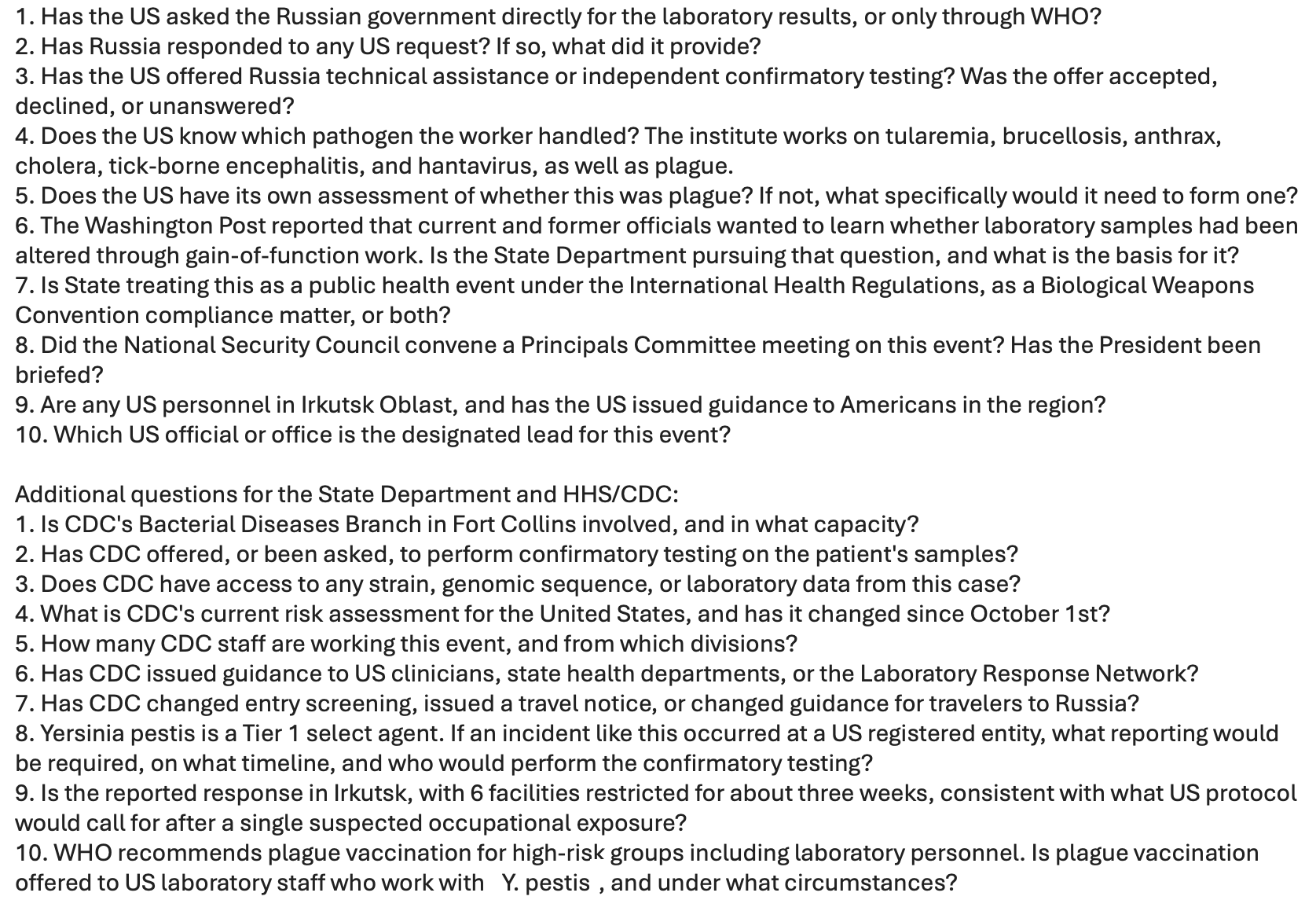
Here are the questions that I submitted to the State Department:
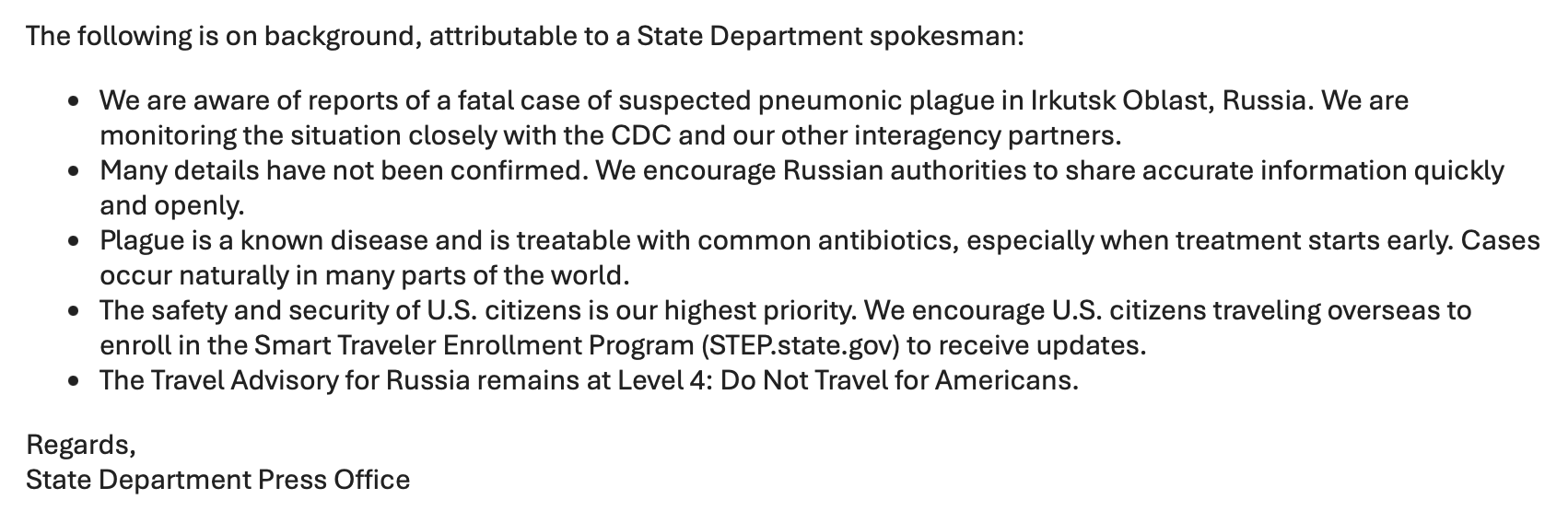
And their response:
From HHS:
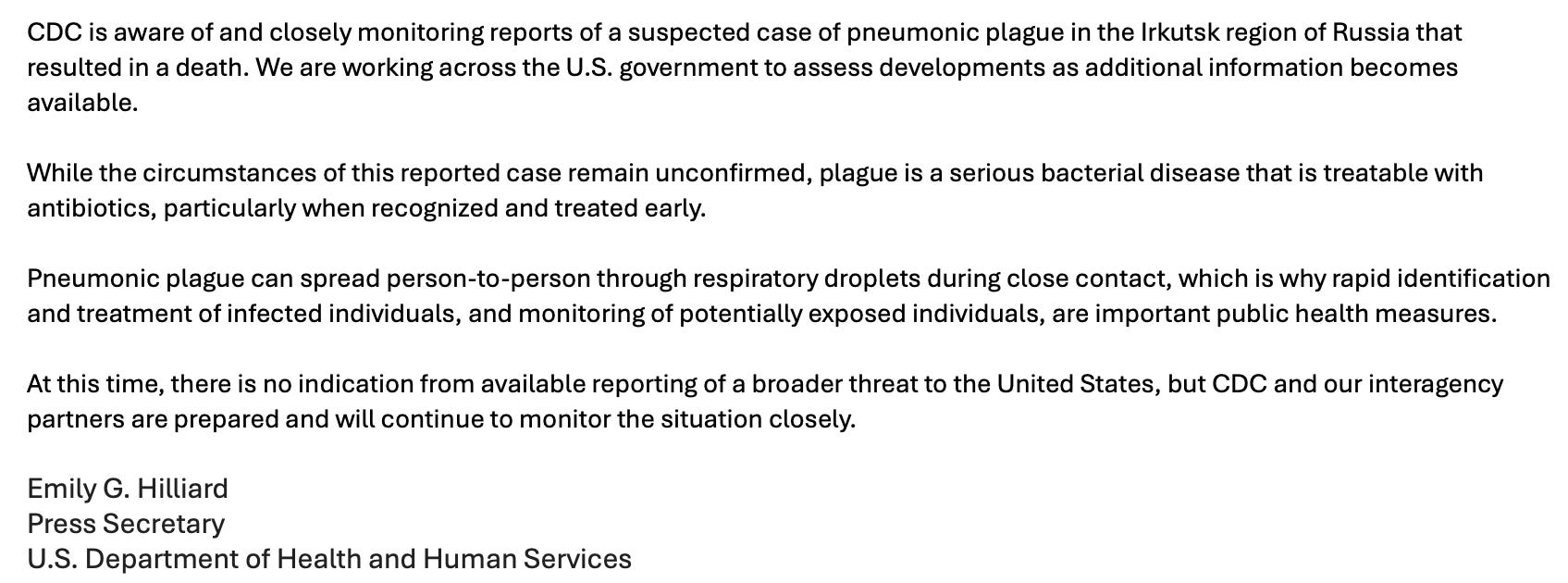
Between them, they answered only one of my questions.
Neither said whether the U.S. has asked Russia for the laboratory results directly or only through WHO, whether Russia has replied, whether the U.S. offered confirmatory testing, or whether it knows which pathogen Shipilova handled. Neither said whether CDC’s own plague laboratory in Fort Collins has seen a strain, a sequence, or any laboratory data. Neither addressed whether this is being handled as a public health event or a Biological Weapons Convention matter, or whether the National Security Council has convened on it. I asked both which office is the lead. State said it is working with “the CDC and our other interagency partners.” HHS said it is “working across the U.S. government.”
What is Yersinia pestis plague, and how dangerous is it?
It’s a bacterial infection, and it causes three different diseases depending on where it lands.
Bubonic plague is the most common. A flea bites you, the bacteria travel to your lymph nodes, and those nodes swell into what doctors call “buboes.” You get sudden fever, chills, body aches, and vomiting. Septicemic plague is when the bacteria infect the blood, and pneumonic plague is when the bacteria infect the lungs; these are the most deadly forms of plague. Pneumonic plague causes shortness of breath and a cough, often with blood in the sputum. Symptoms usually start within 1 to 7 days, and sometimes in under a day.
It spreads less easily than its reputation suggests. Bubonic plague doesn’t pass between people at all, because you get it from a flea. Pneumonic plague can pass person to person in respiratory droplets. Dr. Jacob Kool, then a CDC infectious disease epidemiologist in Fort Collins, reported in 2005 that patients usually infect others only in late illness, when they cough copious bloody sputum, and only in close contact. Because spread needs that level of closeness, masks and distance could stop these outbreaks even before antibiotics existed.
WHO puts the case fatality ratio for untreated bubonic plague at 30% to 60%, and calls the pneumonic and septicemic forms “always fatal” when left untreated. Pneumonic plague can kill within 18 to 24 hours of onset.
Researchers at CDC’s Bacterial Diseases Branch in Fort Collins reviewed 762 treated cases of Yersinia pestis plague reported between 1937 and 2019. Overall mortality was 20%, 27% for pneumonic plague, but 13% in patients who got an aminoglycoside. Common antibiotics work, especially when started promptly. CDC's treatment guidelines recommend 10 to 14 days for all three form, but the drug depends on the form: doxycycline for an uncomplicated bubonic case, and an aminoglycoside (like streptomycin or gentamicin), a fluoroquinolone (like levofloxacin), or a tetracycline (like doxycycline) for pneumonic and septicemic plague.
Doctors diagnose plague from blood, sputum, or fluid drawn from a bubo. WHO has validated a rapid dipstick test now used in Africa and South America. Close contacts get a 7-day course of preventive antibiotics, usually doxycycline, ciprofloxacin, or levofloxacin.
Most human Yersinia pestis plague cases reported to WHO between 2019 and 2025 came from the Democratic Republic of the Congo and Madagascar.
Why was the Black Death so deadly?
Because nobody had modern medicine, specifically antibiotics, in the Middle Ages.
The Black Death ran from about 1347 to 1351 and killed tens of millions of Europeans. Researchers reconstructed the pathogen’s DNA in 2011 from skeletons at the East Smithfield mass burial ground in London; the deaths were caused by “a variant of Y. pestis that may no longer exist.” And that pandemic did not kill randomly. The elderly and people with underlying conditions were at highest risk.
How worried should Americans be?
Based on the information we have, not very.
A WHO spokesperson says that “based on unofficial information available, the public health risk to the general population appears to be low.”