


What Secretary Kennedy leaves out.
HHS Secretary Robert F. Kennedy Jr. has argued that getting measles beats vaccination. Natural infection, he says, provides more durable immunity than the vaccine. Natural measles may confer durable immunity, but two doses of MMR vaccine are 97% effective against measles. The CDC says most people vaccinated with MMR will be protected for life.
What Secretary Kennedy leaves out is the impact of measles infection on your immunity to other infections.
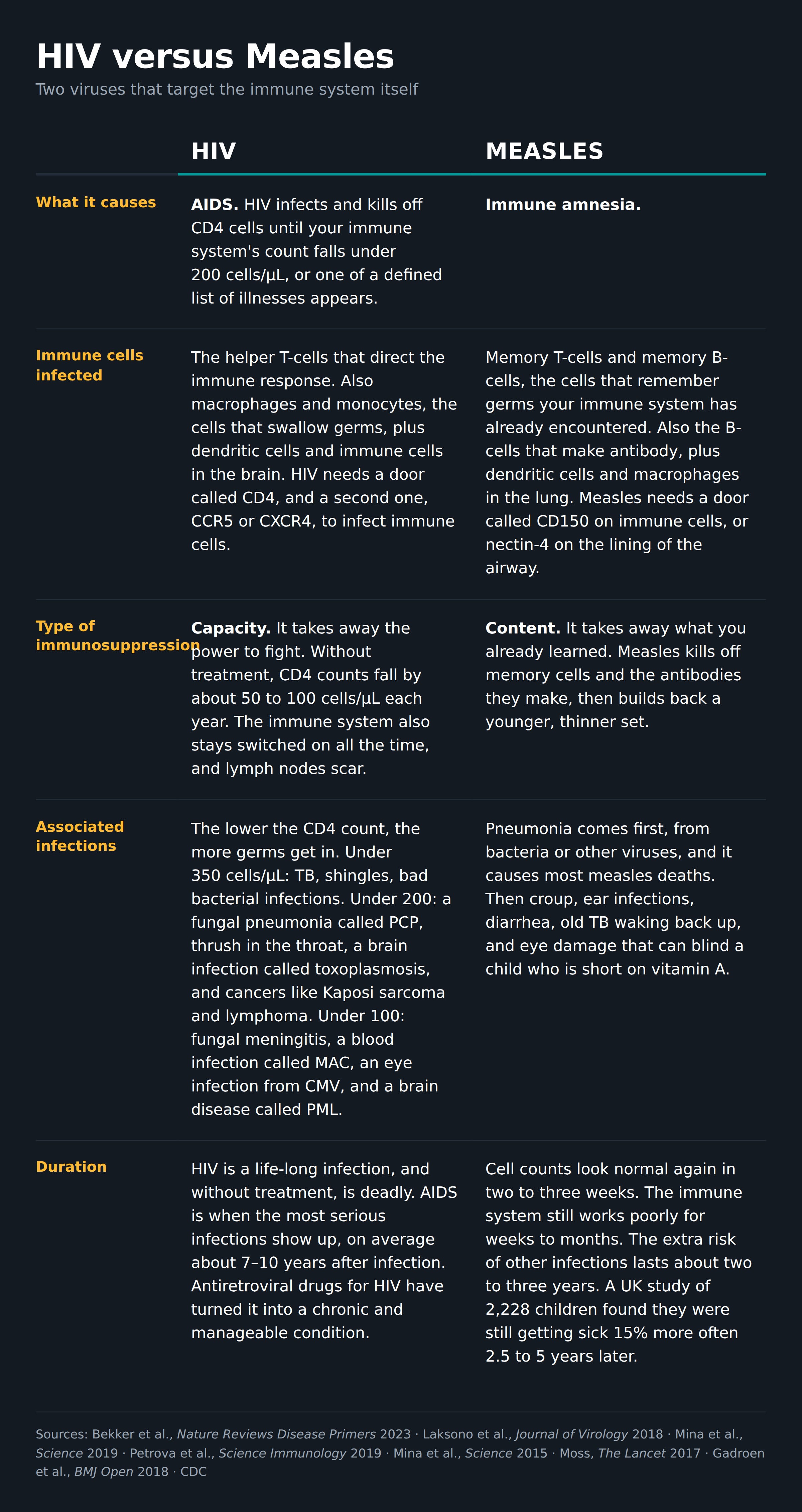
Measles is a factory reset for your immune system, which is why I think of measles as a mini HIV.
Measles gets into cells through a receptor called CD150, which sits on memory B-cells, memory T-cells, and plasma cells in bone marrow. Those cells store the immunity you built from past infections and vaccines. HIV gets in through CD4. CD4 sits on the helper T-cells. Helper T-cells switch on the B-cells that make antibody and the T-cells that destroy infected cells. Both viruses go after the immune system itself. Measles infects 20% to 70% of memory cells in the first 3 to 10 days.
HIV vs Measles
What happens to immune memory after measles.
Dr. Michael Mina and colleagues at Harvard Medical School and Erasmus MC in Rotterdam screened the blood of 77 unvaccinated Dutch children before and after measles infection against thousands of pathogen epitopes, the tiny pieces of a germ that an antibody recognizes. Measles eliminated 11% to 73% of each child’s antibody repertoire. That repertoire is the full set of germs their antibodies could recognize. Total antibody levels didn’t change, but what those antibodies recognized changed enormously.
At the Wellcome Sanger Institute, Velislava Petrova’s group sequenced B-cell receptors before and after infection and found two lasting defects. The supply of naive B-cells rebuilds incompletely. Naive B-cells are the untrained ones, still waiting for a germ they have never encountered. Measles destroys the families of cells that remember germs the child has already met. These same researchers found that in ferrets, a measles-like virus eliminated influenza immunity from vaccination. When animals who’d been infected with the measles-like virus were later infected with influenza, they developed more severe disease.
Children die of pneumonia, sepsis, and diarrhea at rates that track measles cases with a lag of a bit over two years. Dr. Mina’s group found that pattern in England, Wales, the US, and Denmark. Ryoko Sato and Masahiko Haraguchi found the same pattern across 46 African countries. Death certificates record those deaths as pneumonia, sepsis, and diarrhea. Few connect them back to a measles infection two years earlier. Dr. Mina’s group links measles to as much as half of all childhood infectious disease deaths in the pre-vaccine era.
The line between infectious and chronic disease is blurry.
HIV is a chronic infection, while acute measles infection lasts about two weeks. But the immune compromise measles leaves behind can last two to three years.
The line between infectious and chronic diseases is a lot blurrier than most people realize. Some infections, like herpes viruses, are for life. HSV-1 and 2, Epstein-Barr virus, and cytomegalovirus persist for life after the first infection and have long-term consequences. Among 10 million young adults, multiple sclerosis risk rose 32-fold after Epstein-Barr infection. Hepatitis B and C, human papillomavirus, and Helicobacter pylori persist for years and cause cancer. HIV persists too, but antiretroviral therapy turned it from a fatal infection into a chronic condition.
Measles is an acute infection with long-lived or chronic consequences. The virus clears, but the damage stays. Long COVID, post-treatment Lyme disease syndrome, and measles immune amnesia all sit in that second group.
HIV removes the capacity to respond. Measles wipes out immune system memory. Antiretroviral therapy restores CD4 counts and reverses the immunodeficiency. But, there are no drugs to restore an immune repertoire erased by measles. Someone has to reencounter each pathogen, or get another vaccine dose, one at a time. And a child faces each of those germs with less protection than before.
The MMR vaccine provides immunity to measles without immune amnesia to other infections. Dr. Mina’s team ran the same tests on MMR-vaccinated infants and found no loss comparable to what they saw in the children who’d had measles.
What are you supposed to do after measles infection?
There’s no validated protocol to test measles survivors antigen by antigen and re-immunize them. Dr. Mina’s group suggests restarting the routine vaccination schedule, since earlier doses may no longer be protective.
The Advisory Committee on Immunization Practices advises the CDC on the childhood vaccination schedule and could make recommendations for what to do after a measles infection.
Researchers don’t yet know how soon after measles a child can mount an effective response to vaccination. A study in Guinea and Mali is testing that now with a rabies vaccine. One group gets it about 8 weeks after measles infection, the other about 47 weeks.