


What the executive order does.
President Trump signed an executive order on childhood vaccines Monday. At the signing he said it covered “many subjects, but including autism in particular.”
The word autism does not appear in it.
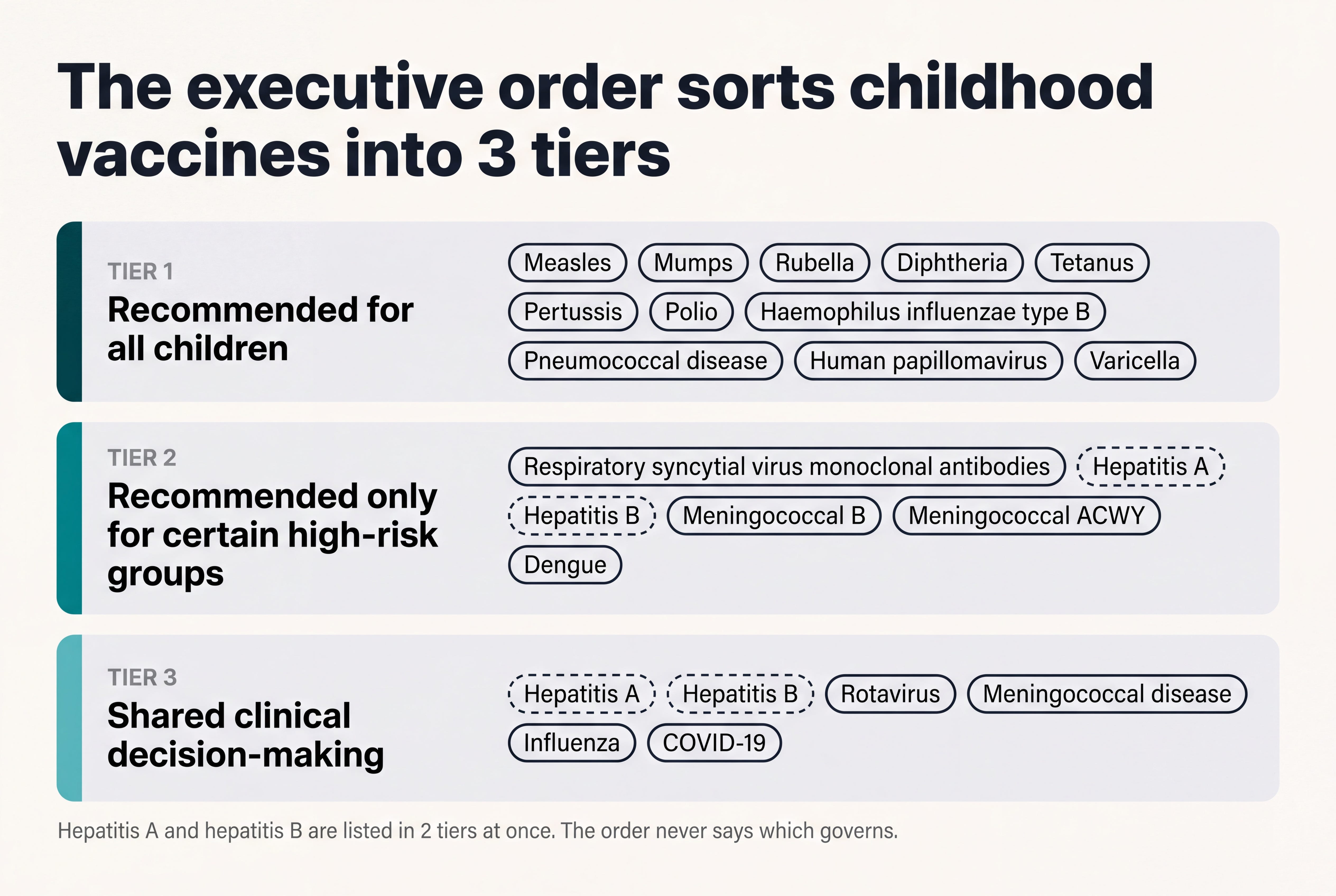
The order sorts childhood vaccines into three tiers. One tier is recommended for every child. A second is only for kids at high risk. The third is called shared clinical decision-making, which means the government takes no position and leaves the call to you and your doctor.
That cuts the recommended list from 18 diseases to 11. Measles, mumps, rubella, polio and the DTaP shots keep their place at the top. Hepatitis A and B, meningococcal, flu and COVID drop to the lower two tiers.
The order also says MMR “should be administered in 3 separate single-disease shots once such products are domestically available.” It says all childhood shots “should be administered at separate medical visits.” It gives HHS 90 days to reassess timing. It orders work to develop alternatives to aluminum. An adjuvant is the ingredient that wakes the immune system up, and each one is matched to the vaccine it goes with. Swap it out and you have a new product. New product, new trials, new approval.
Hepatitis A and hepatitis B each appear twice, once under high-risk and once under shared decision-making. Those two tiers carry different rules for insurance coverage. The order never says which one wins.
Dr. Paul Offit helped invent the RotaTeq rotavirus vaccine and sat on ACIP from 1998 to 2003. “It’s not a gold standard recommendation,” he told me. “It’s a non-science-based recommendation, and it makes no sense.”
Look at the 3 vaccines moved to shared decision-making: rotavirus, COVID and flu. “Those are all short incubation period mucosal infections,” Offit said. They infect the nose, the throat and the gut, and they make you sick fast. “Even if the entire world was vaccinated with those vaccines every year, those viruses would still circulate. You’re never going to eliminate those viruses.” A vaccine you take because the virus is everywhere is a strange candidate for no default.
Before the rotavirus vaccine, every child got it. “You could not find anybody who by 5 years of age had not been infected,” Offit said. That meant 55,000 to 70,000 US hospitalizations a year and 20 to 60 deaths in children under 5, and up to 500,000 deaths a year worldwide.
The American Lung Association singled out flu. The 2024-25 season brought 289 pediatric flu deaths, the most of any non-pandemic season since these deaths became reportable in 2004. Among children old enough to be vaccinated whose status was known, 89% were not fully vaccinated. The shot cuts a child’s risk of dying from flu by 80%. The order, chief executive Harold Wimmer said, “will cause more confusion for parents and healthcare providers, reduce vaccination rates and increase the spread of vaccine-preventable illnesses.”
The high-risk tier has the same problem. “Everyone’s at risk for those diseases,” Offit said of hepatitis A, hepatitis B and RSV. Meningococcal disease is likelier without a spleen, “but everyone’s at risk. I saw a lot of meningococcus in my life in previously healthy people.” (So have I.)
Where the real authority sits.
The Advisory Committee on Immunization Practices makes recommendations and then the CDC director adopts them. That adoption is what triggers private insurance coverage and Vaccines for Children. The president is not part of that chain.
Former CDC Director Dr. Rochelle Walensky once went beyond ACIP on COVID boosters, so a director has some room at the adoption step. She did not skip ACIP.
The EO acknowledges the active lawsuit and tells agencies to proceed “to the fullest extent allowable by law.” Judge Brian Murphy blocked Secretary Kennedy’s January childhood vaccine schedule change in March. ACIP is not meeting. The First Circuit has the appeal.
Almost all the coverage has been about the tiers, which is what the president cannot execute on his own.
But Section 4 is the part the president can act on. It directs newly confirmed Attorney General Todd Blanche to sue states over religious and medical exemptions to school vaccine rules, and it tells Justice, Education and HHS to make their “contractors and grantees, including States and localities” comply. That gives the government a way to squeeze health departments and school districts through their federal grants. A lawsuit takes years.
The legal question is whether a state that allows medical exemptions must also allow religious ones. Every federal appeals court to take it up has said no, including the Fourth Circuit in April. The Supreme Court has held since 1944 that religious freedom “does not include liberty to expose the community or the child to communicable disease.”
The Supreme Court has held since 1944 that religious freedom “does not include liberty to expose the community or the child to communicable disease.”
What splitting the shot would actually take.
Not now, and not soon. No separate measles, mumps or rubella vaccines are licensed here. Merck stopped making them in 2009 because almost nobody ordered them, and says it would take more than 10 years to win FDA approval for three new products.
“The companies can neither remove aluminum, nor separate the MMR components, and they know that,” Dr. Peter Hotez, who develops vaccines at Texas Children’s Hospital, told me.
Splitting the shot would also mean six appointments instead of two. Researchers in Oregon followed nearly 100,000 children. By nine months, the ones whose parents spread shots out had to make more visits and received fewer vaccines: 4.2 visits and 6.4 shots, against 3.3 and 10.4. More trips, less protection.
Senator Bill Cassidy (R-LA), a physician, made the same point Monday. “Breaking up vaccines will mean children have to get more shots to get the same protection, not fewer shots.”


In 2022 the World Health Organization said one dose was enough for most kids. Britain, Australia, Canada, Ireland and Spain moved, and 93 countries now use a single-dose schedule. We didn’t, and here the critics have a fair point. If the goal were fewer shots that work just as well, that is where you would start.
In January, HHS announced we would. But it skipped ACIP. There is no FDA-licensed one-dose product here. CDC's own webpage still says two or three doses. And Judge Murphy froze the whole package in March, so nothing changed in any exam room.
Do vaccines cause autism? No.
This has been studied in more than 5 million children, in more than 40 studies, across 7 countries.
A Danish study followed 657,461 children and found no increased risk. A study of 95,727 American children included nearly 2,000 with an autistic older sibling, the group where a trigger would show up first. Their risk was no higher. Thimerosal came out of childhood vaccines by 2001, and California diagnoses kept climbing every quarter for 6 more years. A Danish study of 1.2 million children found no risk from aluminum.
So why are autism diagnoses rising?
Trump gave his answer at the signing. “It’s many many times what it used to be years ago,” he said, “and it gets progressively worse and we add progressively more and more vaccines.”
Autism diagnoses have risen. Most of that is a change in how autism is defined, spotted and recorded. CDC’s own surveillance found autism in 9.7 per 1,000 8-year-olds in Laredo, Texas, and 53.1 per 1,000 in California. Same year, same country. Biology does not vary five-fold between two American cities.
Genetics carry most of the rest. Researchers followed 2,001,631 children in Denmark, Finland, Sweden, Israel and Western Australia, 22,156 of whom were diagnosed with autism. About 80% of the differences in autism risk across a whole population trace back to inherited genes. That’s a fact about populations, not about any one child. It does not mean 80% of a given child's autism is genetic and 20% is something else.
About 80% of the differences in autism risk across a whole population trace back to inherited genes. That’s a fact about populations, not about any one child. It does not mean 80% of a given child's autism is genetic and 20% is something else.
There is also a reason the timing fools people. About a third of autistic children lose skills they had already learned, on average around 20 months. MMR is given at 12 to 15 months. A parent who notices that sequence is seeing something real. But regression happens at the same rate whether or not MMR is in the picture. British researchers compared autistic children assessed before and after MMR was introduced and found regression in 16% of the post-MMR group against 18% before it. Eye-tracking studies show infants later diagnosed with autism start diverging from other babies between two and six months, before the shot.
What parental age does and does not explain.
After genetics, the finding that keeps turning up is parental age. Both parents.
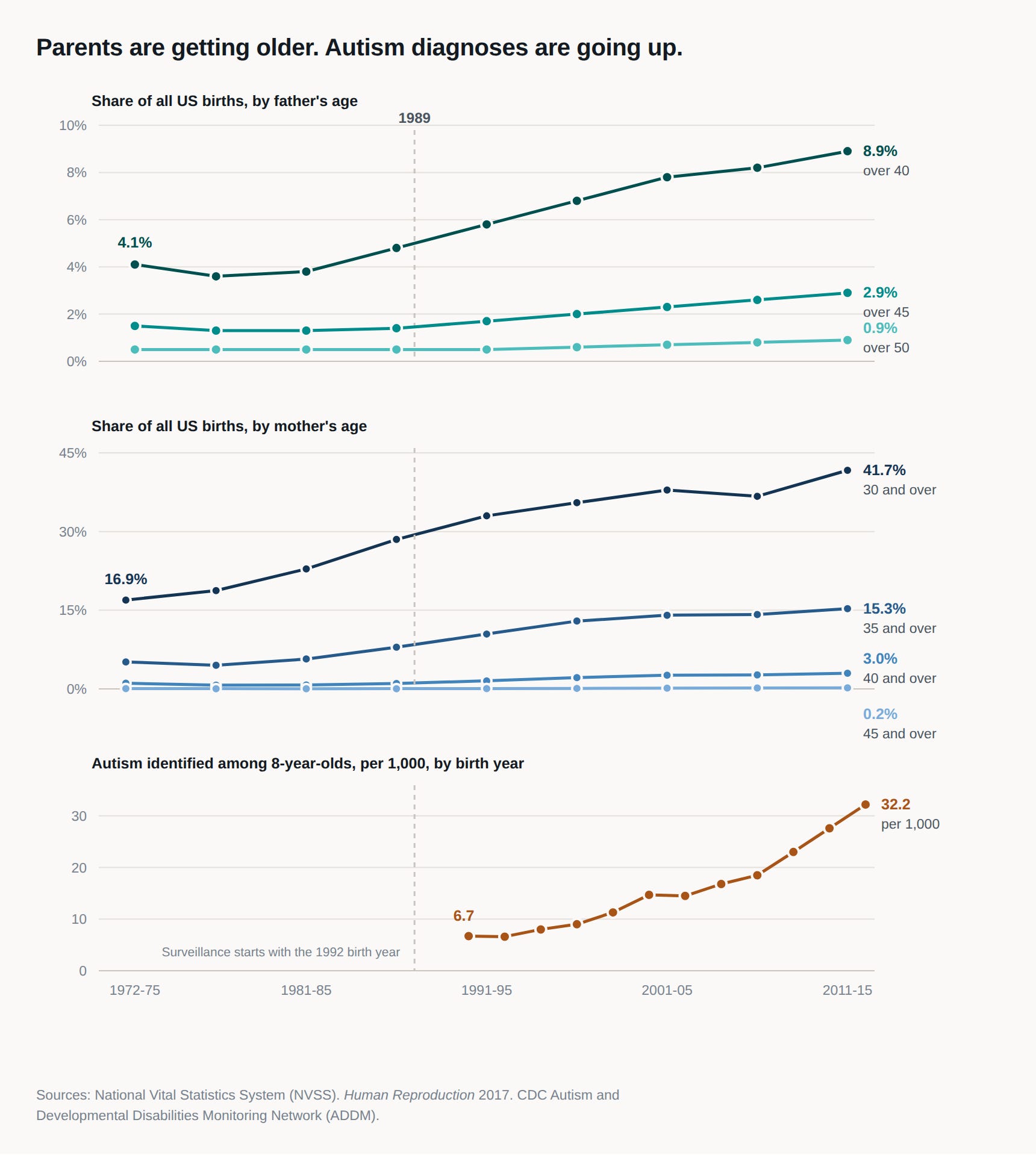
Sperm cells keep dividing across a man’s life, and every division is a chance for a new mutation. Each year of a father’s age adds about 1.5 of them to what he passes on. For mothers it is about a quarter of that. Children of fathers 50 and older were ~2x as likely to be autistic as children of fathers under 30. Children of mothers 35 and older were ~1.3 times as likely as children of mothers 25 to 29.
The mutations explain less than you would think. Researchers sequenced families, matched them to Danish health records, and worked out how much autism those extra mutations should cause.
Their math predicted that a father of 45 should have about 1.1x the risk of a father of 25, while health records showed a 1.7x higher risk. The rest comes from somewhere else: genes parents already carry and pass down, who waits to have kids and why, fertility treatment, and what happens during pregnancy.
But how much of the rise in autism diagnoses comes from parents getting older? California researchers looked at the 1990s and put it at about 5%.
Father’s age is on the birth certificate, and it has been in the national birth data since at least 1968. NCHS used to publish tables of births by father’s age. The flagship report, Births: Final Data for 2024, sorts births by the mother’s age a dozen ways but never once by the father’s, and CDC WONDER doesn’t offer paternal age at all.
Father’s age is also missing on 10% to 20% of certificates, depending on the year. Those holes cluster. Father’s age was filled in for 70% of births to Black mothers and 91% of births to White mothers.
Every one of those gaps is a reason to fund the research.
Nothing has changed at your pediatrician’s office.
Nothing has changed at your pediatrician’s office. A judge blocked the January changes back in March, and that order still holds. Kids go back to school on the same schedule as last year.
Michael Osterholm, who runs the Vaccine Integrity Project at the University of Minnesota, said the order “does not change the underlying scientific evidence supporting childhood immunization.” Parents, he said, “deserve clear, evidence-based guidance about how to protect their children, not competing recommendations issued through political processes.”
The American Academy of Pediatrics and twelve other groups published a childhood schedule that twenty-eight states and DC have endorsed. In June, the American College of Obstetricians and Gynecologists (ACOG) issued its first maternal vaccination schedule to depart from the federal one, backed by thirteen medical societies. And on Monday, hours after President Trump signed the EO, New York State and New York City told clinicians to use the ACOG schedule.