


The part that isn’t on camera.
On Saturday night, Alexandria Ocasio-Cortez went live on Instagram and gave herself a fertility shot on camera. She’s 36. She said she’d been weighing it and saving for it for a very long time. The next morning, on ABC’s “This Week,” she said she was talking about it publicly because “this administration is denying reproductive care to women across the country, from abortion rights to the ability to carry out a healthy pregnancy.”
It’s a choice. It’s a choice people should be able to talk about publicly. And it’s also a big purchase.
What are you buying for $12,000?
Egg-freezing technology works. Vitrification, the flash-freezing method used everywhere, stopped being experimental in 2012. About 78% of eggs survive thawing, and about 72% of those fertilize, per a 2024 meta-analysis of 8,750 women. No rise in birth defects has been detected in the children.
What it buys is a probability that drops with each step. 60 Minutes described an inverted pyramid: eggs survive, then fertilize, then become embryos, then healthy embryos, then embryos that implant.
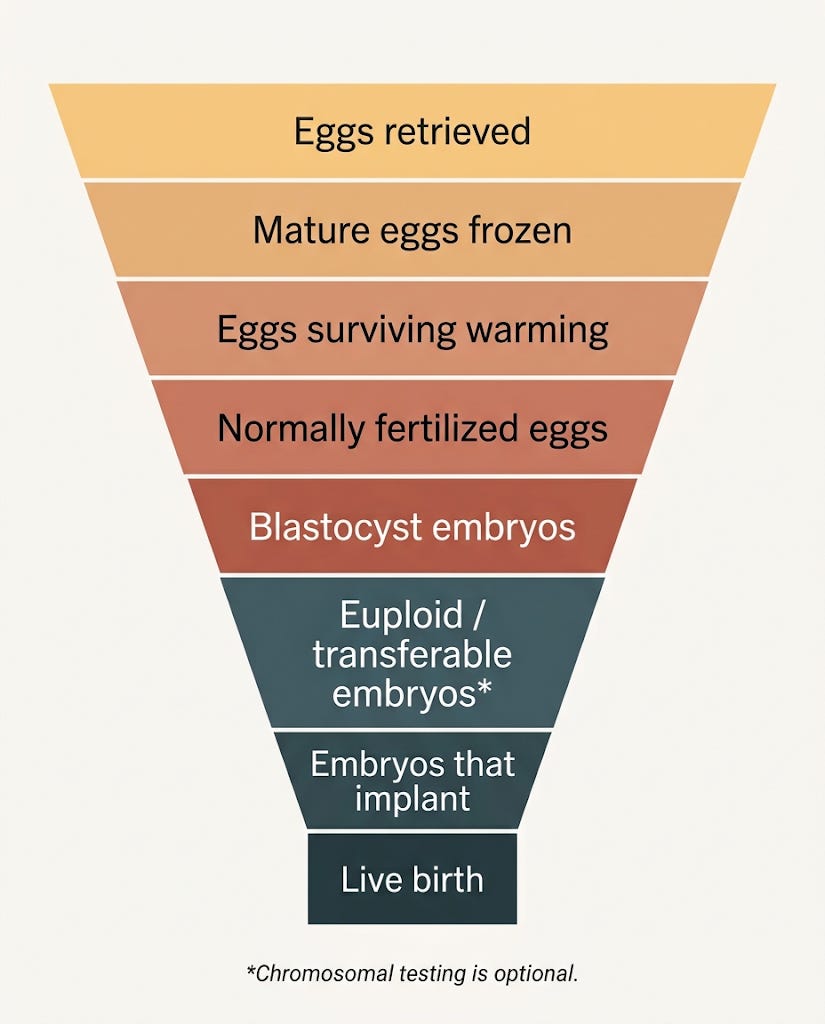
The American Society for Reproductive Medicine 2021 guideline estimates a woman aged 35 to 37 needs about 15 mature eggs for a 70% chance at one live birth, but that’s a projection from one clinic’s thaw data. The same guideline says there’s “insufficient evidence to counsel women of various ages on the absolute number of oocytes necessary to achieve a reasonable probability of a live birth.” No number, in other words, for how many eggs are enough. When NYU followed its own patients through real thaws, clearing 70% took at least 20 mature eggs, frozen before 38.
The costs of egg-freezing are also murky. The most recent peer-reviewed US figure is “around $12,000” per cycle, in 2023 dollars. The last paper to itemize the whole chain priced it in 2014 dollars: $9,261 for the retrieval cycle, $300 a year to store the eggs, $4,416 to thaw and fertilize, $4,169 for the transfer. 60 Minutes put a cycle at $12,000 to $15,000 with medication in May 2025, storage at $500 to $1,000 a year, and about $10,000 to thaw and fertilize later.
About 1 in 10 women comes back for her eggs, at a mean of 3.8 years. NYU followed one cohort 10 to 15 years: 38% used them, 47% were still in storage, 12% were discarded.
Freezing preserves the age of the eggs, nothing else. Young eggs cut the risk of miscarriage and of chromosomal problems in the embryo. They do nothing for the body carrying the pregnancy. The risk of preeclampsia rises about 30% at ages 40 to 44 and more than doubles at 45 and older; gestational diabetes and cesarean delivery climb with age even after controlling for prepregnancy hypertension and diabetes; and stillbirth goes from 6.2 per 1,000 pregnancies under 35 to 12.8 at 40 and older. Those risks fall on the pregnant woman and on the baby, and younger eggs don’t lower them.
Freezing preserves the age of the eggs, nothing else. Young eggs cut the risk of miscarriage and of chromosomal problems in the embryo. They do nothing for the body carrying the pregnancy.
60 Minutes asked Dr. Marcelle Cedars whether doctors at firm-owned fertility companies get pushed to run more cycles. She said it “is definitely occurring in some companies,” and that pay is tied to cycles per patient.
Does insurance cover egg freezing?
Twenty-one states and Washington, DC now require insurers to cover fertility preservation, up from 11 in 2021. Nearly all are tied to a medical indication, such as chemotherapy or radiation. None cover freezing because you haven’t met anyone yet. Maryland and New Jersey write into their statutes that the mandate doesn’t cover keeping the eggs in the tank, which is the bill that arrives every year they sit there.
Self-insured employer plans are exempt from state mandates under federal law. That’s 80% of covered workers at firms with 200 or more employees.
Coverage predicts who seeks out egg-freezing. At one New York practice, insurance paid for 0% of egg-freezing cycles in 2012 and 47% in 2022. Over the same period, the average age at freezing fell from 38 to 35 and mature eggs banked per cycle rose from 11 to 13.
What it didn’t change is who the patients were. At an Atlanta practice that added a $25,000 fertility benefit, the racial and ethnic mix of new patients didn’t budge: 42% to 40% non-Hispanic White, 39% to 40% non-Hispanic Black.
Does the father’s age matter?
Men’s fertility declines with age, too. In a British study of 8,515 planned pregnancies, men 40 and older had about half the odds of conceiving within a year as men under 25.
Children of older fathers carry more new mutations. Fathers pass on about 1.5x more of them for every year of their own age, so a 40-year-old transmits roughly 2x as many as a 20-year-old. That’s why older fathers drive rare dominant conditions like achondroplasia. It occurs in about 1 in 26,000 to 28,000 births.
In a study of 17.8 million US births, fathers over 44 had slightly more congenital anomalies in their children.
Older fatherhood is also linked to autism, schizophrenia, and bipolar disorder. The largest study followed 5.8 million children in five countries. Fathers 50 and older had 1.7x the rate of autism in their children as fathers aged 20 to 29.
Older fatherhood is also linked to autism, schizophrenia, and bipolar disorder. The largest study followed 5.8 million children in five countries. Fathers 50 and older had 1.7x the rate of autism in their children as fathers aged 20 to 29.
How big that risk looks depends on what you compare it to. Older fathers differ from younger ones in ways that have nothing to do with sperm. A Swedish cohort of 2.6 million births compared siblings born to the same father at different ages to account for that and still found that age was not only associated with increased risk of neurodevelopmental disorders, but more strongly so. Compared with fathers aged 20 to 24, fathers 45 and older had children with 4x the rate of autism, 2x psychosis, 13x ADHD, and 25x bipolar disorder. The authors interpret this as evidence that new sperm mutations may be driving the risk.
Delayed childbearing accounted for 5% of the rise in autism diagnoses in California across the 1990s, and 3% in New York City over a similar stretch. Paternal age is one of the few biological contributions to autism risk that researchers take seriously, but it’s been drowned out by arguments about vaccines, which don’t cause autism.
The joint American Urological Association and ASRM male infertility guideline was amended in 2024. Its 7th statement says clinicians “should advise couples with advanced paternal age (≥40) that there is an increased risk of adverse health outcomes for their offspring.” Blood panels for a couple dozen paternal-age genes exist and aren’t standard care. Those work because each of those conditions traces to one known gene. The autism and schizophrenia risk comes from many random mutations scattered across the whole genome. No prenatal test looks for that.
Who can change this?
State legislatures can widen the mandates past medical indications. Congress wrote the preemption that lets self-insured plans ignore them, and it can close it. Employers decide whether a benefit covers the thaw as well as the freeze, and whether it survives a job change. Ask HR both questions before you start the process.
The federal government has used that power once. Starting with plan year 2023, the Office of Personnel Management required every carrier in the federal employee health program to cover egg and sperm freezing. It covers people facing infertility caused by medical treatment. For 2026, it added a year of storage.
The White House fertility plan announced in October 2025 didn’t mention OPM. It promised three other things: an EMD Serono deal cutting fertility drug prices by about 84%; guidance allowing employers to offer a standalone fertility benefit; and an FDA priority voucher for a cheaper gonadotropin, a program that advertises a 1-to-2-month review instead of 6 months or more.
Ten months on, one of the three works, narrowly. TrumpRx launched in February 2026, and the discounts are real. Gonal-f went from $966 to $168. But the site issues a coupon, and you’re ineligible if you use your insurance. Drugs are about a fifth of the cost of a cycle. The employer benefit is still a proposed rule. It’s voluntary and can’t start before January 2027, and KFF found the original guidance created no new coverage at all. The gonadotropin still isn't approved. It's not on the FDA's list of drugs cleared under that voucher program, which has cleared others since December 2025. The CDC team that tracked assisted reproduction outcomes was cut in April 2025, so there's no federal data on whether a cycle got cheaper.