


Nine recalls, nine mysteries.
Nine recalls this year came after investigators tied a food to people getting sick. Moringa powder, three separate times. Raw cheddar. Soft cheese. Powdered infant formula. Frozen blueberries. Iceberg lettuce. Eggs. Two of those investigations are still growing this morning.
The FDA is running nine more investigations in which no one has identified the food at all. Salmonella, Listeria, E. coli, and five separate Cyclospora clusters. Without a food source, there’s nothing to recall.
Note that many 2026 recalls occurred because a routine test came back positive, and no one got sick. Salmonella in Ghirardelli cocoa mix made with recalled milk powder. Listeria in Atlantic salmon sold at BJ's, caught by a random FDA sample. Listeria in ready-to-eat grilled chicken, caught by a third-party lab. E. coli in nearly 23,000 pounds of ground beef, E. coli O145, caught by USDA testing.
How big is the lettuce outbreak now?
Michigan reported 11,503 cases of cyclosporiasis as of August 4th, and 193 hospitalizations as of July 30th. In a normal year, the state sees about fifty cases.
On August 3rd, Michigan also reported the first two deaths. Both people had serious underlying conditions. Cyclosporiasis almost never kills anyone.
The Washington Post and The New York Times both report that the CDC is expanding the outbreak linked to Taylor Farms lettuce from nine states to fifteen: Arkansas, Illinois, Indiana, Iowa, Kansas, Kentucky, Michigan, Missouri, Nebraska, New Hampshire, North Carolina, Ohio, Oklahoma, Pennsylvania, and West Virginia.
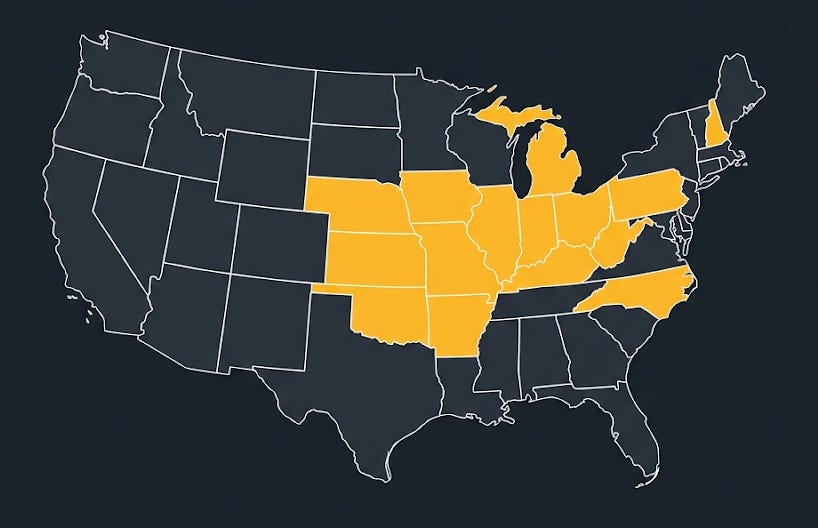
CDC is separately looking at a North Carolina cluster linked to parsley and cilantro.
There is still no positive food sample anywhere in this investigation. The link to Taylor Farms rests on traceback and patient interviews.
Et tu, Salmonella?
On July 22nd, Midwest Poultry Services recalled 1,589,577 dozen shell eggs, about 19 million, sold as Kroger, Simple Truth, Brookshire’s, Country Morning and Sunups. Ninety-eight people across 17 states are confirmed sick with Salmonella Enteritidis, and 26 have been hospitalized. Of 44 people interviewed, 40 reported eating eggs. Samples from the company’s Texas farms matched the outbreak strain by whole-genome sequencing. However, additional sources are still under investigation.
The outbreak strains appear to be resistant to ciprofloxacin and nalidixic acid. Most Salmonella infections don’t need antibiotics at all, but for those that do, the usual first-line option may not work.
Minnesota is now facing a second outbreak of Salmonella. The food source has yet to be identified. The state has reported 110 cases of Salmonella Javiana. Of 84 people interviewed, 75 had eaten at Chipotle. Chipotle found jalapeños from a common lot and pulled them, but no positive product sample has been reported. FDA opened a traceback on July 22nd covering several ingredients, and no supplier, farm, or growing region has been named. People who ate at other Mexican-style restaurants got sick too. That points to an ingredient several operators buy from the same place.
Chipotle has been here before. In 2015, Salmonella Newport sickened 64 people across 22 Minnesota locations. The food turned out to be tomatoes. The company rebuilt its whole food safety program afterward, and that rebuild is why it could find the jalapeño lot in days. Finding a lot fast is containment. Prevention happens out on the farm and in the packing house, and that’s where it keeps failing.
Why is it so hard to trace foods at the center of an outbreak?
A 2022 FDA new rule requires companies that handle foods like lettuce to keep detailed tracking records, so investigators can trace contamination to its source in about a day instead of weeks. The compliance date was originally January 20, 2026.
On March 20, 2025, the FDA announced it intended to push that date back 30 months. Six days later, Taylor Fresh Foods, the parent company of Taylor Farms, gave one million dollars to MAGA Inc., a super PAC supporting President Trump. It’s on line 17 of that committee’s mid-year filing, dated March 26, 2025. (Search the page for “Taylor.”) It was the company’s first gift to any Trump-aligned committee, and twice the largest single donation it had ever made.
Taylor Fresh Foods has written six-figure checks to Republican super PACs across four election cycles, but 2025 was a year of broad escalation. It gave another million dollars to the Congressional Leadership Fund in June, plus two more six-figure gifts. Its federal political giving that year came to $2.2 million, against $950,000 in 2024. Bruce Taylor, the company’s chief executive, is a major Republican donor personally but has never given to a Trump-aligned committee.
I don’t know whether the March donation had anything to do with the delay, and I’m not claiming it did.
In August 2025, the FDA published a proposed rule to move the compliance date to July 20, 2028. It was never finalized. But what’s actually stopping enforcement is money. Section 780 of the appropriations act that ended the shutdown, signed November 12, 2025, says no funds appropriated by that Act “may be used to administer or enforce” the traceability rule “prior to July 20, 2028.”