



A poll from the Goldwater Institute
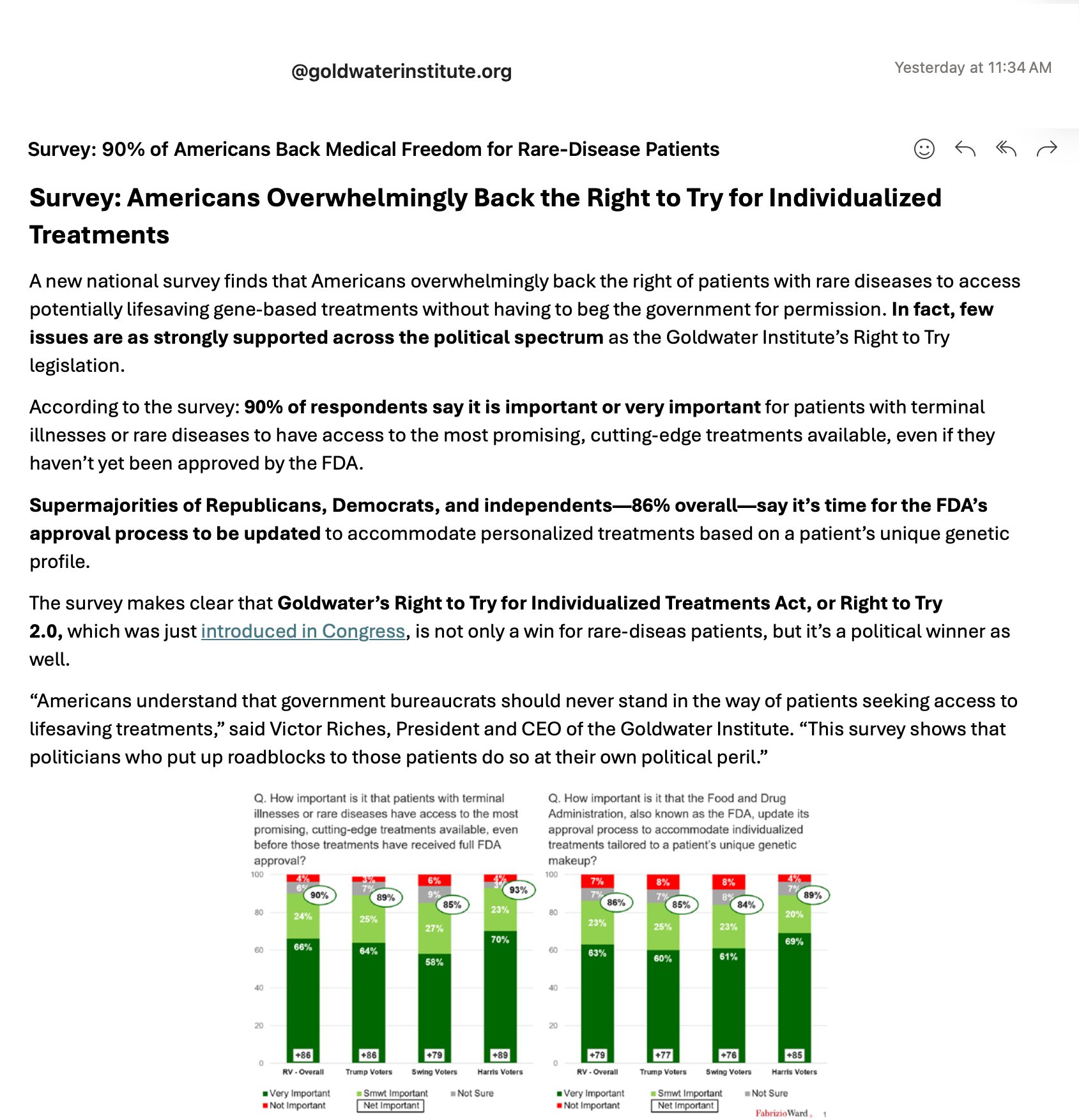
On Friday, an advocacy group emailed me a survey. The finding: 90% of Americans say it is important that patients with terminal illnesses or rare diseases reach “the most promising, cutting-edge treatments available, even before those treatments have received full FDA approval.”
The email left out a few things. The pollster, Fabrizio Ward, polls for President Trump. The sample was 1,000 registered voters, not “Americans.” And almost no one says such access is unimportant, which is the answer a question like that always gets.
The group is the Goldwater Institute, and it wants Congress to pass a bill it calls Right to Try 2.0. The survey was conducted to demonstrate popular support for the bill.
Meanwhile, last fall, Hims & Hers, the telehealth company you know from its hair-loss and erectile-dysfunction ads, started selling lab tests straight to consumers, no doctor required. One names the government as standing between you and a cure; the other, your doctor, between you and your data. They are selling the same product, and both are having a very good year.
The war being waged in American medicine.
It is a fight over control. On one side is evidence-based medicine, which says a test or a drug should be filtered by proof before anyone recommends it. On the other is a public that increasingly wants to test, treat, and prevent on its own terms: order the labs, buy the supplement, try the drug, skip the shot.
The public is winning, and not because its customers are fools. It wins for reasons my own profession would rather not say out loud.
Evidence-based medicine, on paper, already takes into account what the patient wants. But in the exam room, it often does not. People meet it as a refusal, a six-week wait, a shrug, a pathway with no time for their story. And sometimes the problem is worse than slowness. The experts are wrong. The opioid epidemic ran on “evidence”: industry-funded trials, paid specialists, and professional-society guidelines that assured doctors that pain was undertreated and the new pills rarely addicted anyone. The mainstream helped kill hundreds of thousands of people. So when someone tells you they have stopped trusting the experts, they are sometimes remembering the last time the experts, footnotes and all, were catastrophically wrong.
The real disconnect is not science versus freedom. Evidence-based medicine asks whether something works for people like you, on average, with proof. A lot of the public is asking a different question: whether they should be free to try it anyway because it fits their values; because they can afford it and what do they have to lose; or because it is the only move they have. Both are legitimate questions.
Distrust of mainstream medicine, sold two ways.
If you think mainstream medicine has grown too synthetic, too corporate, too far from nature, there is a store for you. Raw milk, the supplement stack, the parasite cleanse, castor oil in your belly button, sold as rebellion against a captured system. This is the natural-equals-safe loophole: the product must be good, because mainstream medicine doesn’t want you to have it.
If you think mainstream medicine is too slow and too low-tech, too willing to wait until you are already sick, there is a different store. Function Health will sell you a lab-testing membership, and just raised $298 million doing it. Prenuvo will sell you a $2,499 full-body MRI that doctors say offers reassurance they cannot deliver. A concierge longevity clinic will sell you the whole package. It’s all sold as optimization.
These look like opposites, the naturalist and the biohacker, but they start from the same place: mainstream medicine cannot be trusted. One decides the answer is to minimize the use of biomedical diagnostics and therapeutics, and the other, to maximize their use. Both are selling the same thing: control. One calls it natural. The other calls it data.
“Do your own research” feels like power. Researchers have also found that the more people embrace it, the more likely they are to distrust science. Both of those can be true at once. Ordering your own blood panel feels like power too, especially if the last three times you raised a symptom, a doctor waved you off. When you cannot get an appointment for six weeks, a chatbot that answers at midnight and does not make you feel small is meeting a real need. Doctors are now openly frustrated that patients arrive with results from tests they did not order and cannot easily interpret. The demand is rational. And the market is responding.
Follow the money into medicine and wellness.
The alternative to the wellness market is not clean, disinterested science either. It runs on industry money, and discloses far less of it than it should. In 2020, researchers found that 72% of the leaders of major U.S. medical associations had financial ties to industry. The professional societies that write the guidelines your doctor follows take millions from drug and device companies through conference sponsorships, satellite symposia, and educational grants. When researchers checked the authors of 2020 U.S. clinical guidelines against the federal payments database, about three-quarters had taken money from a drug or device company, though not necessarily from the makers of the drugs in their own guidelines, and only about a third disclosed it. Separately, when guideline writers do have a stake in a product, their recommendations tend to favor it.
Both sides of the wellness market — the naturalists and the biohackers — take industry money, too. Influencers are usually selling the products they’re praising, though they rarely disclose it.
What is left is method and accountability: a doctor’s industry payments are public record, a guideline can be challenged and rewritten, a bad recommendation can be pulled. None of that applies to someone ranking supplements on TikTok. The medical-freedom movement is right that you should follow the money. It just never follows it home, to the supplement seller and the think tank that wrote the bill.
The American free market in health was a policy choice.
Congress exempted supplements from drug-grade proof in 1994. It passed the first Right to Try in 2018, a law used by remarkably few patients, because the thing standing between dying people and experimental drugs was almost never the FDA. The agency already grants the large majority of compassionate-use requests. What actually stands in the way is cost, manufacturing, and whether a company thinks there’s a market for the drug and will make the drug at all.
Other high-income countries have the same distrust, the social media, the same influencers. Germany strictly controls genetic testing. Australia rejects tick-box online prescribing. They looked at the same pressure and chose guardrails. The United States has chosen to run the loosest consumer-health market of its peers.
American medicine is slow, expensive, dismissive, and occasionally captured, sending people to seek control, and there’s a market is waiting to sell it back to them at $2,499 a scan. The system offloads its failures onto the individual, sells that person the freedom to fix it, and calls it empowerment.
The Goldwater email is built the same way. Out front is a real patient, a young man with Duchenne muscular dystrophy whose situation is desperate and whose wish to name his own risk tolerance, when it is his own life, I take seriously. The science he is pointing at is real: individualized gene-based therapies do not fit a system built around large placebo-controlled, randomized clinical trials. But read the bill, and the families still pay for the treatment, the manufacturer still has no obligation to provide it, and no one can be sued if it goes wrong.
The people who invented the right to try
The right-to-try movement didn’t start with the Goldwater Institute. It started with dying gay men.
In the late 1980s, people with AIDS were handed a death sentence and told to wait years for the science to catch up. ACT UP refused, and so did the group that grew out of it, the Treatment Action Group. Activists like Mark Harrington and Peter Staley taught themselves the trial science, forced their way into the FDA and the NIH, and demanded faster access to experimental drugs. They largely won.
But they didn’t ask for a blank check. They demanded a system called parallel track: let people who couldn’t get into a study take the drug anyway, and collect data on every one of them, so the access itself produced answers. Get the drug to the dying and study what happens at the same time. They did not just want the right to try. They wanted the right to know.
They wanted it because they had seen the alternative. One AIDS drug, ddC, was approved after a trial in which twice as many patients taking it alone died in the first year as those on the older drug. Another, ddI, was waved through on a lab value bump with no proof it helped anyone live longer. For desperate people, access without answers was a second way to die. So the same activists who broke down the FDA’s door turned around and forced companies to finish the trials and replace “promising” with “proven.” Access versus answers, they called it, and they took both. That discipline is part of what produced the combination therapy in 1996 that turned HIV from a death sentence into a condition people live with for decades.
That system still exists. It is called expanded access, and the FDA clears about 99% of the requests it gets. The real bottleneck was never the government. It was drug companies that would not supply the drug, and that is the bottleneck Goldwater’s bill leaves standing.
Right to Try 2.0 keeps the access and throws out the right to know: no trial at the end of it, no data, no duty to learn anything, only a shield against being sued. We ran that experiment recently. During COVID, an expanded-access program enrolled more than 100,000 Americans to receive convalescent plasma, and the FDA authorized it based on that observational data. The U.S. largely didn’t run the randomized trials that could have shown whether it worked. We still cannot say for certain that it helped anyone.
That is access without answers, the one thing the people who invented the right to try refused to accept.