Testing troops over 30 for low testosterone.
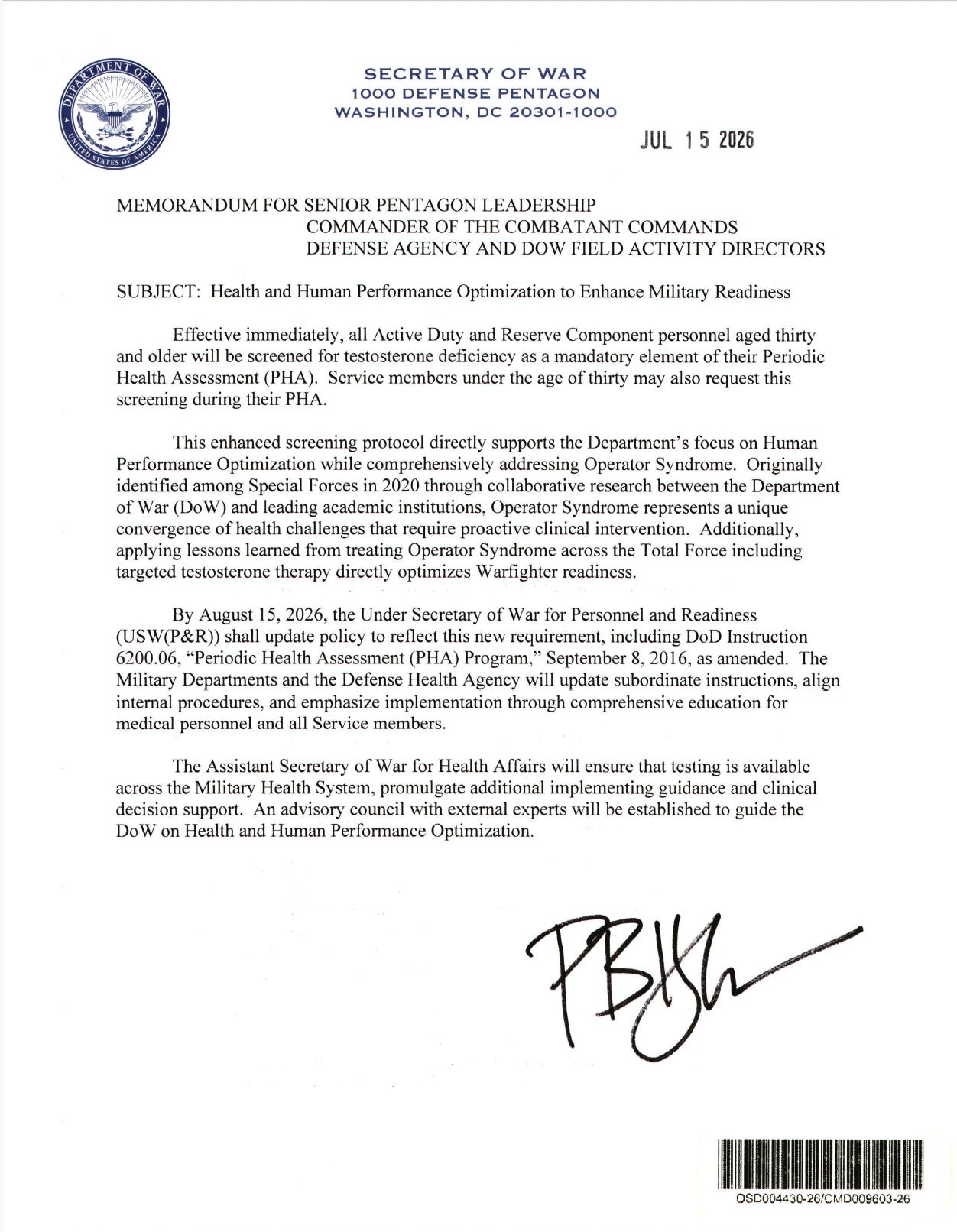
On Tuesday, the Secretary of Defense announced that the U.S. military would start drawing blood from hundreds of thousands of men to look for a diagnosis most of them don’t have.
Pete Hegseth’s new policy makes a testosterone test a required part of the annual physical for every service member 30 and older. Younger troops can opt in. Anyone who screens low can be offered testosterone replacement therapy, which Hegseth called entirely voluntary. The stated goal is “maximum psychological and mental readiness” and “the biological foundation required to sustain the fight.”
The logic is simple: Testosterone makes men strong. Strong men win wars. So test the men, fix the low ones, and win more wars.
Screening healthy people mostly just finds healthy people.
There’s a reason no medical body recommends doing this. The Endocrine Society, which writes the guidelines American doctors actually use, recommends against screening the general population for low testosterone. So does the American College of Physicians. They didn’t miss the memo on male vitality. Screen men who feel fine and most of the low readings come back from men who are fine. All the test adds is the label.
What a testosterone test can and can’t tell you.
Start with the test. One low reading doesn’t make a diagnosis, because testosterone rises and falls over the course of a day, drops when you’re sick, stressed, or short on sleep, and declines slowly with age in nearly every man. To actually diagnose the condition Hegseth is screening for, you need two low morning blood draws plus real symptoms. Low readings are common in aging men. In the largest study of the question, only about 2% had a low level together with the symptoms that define the condition. Run the test on everyone over 30 and most of what comes back is ordinary aging that a lab flagged as low.
Then there’s the treatment. The FDA put a warning on the label years ago, spelling out that testosterone is approved for men whose levels are low because of a specific medical problem, and that its benefits and safety have not been established for aging or for performance. In the one large safety trial that tracked men on the therapy, testosterone thickened their blood and raised the rate of blood clots in the lungs. (I’ve had to refer patients taking testosterone for body-building to the Emergency Department for emergency phlebotomy so they didn’t stroke out.) A companion analysis found more fractures in the treated men, which surprised the investigators. And give the hormone to a man whose own levels are normal, and his body responds by shutting down its own production. That can mean shrinking testicles and, for a man who wants children, infertility.
So the readiness policy asks healthy men to take on the risk of clots, fractures, and infertility in exchange for a benefit that, in a man who isn’t deficient, no trial has shown. Even in men who genuinely are low, the honest list of benefits is short. Testosterone reliably helps libido and lifts mood a little. It has not been shown to improve energy, focus, or physical performance. It doesn’t turn a tired 34-year-old into a sharper soldier.
Low testosterone is usually a signal, not the problem.
The announcement leaves out the most useful fact. When a man in his 30s or 40s genuinely does have a low level, it’s usually pointing at something else: extra weight, bad sleep, chronic pain and the opioids prescribed for it, heavy drinking, relentless stress. It’s often pointing to the conditions of military life. Address the weight or the sleep, and the number frequently climbs back on its own. The evidence-based approach is to treat the cause. Screening finds the number and offers a prescription, and the cause stays remains unchanged.
There was already a market waiting for this announcement. Testosterone prescribing in the U.S. climbed steeply through the 2000s, a lot of it going to men who were never properly diagnosed, until the FDA warning cooled it off. The direct-to-consumer “low T” clinics that filled the gap have spent the years since handing out testosterone in ways the guidelines don’t support. A mandatory screening program across the armed forces would be the single biggest source of new testosterone patients anyone has built.
What the screening costs, and what it can’t buy.
Now put a price on it. There are about 1.3 million active-duty troops, and since the average one is nearly 30, the mandate covers something on the order of half a million men, every year. A testosterone test runs around $85 at typical commercial prices. Screen half a million men annually, and you’re into the tens of millions of dollars before anyone is treated. The screen is the cheap part. Every man who flags low needs a second confirmatory draw and a panel of follow-up hormones, and every man who starts therapy needs the drug plus blood and prostate monitoring for as long as he stays on it, which is often the rest of his life. There’s no published cost-effectiveness analysis showing this is worth doing. The Endocrine Society looked at the question and decided it wasn’t.
And ask what that money treats. Picture a trucking company with a crash problem that decides to test every driver’s reflexes and hand stimulants to the slow ones, while leaving the 14-hour routes exactly as they are. The reflex scores come back precise and official. The routes are what’s causing the crashes. A testosterone number works the same way. It’s a real reading, and in a fit man in his 30s it’s usually a downstream signal of sleep, weight, pain, or stress rather than the problem itself. Tens of millions of dollars a year buy a lot of precise readings. It doesn’t buy sleep, weight programs, non-opioid pain care, or a therapist. The military is already short of therapists, and troops seeking care wait for them. Fifty million dollars could buy a few hundred mental health providers in clinics that don’t have enough of them.
Waste, fraud, and abuse, by the government’s own definition.
There’s a phrase this administration is fond of: waste, fraud, and abuse. The policy manages a version of all three. The waste is already here, in the tens of millions spent to screen for a condition the medical field says not to screen for. The fraud risk is the market it feeds. The modern “low T” business was built on a marketing campaign that took ordinary aging and sold it as a disease, and a share of the testosterone men actually receive comes from compounded products that aren’t FDA-approved and often don’t contain the dose printed on the label. The abuse risk is the drug itself. Testosterone is a Schedule III anabolic steroid, the same class that the Navy has begun randomly testing SEALs for. One arm of the military is working to keep steroids out. Another is preparing to hand one out through the pharmacy.
Testosterone therapy is real medicine for a smaller number of men with true hypogonadism, from Klinefelter syndrome to pituitary disease to AIDS to the aftermath of cancer treatment. Those men should get it, and many still don’t. Everyone else in the ranks is now scheduled to be tested for a deficiency the guidelines warn against screening for, and offered a drug whose own label says it won’t sharpen a healthy man. The Secretary of Defense is calling that "readiness.