Last updated on July 14, 2026 at 5:21 PM.
What the FDA stopped checking in 2025.
In April 2025, the FDA suspended a program that checks whether its own labs can correctly identify contaminants in food. The suspension was scheduled to run “at least through September 30.” One of the tests the agency said it would no longer validate was this one: detecting the parasite Cyclospora in spinach.
The reason was staffing. The Food Emergency Response Network runs proficiency testing across about 170 labs, the quality control that confirms a lab can find what it’s supposed to find. After the spring layoffs took out a quality assurance officer, an analytical chemist, and two microbiologists, the checks stopped.
So the window ran, roughly, May through September of 2025, almost exactly cyclosporiasis season. More than 90% of homegrown US cases land between May and August. The FDA said it meant to restart the program once it set up a new lab. Asked this week whether it has, the agency didn’t say.
Nearly 1,000 cases in two weeks.
By mid-June of this year, the CDC had logged 145 cases of cyclosporiasis across 17 states, with illnesses starting as early as May 1st. Median age 42. Twenty hospitalized. No deaths. A normal summer, more or less.
Then southeast Michigan happened. Between June 22nd and the morning of July 8th, the state logged 992 cases. Michigan usually sees about 50 in a whole year. The national tally is ordinary. Michigan just recorded close to twenty times its usual annual caseload in about two weeks.
What the chlorine wash misses.
Cyclospora is a parasite, not a bacterium. It spreads through fresh produce contaminated with human feces: cilantro, basil, raspberries, snow peas, bagged salads in past outbreaks. It doesn’t spread person to person, so you can’t catch it from a sick housemate. It’s treatable with an old antibiotic, Bactrim (TMP-SMX). For most healthy people it’s miserable but self-limiting, a week or two of watery, sometimes explosive diarrhea. The very young, the elderly, and the immunocompromised are the ones who get dehydrated or drag on for weeks.
There is one thing that reliably kills Cyclospora: heat. Cooking produce thoroughly breaks the parasite down. But the foods it rides on, herbs, berries, leafy greens, are goods people eat raw.
Washing your produce reduces the risk but doesn’t remove it. The parasite’s oocysts are resistant to the chlorine washes the industry uses. And that’s the trouble with the “wash your berries” as advice. It moves the responsibility onto the shopper, who can wash all day and still get infected.
Built for bacteria, blind to parasites.
The federal rule governing produce safety, the Food Safety Modernization Act (FSMA) Produce Safety Rule, leans on E. coli, a bacterium, as its fecal indicator for agricultural water. E. coli is a good proxy for bacterial contamination, but it tells you almost nothing about a chlorine-resistant parasite that can sit in irrigation water for months.
And there is no rule anywhere requiring a grower or processor to test produce or water for this parasite at all. The FDA has validated methods to do it, but they aren’t mandatory and aren’t very sensitive: in FDA validation studies, at low contamination levels, the assays detected only about half to two-thirds of contaminated produce samples. Testing is voluntary, imperfect, and therefore rarely done.
Reading the numbers honestly.
You’ll hear that cyclosporiasis cases are rising, and they have been over the last decade. But a large share of the increase is that hospitals switched to multiplex PCR panels, which are a lot more sensitive. Old stool tests didn’t include it; you had to ask. When you go looking for something you were previously missing, you find more of it. As one food safety lab director told CBS News, better testing makes the numbers “a little bit less comparable.” More detection is not the same as more disease.
The damage from a thinner CDC and FDA shows up one step later, where epidemiologists (aka disease detectives) log what people ate and figure out what was contaminated: the genotyping that links scattered clusters, the traceback that walks a contaminated salad back to a field, the state rapid response teams whose budgets were cut by around 60%. A 2025 analysis found that states with CDC food safety funding report foodborne outbreaks at up to 2-3 times the rate of states without it. That’s reporting rates, not actual disease rates. The parasite doesn’t get less common when you defund the people who track it. It just gets harder to see.
After the layoffs, the worry, one food safety advocate told TIME, is that it will “look like the country has fewer foodborne illnesses” when really the illnesses are “going unseen and undetected.”
The questions the FDA didn’t answer.
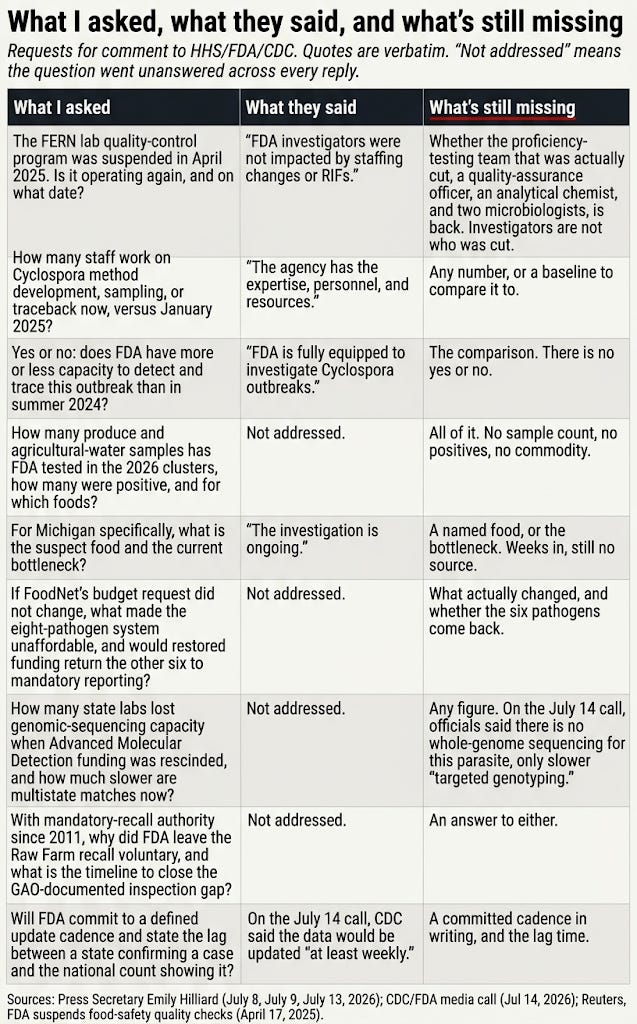
I sent the FDA a list of specific questions. Is the lab quality control program that was suspended in 2025 running again, and if so, when did it restart? Has it checked this season that FDA labs can still spot Cyclospora in produce? How many people work on Cyclospora testing and traceback now, compared to January 2025? Does the FDA have more or less ability to trace an outbreak this summer than it did in 2024, yes or no? How many produce and water samples has it tested in the 2026 clusters, and how many came back positive? For Michigan, has it found a suspect food yet, and what is slowing the answer down? And does the FDA ever require a grower to test produce or water for Cyclospora?
Here is the reply I got, in full:
“The investigation is ongoing, and the FDA and the CDC continue to monitor case counts and cluster activity. Additionally, the FDA is aware of the ongoing investigation of Cyclospora illnesses in Michigan and is engaged with state partners to assist in an outbreak response. FDA’s scientists and investigators work closely with state partners, international regulators, and industry stakeholders to drive compliance with food safety regulations.”
Emily G. Hilliard, Senior Press Secretary, U.S. Department of Health and Human Services
The FDA did not answer any of my questions. It did not give the staffing numbers, the yes-or-no on capacity, the number of samples tested, or whether the lab quality check is back up. The reply confirms two things: the investigation is happening, and the FDA is helping Michigan.
The unanswered item that matters most is the lab check. The public record shows it was down through at least September 2025. The FDA said then that it planned to restart the program once it set up a new lab. It has not said, publicly or to me, whether that happened. So as this outbreak runs, no one outside the agency can say whether the check that confirms FDA labs can spot this parasite in produce is working.
Whose job this really is.
Not you, standing at the sink. You can wash the lettuce and still get sick, because the oocysts don’t come off.
The people who can fix this are the ones who write the rules and fund the labs. A water standard that looks for parasites, since the bacterial indicator misses them. A testing requirement with teeth. Protected genotyping and traceback capacity at the CDC and FDA, the unglamorous machinery that turns “several clusters” into “stop eating this specific thing from this specific grower.” That machinery is what got thinned in 2025, and the proficiency check for finding Cyclospora is one of the things that got switched off.
A 2:19 PM EST update from the FDA
“FDA is fully equipped to investigate Cyclospora outbreaks using established epidemiologic, laboratory, and traceback tools in coordination with CDC and state partners. Protecting the nation’s food supply remains a core FDA responsibility, and the agency has the personnel and resources to investigate foodborne illness outbreaks and act when warranted.”
Emily G. Hilliard
Press Secretary
U.S. Department of Health and Human Services
My questions were specific and falsifiable; this is a general assertion of capability. with no dates, no numbers, no names. Here’s the gap, point by point.
Still unanswered:
The suspended program itself. Hilliard cites “laboratory tools” in general. She does not say whether the FERN proficiency-testing program — the one they suspended in April 2025 — is running again, or on what date it resumed. “Fully equipped” is not “the program is restored.” Proficiency testing is quality control, which is different from having lab equipment.
Any number. “Has the personnel and resources” comes with no figure and no baseline. I asked how many staff work on Cyclospora now versus January 2025.
The yes/no. I asked point-blank whether they have more or less capacity to trace an outbreak than in summer 2024. “Fully equipped” dodges the comparison entirely.
The outbreak results. Nothing on how many produce or water samples they’ve collected and tested in the 2026 clusters, how many were positive, or for which commodities. “Investigate... and act when warranted” is process language.
Michigan specifically. No suspect commodity, no bottleneck, no timeline.
The structural asks. Nothing on whether they support a parasite-specific water standard, whether they’ll ever require Cyclospora testing, or whether sensitivity research is funded in FY2026.
And a July 13th update
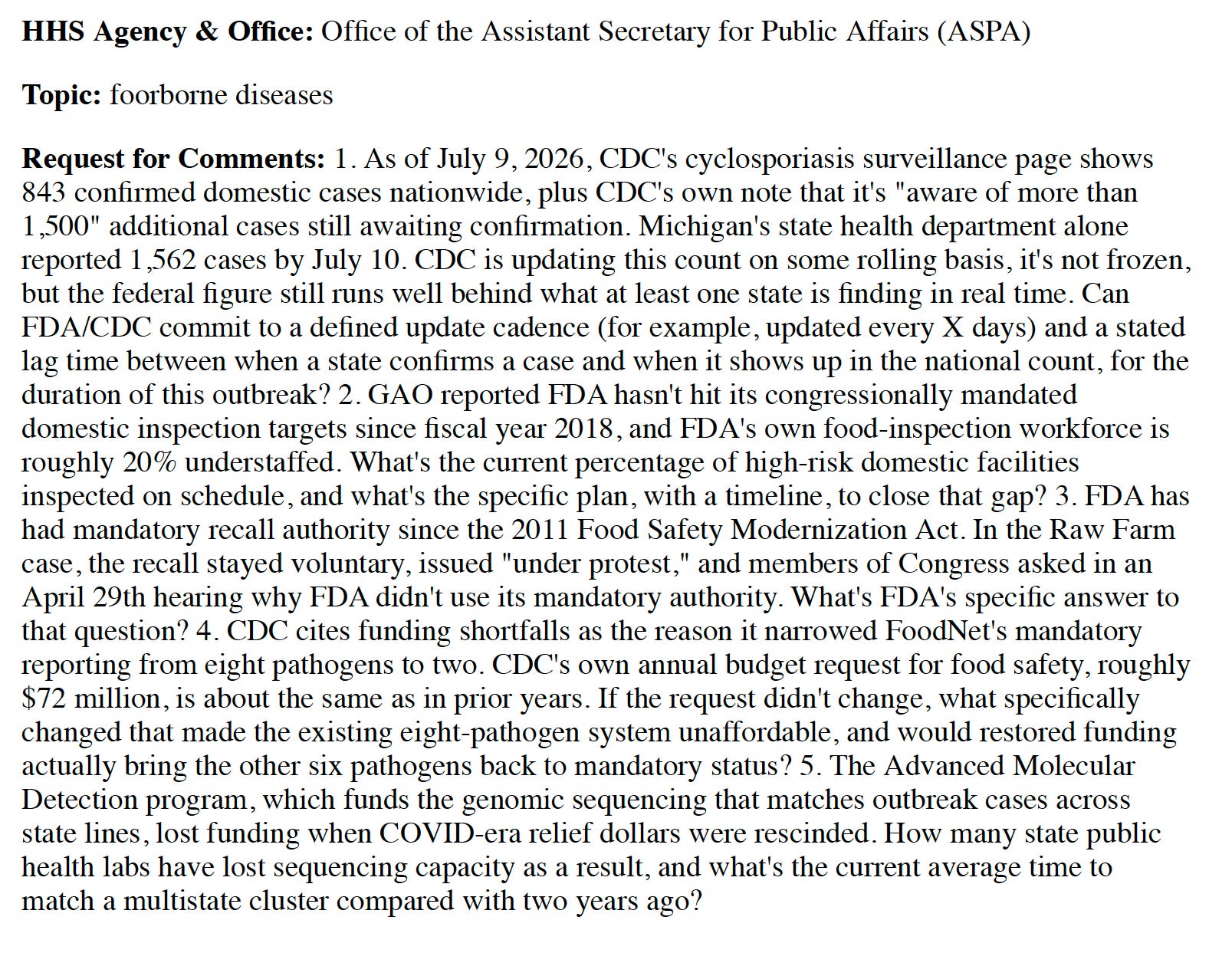
On July 11th, I sent HHS a second request for comment, and it was written to be harder to dodge: five questions, each anchored to a specific public record so that a non-answer would be conspicuous. I asked CDC to commit to a defined update cadence and to state its reporting lag; pressed FDA on the GAO finding that it has missed its congressionally mandated inspection targets since 2018; asked why, with mandatory-recall power since 2011, the FDA left the Raw Farm recall voluntary; asked what actually changed to narrow FoodNet from 8 reportable pathogens to 2 when the budget request didn't move; and asked how much genomic-sequencing capacity states lost when the Advanced Molecular Detection money was rescinded, and how much slower multi-state matches run now.
In their third reply, HHS made two concrete denials that didn’t address my specific questions. “FDA investigators were not impacted by staffing changes or RIFs” is about a job category, investigators, that isn’t the my question flagged. The documented April 2025 cut hit the FERN lab quality-control team, a quality-assurance officer, an analytical chemist, and two microbiologists. Saying investigators were spared neither confirms nor denies that. And “cyclospora tracking never stopped” answers a claim I didn’t make: my point was about the lab check that validates detection and the absence of any testing requirement, not that case-counting halted. Case tracking and lab quality-control are different things.
They still didn’t answer my specific questions: no staffing count, no sample results, no yes-or-no on capacity versus 2024, nothing on whether the FERN proficiency-testing program is running, and no named food.
Under the leadership of Secretary Kennedy, FDA is currently investigating Cyclospora outbreaks using established epidemiologic, laboratory, and traceback tools in close coordination with CDC and state and local partners. Protecting the nation’s food supply is a core FDA responsibility, and the agency has the expertise, personnel, and resources necessary to detect, investigate, and respond to foodborne illness outbreaks and take regulatory action when warranted. Additionally, FDA investigators were not impacted by staffing changes or RIFs.
To be clear, cyclospora tracking never stopped. CDC is actively working with 3,000 health departments to gather data.Emily G. Hilliard
Press Secretary
U.S. Department of Health and Human Services


What I asked, what they said, and what’s still missing