


The reversal
The FDA spent years rejecting flavored vaping products. Teen vaping dropped to a 10-year low. Then the president had lunch with tobacco executives at his golf club, and the agency reversed course.
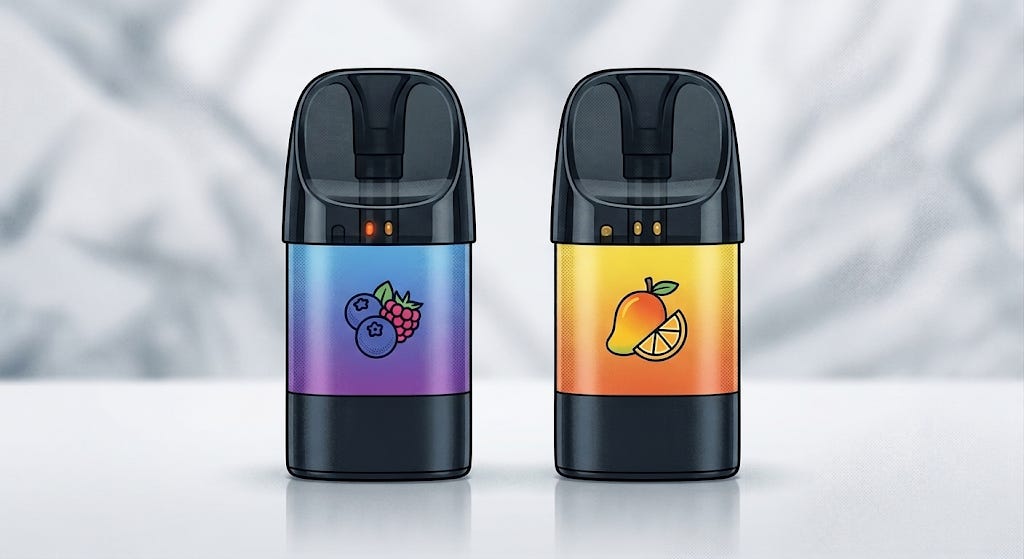
On May 5, the FDA cleared fruit-flavored e-cigarettes for the first time, giving the go-ahead to mango and blueberry pods made by Glas, a Los Angeles company. The move came days after the Wall Street Journal reported that President Trump had scolded FDA chief Marty Makary for not moving fast enough on flavored vapes.
Within a week, the FDA put out new rules that could let the big tobacco companies sell their own flavored products, a slice of the $6 billion e-cigarette market. Then Makary resigned.
This is what it looks like when industry captures a regulator. Not one big moment, but a sequence: donations, firings, pressure from the top, and a federal agency bent away from its own science.
Follow the money
The tobacco industry invested heavily in this presidency.
RAI Services, part of British American Tobacco, gave $10 million to the Make America Great Again super PAC. Altria gave $1 million to the same PAC and $1 million to Trump’s inauguration fund. Both chipped in for the president’s White House ballroom, a roughly $300 million build funded by corporate donors.
The Vapor Technology Association gave $1.25 million to the inauguration fund. Philip Morris put in $500,000. Juul gave $1 million.
And money didn't just come from the tobacco industry. It came from the company whose product the FDA cleared. Phillip Sarofim, founder and CEO of Trousdale Ventures, which is an investor in Glas, gave $1 million to Trump's inauguration. It was his largest political donation and his first in many years. The Sarofim family is a longtime Republican donor. In 2016, the family gave $530,000 to presidential campaigns and super PACs, placing them among the top 158 donor families tracked by the New York Times.
Then, the New York Times reported, Reynolds executives and Altria lobbyists sat down to lunch with the president at his Jupiter, Florida golf club on the first Saturday of May — days before the Glas decision. Lobbyists from Ballard Partners, which works for Reynolds, were there too.
These donations were public. They were filed with the FEC, covered by reporters, tracked by watchdog groups. What followed was a string of wins for the industry.
Gutting the guardrails
Money alone doesn’t change federal policy. You also need to get rid of the people who might push back.
The head of the FDA’s tobacco office was fired. Most of the CDC’s smoking prevention staff were cut. A former tobacco executive was placed in a senior CDC role. The CDC’s Tips From Former Smokers campaign — credited with helping roughly one million Americans quit smoking — was effectively killed when its paid ads were set to stop airing after September 2025.
These moves were not random. They took out the people who knew the science and would have slowed or blocked the Glas decision and the broader rules that followed. Remove the experts who built the record, and the record gets easier to ignore.
The science they overrode
The FDA’s own staff said in February they needed more time to review the Glas application. The agency had spent years building a record of rejections — more than a million flavored products denied — based on one clear finding: flavored e-cigarettes attract kids.
The data backs that up. Nearly 90% of teen vapers use flavored products. Fruit is the top pick, used by 63% of youth vapers. Mango was one of the Juul flavors that drove the first teen vaping wave before it was pulled.
Two large studies — a 2021 review in BMJ Open and a 2025 analysis in Tobacco Control — found that young people who vape are about three times more likely to start smoking regular cigarettes, even if they never smoked before.
Vaping itself causes real harm: higher rates of asthma, chronic lung disease, high blood pressure, and heart attack, per a 2023 American Heart Association report. Nicotine hooks people fast, and teen brains are more prone to getting hooked. Long-term risks, including cancer, are still not known.
The FDA’s legal bar for clearing a tobacco product isn’t “is it safe?” It’s whether the product is “appropriate for the protection of public health,” weighing the gains for adult smokers against the risks for everyone else, especially kids. The agency had found, again and again, that fruit flavors failed that test.
Then the president called.
A technology with no track record
The FDA based the Glas decision mainly on one feature: the device requires a government ID scan and pairs with the user’s phone by Bluetooth. If the age check fails, the device won’t turn on.
It’s a clever design. It’s also untested at scale. No one knows what happens when these products reach millions of users, when teens borrow devices paired to older siblings’ phones, or when hacks spread online.
The Campaign for Tobacco-Free Kids put it bluntly: the FDA should not bet on untested tech to keep kids from getting hooked on nicotine.
The bigger question is who polices the rules. The same White House that cleared the path also fired the people who would have tracked whether the safeguards work.
Why health groups disagree
The opposition was broad.
The American Academy of Pediatrics called the decision a major setback. AAP president Andrew Racine said it threatens to reverse recent progress in keeping kids from these products and leaves pediatricians “deeply alarmed” that fruit-flavored vapes will end up in young people’s hands.
The American Lung Association condemned it outright. ALA president Harold Wimmer said the FDA is ignoring its own evidence. Flavored e-cigarettes, including Juul’s mango pods, helped push youth vaping rates to 20%. Proven policies like flavor bans and public education campaigns then drove a 70% drop in youth e-cigarette use from 2019 to 2024. The ALA warned the FDA is placing “far too much faith” in unproven age-check tech to justify clearing kid-friendly flavors.
The ALA also pointed to the gutting of the CDC’s Office on Smoking and Health, the very office that tracked youth vaping trends and helped young people quit.
The Campaign for Tobacco-Free Kids warned the decision could spark another wave of teen vaping. But the Truth Initiative struck a different tone, calling the Glas decision a real test of whether age-gating can keep products away from kids while giving adult smokers a way off cigarettes.
That split shows a real tension. Regular cigarettes kill roughly 480,000 Americans a year. If the age-check tech works, flavored e-cigarettes could help some adult smokers switch to a less harmful product. The possible gain is real.
But the question is not just whether age-gating can work in theory. It’s whether a White House that took millions from the tobacco industry, fired the watchdogs, and stepped in to speed the decision has any plan to enforce the rules if the tech fails.
What this is really about
The Glas decision is small: four pods from one company. The real prize is the broader FDA guidance that followed, which could let Altria, Reynolds, and other big tobacco companies bring their own flavored products to market.
That guidance didn’t come from a science review. It came from a sequence: millions in donations, a lunch at a golf club, a phone call to the FDA chief, a resignation, and a new policy.
The people who work in tobacco control built the system — the staff, the data, the legal record — to block exactly this outcome. That system was taken apart by people who had every reason to want it gone.
The FDA cleared these products. That does not mean they are safe. And it does not mean the process that got them there was clean.
This post featuring experts from MUSC's Hollings Cancer Center may be of interest to readers of this story:
https://hollingscancercenter.musc.edu/content-hub/News/2026/06/02/promise-and-risk-the-debate-over-flavored-ecigarette
https://substack.com/@joegitchell/note/c-258907444?utm_source=notes-share-action&r=tbkzj