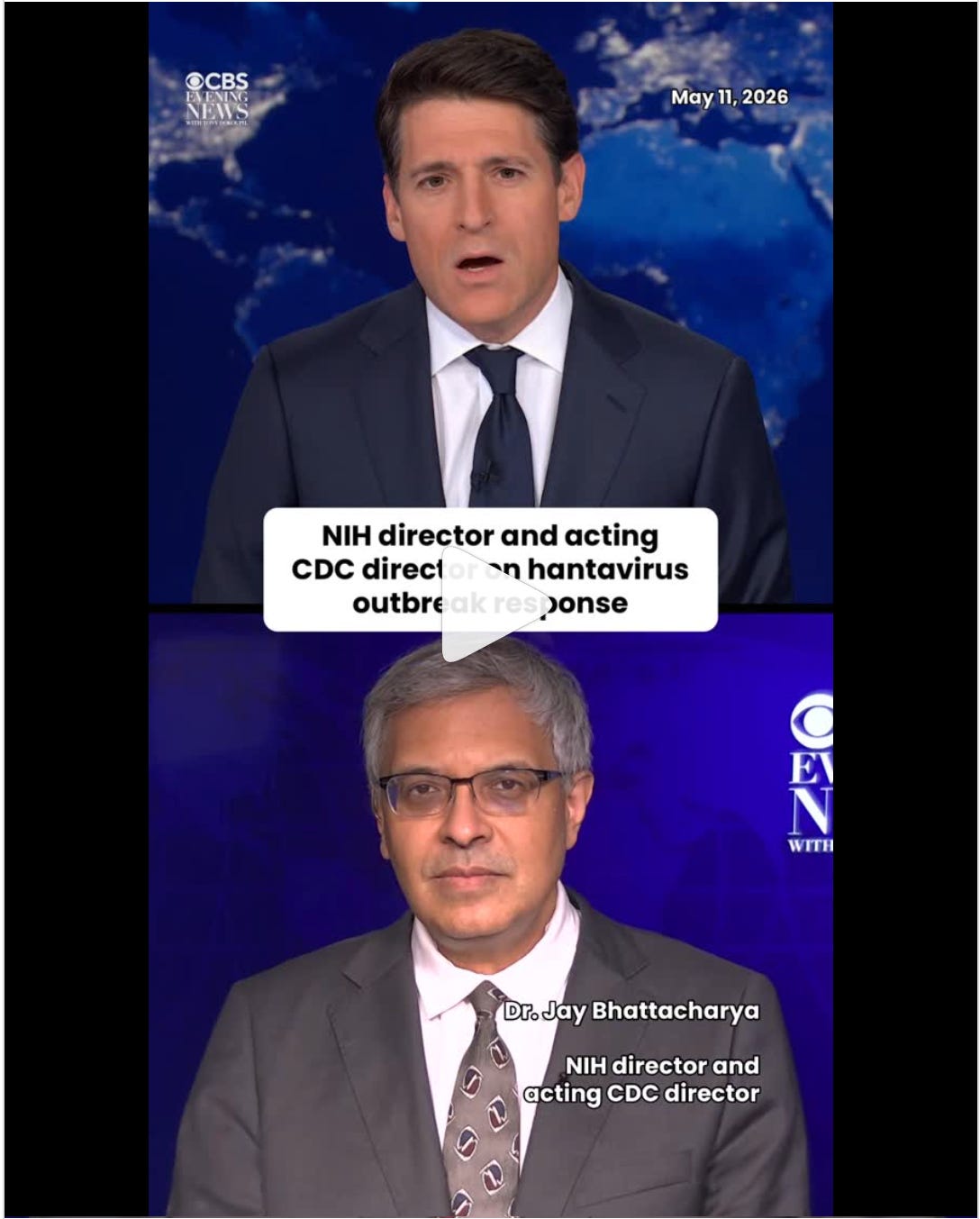
What the director said vs. what the staff have been told
Yesterday on CBS Evening News, Dr. Jay Bhattacharya, the NIH director and acting CDC director, said CDC staff can work with the World Health Organization again. No waivers. No restrictions. Not just for emergencies, but for everything.
Inside the CDC, thirty-five out of thirty-six staff informed me they’d received no such update. Their last guidance: waivers were still required or communication was simply not allowed. One described the current process for getting permission to engage with WHO as seventeen emails deep, with no answer at the end. Only one person reported that they were working normally without need of a waiver.
“Nothing has changed,” one CDC employee wrote. “We are in the same stance.”
This would be notable on its own. It is part of a pattern that now defines how the CDC is run, or, more precisely, how the CDC is described in public versus how it operates in practice.
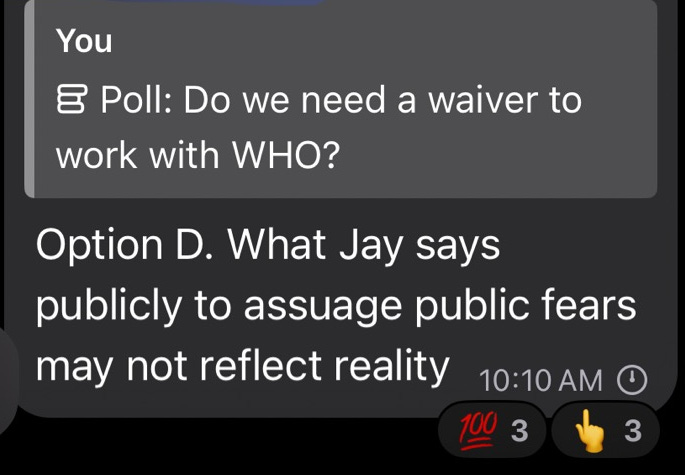
WHO restrictions: lifted on TV, enforced in practice
The United States formally withdrew from the World Health Organization on January 22, 2026, completing a process that began with President Trump’s executive order a year earlier. During that year, the U.S. stopped funding WHO, recalled all personnel embedded with the organization, and began handling global health work through direct country-to-country deals instead.
For CDC staff, the withdrawal came with rules. Anyone who wanted to engage with WHO — attend a meeting, join a call, share data — needed approval. In practice, that approval process was slow, opaque, and, according to multiple staff, functionally designed to produce the word “no” without ever saying it.
Staff in at least one division were fired for working with WHO after the withdrawal notice went out. They won their cases before the Merit Systems Protection Board and were reinstated. But the message landed.
“People in our division were fired for theoretically working with WHO after the withdrawal notice,” one CDC employee said. “Until we hear officially that something has changed, we will not be working with them again.”
When Bhattacharya said the restrictions were gone, his own employees had to figure out whether the policy was real by polling each other. Thirty-two checked in. All thirty-two said they’d heard nothing. One suggested, half-seriously, that colleagues could just attach the Instagram clip to their internal request as documentation.
The hiring freeze that isn’t a freeze
Bhattacharya has also said there is no hiring freeze at the CDC. He told staff the agency is “open for business” and looking to “shore up some of the gaps” left by the loss of roughly a quarter of its workforce over the past year.
CDC employees describe something different. Staff say they cannot even transfer to funded, open positions within the agency — lateral moves that don’t add headcount or cost. This has been the case for more than a year. The agency’s human resources staff were moved to a centralized HHS office as part of the department’s 2025 reorganization, and the HR operation has been described as overwhelmed, unable to process routine personnel actions.
NIH, by comparison, is posting jobs and giving priority hiring status to staff who were let go in the reductions in force. CDC is not. Jobs listed on USAJobs for CDC do not prioritize separated staff the same way.
An estimated 300 people remain on administrative leave, many of them from programs Congress specifically funded — chronic disease prevention, maternal health, vaccine education. The money is there. The positions are authorized. The people who used to fill them are sitting at home, drawing paychecks, doing nothing, because the agency cannot or will not process their return.
Then there are the Title 42 staff — scientists hired under a special authority that allows the CDC to recruit and retain top researchers on renewable terms, sometimes for decades. This year, all renewals require HHS approval. The result is that scientists whose programs want to keep them are being functionally fired by HHS, often despite strong performance or critical program need. Some find out they’ve been renewed on their last day. Many hold out hope and it never comes. Some divisions have stopped advocating for renewals altogether and told their Title 42 staff to start looking for new jobs before their terms expire.
In practice, there is no hiring freeze. There is also no hiring. And the staff the CDC already has are being slowly bled out through expiring appointments that no one will approve.
The communications pause that isn’t a pause
In January 2025, the Trump administration ordered a communications pause across federal health agencies. CDC couldn’t update its website, release case numbers, issue health advisories, post on social media, or meet with external partners. The pause was supposed to last until February 1, 2025.
Bhattacharya has said the pause is over. CDC staff describe something closer to a permanent bottleneck. All external communications must be cleared by HHS or a political appointee. For some groups, this amounts to a functional pause — not because a memo says communications are frozen, but because the clearance process is slow enough that timely communication becomes impossible.
The result is the same as the pause. It just doesn’t have the same name.
The money that doesn’t move
Congress appropriated money for CDC programs. That money is not going out the door. Grants are delayed. Award announcements aren’t being prepared. When they do get released, applicants — state health departments, universities — get compressed timelines to apply.
In January 2026, the administration briefly paused more than $5 billion in public health infrastructure grants to states, then reversed the pause within 24 hours. The White House began apportioning CDC’s budget on a month-by-month basis, citing the need for external reviews. Unobligated funds will expire on October 1.
Taxpayer money, appropriated by Congress for public health, is sitting in accounts. The staff who would spend it are on leave. The systems that would process it are centralized and backlogged. The grants that would distribute it are delayed. The result is not a cut. Congress didn’t cut the funding. It is something quieter: money that exists on paper but does nothing in the world.
The pattern
Bhattacharya told CDC staff his goal was to take politics out of public health. He wasn’t able to explain what the politics in public health at CDC supposedly were. The next day, he spoke at CPAC.
The pattern is consistent. Say there is no hiring freeze while hiring is frozen. Say communications are flowing while clearance requirements choke them. Say WHO restrictions are lifted while staff still need seventeen emails to get a non-answer. Say the money is there while it sits unspent.
None of these are lies in the narrow, technical sense. There may be no memo titled “Hiring Freeze.” There may be no document labeled “Communications Pause” still in effect. Bhattacharya may believe, when he speaks to a CBS News anchor, that CDC staff can work with WHO. But the people inside the agency describe a reality that the director’s public statements do not touch.
The effect is a kind of governance by announcement. The policy is whatever the director says on television. The operations are whatever the bureaucracy enforces. And the two aren’t connected.
For an agency whose core job is to tell the public what is true about disease, this is not a small problem. If the CDC’s own director can announce a policy that his own employees don’t recognize, the agency’s ability to communicate reliable information, about anything, is worth questioning.