


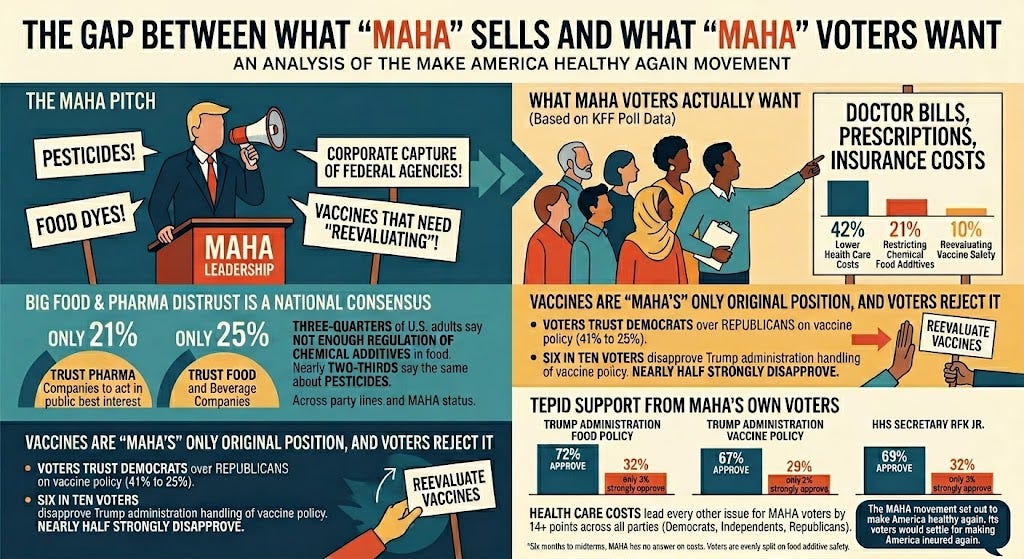
Everyone distrusts Big Food and Big Pharma. MAHA didn't start that.
Vaccines are MAHA’s only original position, and voters reject it.
Six months to the midterms, and MAHA has no answer on costs.
The gap between what MAHA sells and what MAHA voters want.
The Make America Healthy Again movement has a theory about what’s wrong with American health. It involves food dyes, pesticides, corporate capture of federal agencies, and vaccines that need “reevaluating.” It does not, as far as I can tell, involve the price of going to the doctor.
This is a problem. Because when you ask MAHA’s own voters what they most want the government to do about health, 42% say lower the cost of health care. Restricting chemical food additives comes in at 21%. Reevaluating vaccine safety lands at 10%.
The movement’s flagship issue finishes second by a two-to-one margin among the movement’s own supporters. Its most controversial issue barely registers.
These findings come from KFF’s April 2026 Health Tracking Poll, which surveyed 1,343 U.S. adults and offers the clearest picture yet of what MAHA supporters actually care about and how far that is from what MAHA’s leaders are talking about.
Everyone distrusts Big Food and Big Pharma. MAHA didn’t start that.
About 41% of U.S. adults say they support the MAHA movement. Among voters, the number is 43%. The coalition skews Republican: two-thirds of MAHA supporters identify as Republican or Republican-leaning, and a majority of MAHA voters also back the MAGA movement.
But here’s what makes the poll interesting. The concerns MAHA has raised — food additives, pesticides, and corporate influence over health agencies — are not MAHA's concerns. They’re everyone’s concerns.
Three-quarters of U.S. adults say there isn’t enough regulation of chemical additives in food. Nearly two-thirds say the same about pesticides. These majorities hold across party lines and across MAHA status. Democrats, Republicans, independents, MAHA supporters, non-supporters — they all agree.
Only 21% of adults trust pharmaceutical companies to act in the public’s best interest. Only 25% trust food and beverage companies. Only 36% have confidence the FDA acts independently. These numbers are low across the board, regardless of whether someone supports MAHA.
So the food safety agenda isn’t a MAHA position. It’s a national consensus that MAHA is trying to claim.
Vaccines are MAHA’s only original position, and voters reject it.
Where MAHA does break from the mainstream is vaccines. And that’s exactly where the public breaks from MAHA.
The KFF poll finds that voters trust Democrats over Republicans on vaccine policy by 41% to 25%. Six in ten voters disapprove of the Trump administration’s handling of vaccine policy. Nearly half strongly disapprove.
This tracks with KFF’s earlier findings on CDC trust, which showed trust in the CDC at its lowest point since COVID. The public viewed HHS’s changes to the childhood vaccine schedule negatively by a two-to-one margin. Even among parents who’d heard about the changes, more said they’d hurt children’s health than help.
A KFF/Washington Post survey of parents added detail: 85% of parents support more regulation of food dyes and additives, cutting across party lines. But MAHA parents are more vaccine-skeptical. 58% lack confidence in the CDC and FDA on vaccine safety.
The pattern is consistent. The food safety stuff is popular because it’s already popular. The vaccine stuff is MAHA’s own contribution. And the public doesn’t want it.
MAHA’s own voters aren’t especially moved by MAHA.
You might expect MAHA voters to rally behind the movement’s signature figures and policies. They do… sort of.
About 72% of MAHA voters approve of the Trump administration’s handling of food policy. But only 32% “strongly approve.” On vaccine policy, 67% approve, but just 29% strongly approve. On HHS Secretary Robert F. Kennedy Jr.’s job performance, 69% approve, but again, only 32% strongly approve.
In each case, the share of MAHA voters who disapprove is roughly equal to the share who strongly approve. KFF calls these “fairly tepid ratings for a group that aligns with Kennedy’s signature movement.” That is a polite way of saying the movement’s own base is not especially moved.
Healthcare costs lead every other issue for MAHA voters.
At least half of MAHA voters say health care costs will have a “major impact” on whether they vote in the midterms (51%) and which party’s candidate they support (56%). Those numbers are higher than the share who say the same about vaccine policy (36% and 40%) or food safety (43% and 45%).
This is consistent across the MAHA coalition regardless of party. Among MAHA-supporting voters, 57% of Democrats, 43% of independents, and 40% of Republicans say lowering health care costs is their single most important health priority. For each group, costs lead the next item by at least 14 points.
And it isn’t just MAHA voters. KFF’s earlier April tracking data found that health care costs are voters’ top economic concern heading into the midterms: 55% say costs will have a major impact on whether they vote, 61% on who they vote for. Democrats hold a double-digit trust advantage on health care costs (40% vs. 27%). And 67% of the public says Congress did the wrong thing by not extending the ACA’s enhanced tax credits, a live pocketbook issue that affects millions of people’s insurance premiums right now.
The MAHA movement has no position on any of this.
Six months to the midterms, and MAHA has no answer on costs.
When MAHA supporters are asked, in their own words, why they support the movement, the most common answers are wanting people to be healthier (19%) and removing harmful substances from food (15%). Only 5% mention health care access and affordability. Just 4% mention vaccines.
So even the movement’s self-described purpose doesn’t match its political agenda. Its supporters want a healthier population. Its leaders are focused on vaccine schedules and food dye bans. And the thing that would most affect the health of the population — whether people can afford to see a doctor, fill a prescription, or keep their insurance — isn’t on the agenda.
With six months until the midterms, voters already trust Democrats more than Republicans on health care costs, vaccine policy, and keeping federal agencies independent of corporate influence. Voters are evenly split on food additive safety, the one area where MAHA has the closest thing to a foothold.
The MAHA movement set out to make America healthy again. Its voters would settle for making America insured again. Nobody’s offering that.