


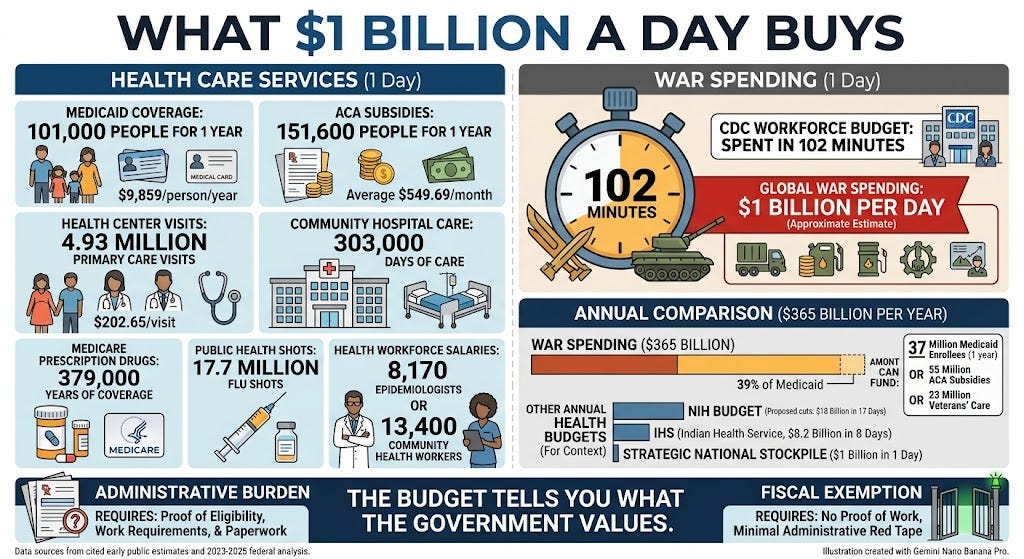
Fiscal responsibility has a $1 billion per day blind spot.
I was listening to the New York Times’ The Headlines this morning and heard an early estimate that the United States is spending roughly $1 billion a day on the war in Iran. That got me thinking.
The One Big Beautiful Bill Act, signed in July 2025, cut $911 billion from Medicaid over the next decade. CBO and KFF analyses project that the law will increase the number of uninsured people by about 10.9 million by 2034, with roughly 7.5 million of that coming from Medicaid changes.
The law added work requirements for some Medicaid expansion adults, tightened eligibility and verification rules, restricted some immigrant access to coverage subsidies, and limited state financing mechanisms used to support the program. The stated reason was fiscal responsibility.
So here is a useful exercise. What does $1 billion actually buy in American health care?
What $1 billion buys in health care.
At today's costs, $1 billion is enough to cover about 101,000 people on Medicaid for a full year at about $9,859 per person per year, based on 2023 federal data.
The same $1 billion covers roughly 151,600 people’s ACA insurance premium subsidies for a year, based on the average advance premium tax credit of $549.69 per month reported by CMS in early 2025. Those enhanced subsidies are scheduled to expire at the end of 2025 unless Congress acts to extend them.
One billion dollars also buys about 4.93 million primary care visits at a federally qualified health center, using the 2025 Medicare payment rate of $202.65 per visit. Or 303,000 days of care in a community hospital. Or 379,000 years of Medicare prescription drug coverage. Or 17.7 million standard flu shots. Or the salaries of 8,170 epidemiologists or 13,400 community health workers or 7,330 registered nurses — for a year.
Those are daily figures. One day of war, converted into health care.
The war spends the CDC's workforce budget in 102 minutes.
Now multiply by 365. $365 billion per year is about 39% of total annual Medicaid spending. It is roughly a third of Medicare. It is 7% of all U.S. health spending. It could fund 37 million people on Medicaid for a full year, or 55 million people's ACA health insurance subsidies, or 23 million veterans' health care for a year. These are not hypothetical line items. Coverage subsidies and beneficiary payments flow through existing federal and state channels: Medicaid claims systems, ACA Marketplaces, and VA facilities.
For context, the entire Medicaid unwinding after the pandemic stripped coverage from about 25 million people. One year of war spending is large enough, in budget terms, to cover the cost of restoring coverage for tens of millions of people.
Now consider the agencies being cut. The CDC’s total budget in fiscal year 2024 was $9.22 billion. One year of war spending equals about 40 CDC budgets. Assuming a $71 million CDC public health workforce funding line, then $1 billion a day in war spending would equal that amount in about 102 minutes. The war spends that in about 102 minutes. The administration’s proposed fiscal year 2026 budget would have cut NIH by nearly $18 billion, roughly 40% of its funding. The war spends that much in 17 days.
The entire annual budget for the Strategic National Stockpile — the federal reserve of drugs, vaccines, and medical supplies meant to protect Americans in a crisis — is $1 billion. BARDA, the agency that develops medical countermeasures against chemical, biological, radiological, and nuclear threats, runs on $1.05 billion a year. Also one day. The Hospital Preparedness Program gets $240 million a year. The war burns through that by lunchtime. The entire HRSA Health Center Program — which funds community health centers serving more than 32 million patients — runs on $6.12 billion. About six days.
The Indian Health Service, which provides care to 2.8 million American Indians and Alaska Natives, operates on about $8.2 billion a year, roughly $2,900 per patient. At current war spending, the entire IHS budget is covered in eight days. Doubling it would cost another eight.
The VA health care system serves 9.1 million enrolled veterans across 1,380 facilities on about $118 billion a year. The PACT Act created a $12 billion funding shortfall in fiscal year 2025, requiring emergency supplemental appropriations. The war covers that shortfall in 12 days.
Only one of them makes you prove you deserve help.
At $911 billion over ten years, the OBBBA represents an extraordinary reduction in Medicaid funding and one of the largest cutbacks in the program’s history. KFF has concluded that the law would reverse major coverage gains associated with the ACA.
At $365 billion a year, the war in Iran will cost roughly $911 billion in two and a half years. The decade of Medicaid austerity and the war exist on the same fiscal timeline, but only one of them came with a formal public estimate of how many people would lose health coverage. Only one imposes work-reporting and recurring eligibility burdens on people seeking care. Only one triggers work-reporting requirements and 90-day redetermination cycles. Only one requires a person to prove, repeatedly, that they deserve the money.
The budget tells you what the government values.
National health spending hit $5.3 trillion in 2024 and is projected to reach $8.6 trillion by 2033. The Medicare Hospital Insurance Trust Fund is projected to be depleted in 2033. The uninsured rate rose in 2024 for the first time in five years. HHS is being reorganized and downsized — about 20,000 positions eliminated, HRSA and SAMHSA folded into a new agency, and about $1 billion in SAMHSA mental health and substance use programs proposed for elimination.
The argument for all of this is the same: we cannot afford it.
But $365 billion a year is going to a war, with no estimate of who loses coverage, no proof of work, and no forms to fill out. The constraint was never money. It’s what we value.
Instead of 37 million Medicaid enrollees or 1.8 billion primary care visits or 6.5 billion flu shots or 365 years of the Strategic National Stockpile, $1 billion buys a war. Every day, for $1 billion, with no paperwork required.