


The smoke problem the Clean Air Act was never designed to handle.
Children are the population most biologically vulnerable to air pollution.
Southern California proved that cleaner air builds bigger lungs.
AI infrastructure is being sited in communities already overburdened by pollution.
The law that made American air breathable is under siege from climate and policy.
One city left with clean air.
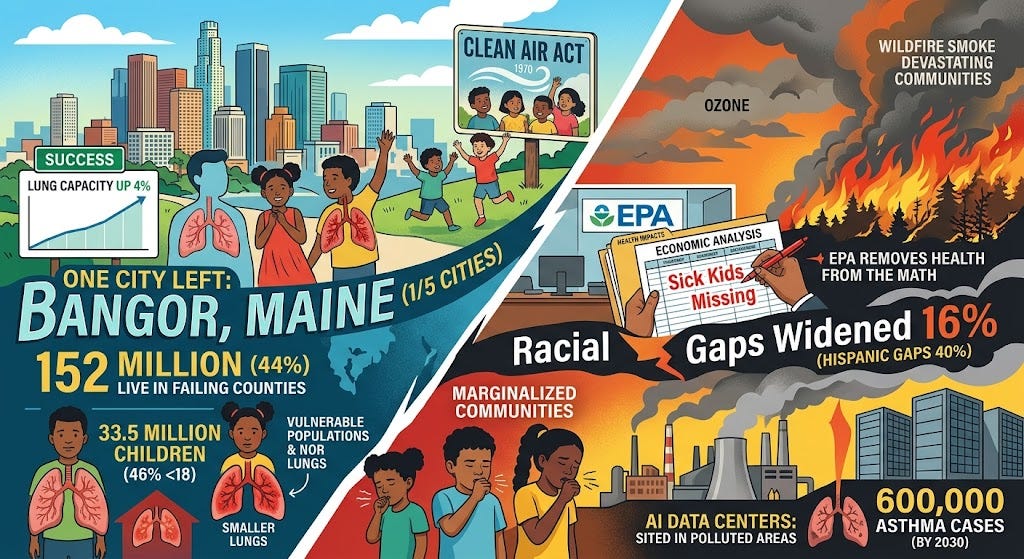
Two years ago, five American cities earned clean grades on all three major air pollution measures. This year, one did. It’s Bangor, Maine.
The American Lung Association released its 27th annual "State of the Air" report today, Earth Day, and the picture is simple. Air quality in the United States is getting worse.
Some 152 million people live in counties that failed at least one air pollution measure. That’s 44% of the country. Among them: 33.5 million children, or 46% of everyone under 18. More than 7 million kids live in places that failed all three.
The Clean Air Act worked for half a century.
For half a century, the Clean Air Act was one of the clearest success stories in American public health. The EPA estimated its 1990 amendments alone would prevent over 230,000 early deaths and 2.4 million asthma attacks per year by 2020, with benefits outweighing costs by more than 30 to 1. Air got cleaner. Lungs worked better. Children in Southern California saw their rates of clinically low lung function drop from nearly 8% to under 4% as pollution fell.
That progress is now reversing.
The number of people living in counties with unhealthy ozone — the lung-searing gas also known as smog — rose by nearly 4 million over last year’s report. More than 129 million Americans now live in areas that earned an F for ozone. The trend is driven by two forces arriving at the same time: a climate that produces more wildfire smoke and extreme heat, and a federal agency that has chosen this moment to step back.
The smoke problem the Clean Air Act was never designed to handle.
Wildfire smoke is now a dominant force in American air quality. A 2023 study in Nature found that smoke has stalled or reversed PM2.5 improvements across the country, especially in western and midwestern states. Researchers estimate that climate change contributed to roughly 15,000 wildfire-related pollution deaths in the U.S. over 15 years. Under a high-emissions scenario, one projection puts annual smoke-related deaths at over 70,000 by 2050.
This would be a reasonable moment to strengthen protections. The EPA has done the opposite.
The EPA removed health from the math.
Over the past year, the agency has weakened enforcement of clean air rules and rolled back regulations on power plant and vehicle pollution. It has also taken a step that sounds bureaucratic but is structurally devastating: the EPA removed health-related information from its economic analyses of regulatory changes. This means the costs of air pollution to children, families, and communities will no longer be counted when the agency decides whether to weaken or eliminate a rule.
Put plainly: the agency has changed the math so that sick kids don’t show up in it.
Children are the population most biologically vulnerable to air pollution.
Children are not a minor footnote in air pollution science. They are the population most biologically vulnerable to it. Their lungs are still growing. They breathe more air relative to their body size than adults. They spend more time outside. Exposure during childhood doesn’t just cause symptoms — it causes lasting damage. The research is extensive and consistent.
PM2.5 — the fine soot that comes from wildfires, diesel engines, power plants, and wood stoves — penetrates deep into the lungs and, in children, can cross into the brain through the olfactory bulb. A meta-analysis of six studies found that each 1 microgram per cubic meter increase in PM2.5 was linked to a loss of about 0.27 IQ points. That’s a small number per child. Applied to 33.5 million children breathing failing air, it’s a population-level cognitive toll.
Traffic-related pollution — particularly nitrogen dioxide — is a major driver of childhood asthma. A global burden study estimated 4 million new cases of childhood asthma per year linked to NO2, with 64% in cities. In the U.S., a large cohort study found that PM2.5 and NO2 exposure in the first three years of life was tied to asthma by early childhood.
Southern California proved that cleaner air builds bigger lungs.
Southern California's Children's Health Study tracked kids from age 10 to 18 and found that those growing up in more polluted communities reached adulthood with measurably smaller lungs. When the air later improved, the next generation’s lung function improved too. The biology responded to the policy. It will also respond to its absence.
There is also this: the air you breathe depends heavily on who you are.
Racial gaps in pollution deaths widened 16% in a decade.
People of color in the U.S. are more than twice as likely as white individuals to live in a county that fails all three air pollution measures. Hispanic individuals are more than three times as likely. A 2021 study in Science Advances found that Black and Hispanic Americans bear 56% and 63% excess PM2.5 exposure relative to their share of consumption-driven emissions. The disparity holds across income levels and geography. A 2022 study of public schools found that students from marginalized racial and ethnic groups face consistently higher NO2 and PM2.5 at school — the place where children spend most of their waking hours.
These gaps have not closed with time. National PM2.5 levels have fallen, but the most polluted neighborhoods in 1981 were still the most polluted in 2016. And between 2010 and 2020, racial disparities in PM2.5-linked premature deaths widened by 16% overall and 40% for Hispanic communities.
AI infrastructure is being sited in communities already overburdened by pollution.
While the air grows more dangerous and the burden remains unequal, a new source of pollution is emerging. Data centers — powered largely by fossil fuels — consumed 1.5% of global electricity in 2024 and are projected to account for nearly 10% of electricity demand growth through 2030. Harvard researchers have begun quantifying the health costs of fossil-fuel plants built to power AI infrastructure. A UC Riverside/Caltech study projects data centers could contribute to 600,000 asthma-related symptom cases by 2030. These facilities are disproportionately sited in communities of color.
The peer-reviewed health evidence for data centers is still thin. The electricity demand is not.
The law that made American air breathable is under siege from climate and policy.
So this is where things stand. The law that made American air breathable for half a century is being dismantled from two directions. Climate change is loading the atmosphere with wildfire smoke and heat-driven ozone that the Clean Air Act was never designed to handle. And the agency responsible for enforcing that act is rolling back protections, weakening standards, and — most quietly — removing health from the calculations used to justify those decisions.
The EPA's own analysis of one power plant rollback projects up to 1,100 additional PM2.5-related deaths and 120 additional ozone-related deaths by 2035. The Environmental Protection Network estimated that rolling back 31 regulations could lead to 200,000 premature deaths and 100 million additional asthma attacks.
Gone from the spreadsheet, not from the emergency room.
Those numbers will no longer appear in the EPA’s cost-benefit analyses. Because the agency decided they don’t count.
Thirty-three and a half million children are breathing air that fails federal standards. Their lungs are still being built. And the government has found a way to make them disappear.