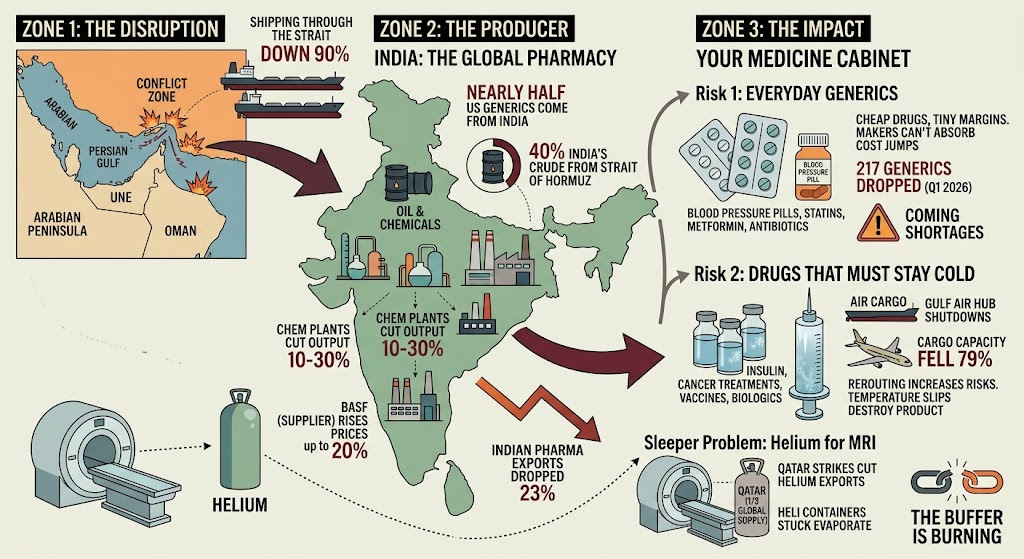
Nearly half of U.S. generics come from India, and India’s oil is going through a war zone.
It’s a chain that most of us never think about.
Nearly half the generic prescriptions filled in the United States come from India. Your blood pressure pill, your metformin, your amoxicillin — there’s a good chance it was made in a factory outside Mumbai or Hyderabad.
Those factories need oil to make your medicine. Not just to power the plant. The drugs themselves are made from oil — solvents, coatings, blister packs, IV bags, syringes, and vaccine vials. Nearly all of it starts with petroleum. Even Tylenol begins with chemicals pulled from crude oil.
About 40% of India’s crude has historically come through the Strait of Hormuz. Shipping through the Strait is down 90% since the war began. Indian pharma exports dropped 23% in March — the steepest monthly decline in five years. The International Energy Agency reported that chemical plants across Asia were already cutting output by 10-30%. BASF, a major supplier of drug ingredients, raised prices up to 20%.
Which medications are most at risk?
Two groups.
The first is everyday generics — blood pressure pills, statins, metformin, common antibiotics, and basic painkillers. These are cheap drugs with tiny margins. Makers can’t absorb big cost jumps, so they raise prices or stop making the drug. 217 generic products were dropped by Indian makers in the first quarter of 2026 — 83% more than the same period last year, per FDA data. When makers start dropping products, shortages follow.
The second is drugs that must stay cold — insulin, cancer treatments, certain vaccines, and biologics. The major air cargo hubs they move through — Dubai, Doha, Abu Dhabi — shut down when the war began. Gulf air cargo capacity fell 79% in the first week. Those hubs are slowly coming back, but capacity is still far below normal and rates have roughly doubled. Companies are rerouting through Jeddah, Istanbul, Singapore. Every extra stop is another chance for a temperature problem — and with cancer drugs, a temperature slip can destroy the product.
There’s also a sleeper problem: MRI machines need liquid helium to cool their magnets. Qatar supplies about a third of the world’s helium. Strikes hit a major gas plant there, and QatarEnergy cut helium exports 14%. Helium containers stuck near the Strait evaporate around the six-week mark. That product isn’t delayed. It’s gone.
Would a ceasefire fix this?
Not quickly. The ceasefire is close to expiring. Even if shipping lanes opened tomorrow, it would take months to clear the backlog. Shipping companies say they need a week and a half to catch up for every week of paused shipments. Damage to chemical plants could take years to fix. And once shipping resumes, distributors will rush to stock up — panic buying that creates its own pressure, especially in countries that can’t afford a bidding war. That hoarding pattern is already playing out with energy: wealthy nations are scrambling to lock up oil and gas supplies, outbidding poorer countries and driving up the cost of the very raw materials that drugmakers need.
What should people do?
Most pharmacies still have 30 to 60 days of supply on hand. This isn’t an empty-shelves moment — yet. Shortages, if they come, will likely surface in June or July.
If you take a daily generic, make sure your prescription is current and filled. If you’re on something that needs refrigeration — an injectable, a biologic, an insulin — talk with your doctor now about a plan in case of delays.
The system hasn’t broken yet. But it’s burning through its buffer. The United States built the cheapest generic drug supply in the developed world by sending production overseas and never really thinking about what happens when the route breaks. Now we’re about to find out.