


AI-generated health podcasts are scaling faster than anyone can check them.
People trust AI medical advice as much as their doctor’s even when it’s wrong.
AI-generated podcasts now outnumber human-made ones. Here’s who’s producing them.
Production is scaling on an industrial timeline. Quality control is not.
AI-generated health podcasts are scaling faster than anyone can check them.
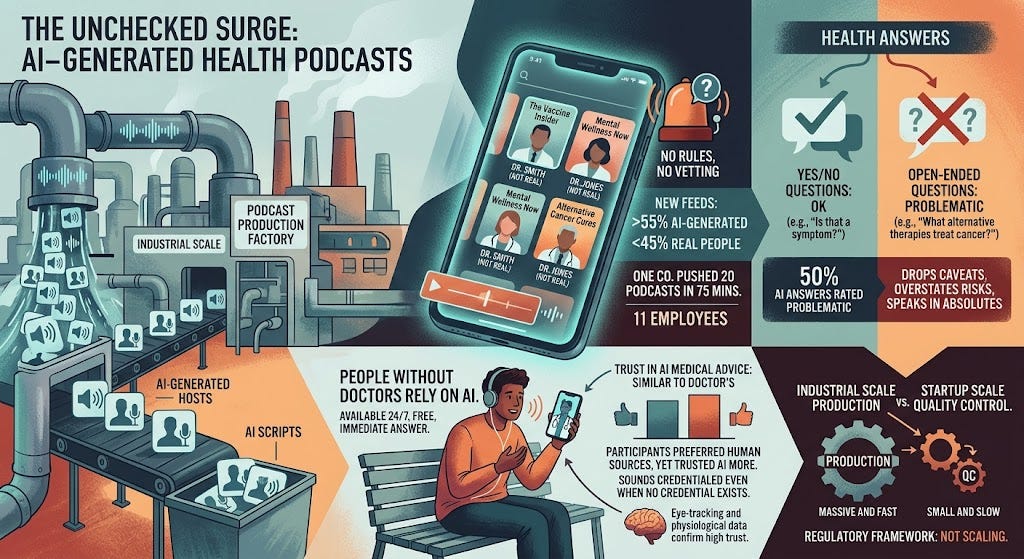
As of this week, fewer than 45 percent of new podcast feeds appear to be made by real people. The rest are AI-generated. Many of them are about health.
One company pushed out 20 wellness podcasts in under 75 minutes. The topics included vaccinations, mental health, and addiction. The hosts had professional-sounding names, but they weren’t real people. The company has 11 employees.
AI-generated audio has real potential for health education. Researchers at Boston University built a tool called PodGPT that trained a language model on more than 3,700 hours of science and medical podcasts and improved its ability to answer health questions in plain language. A pilot study in Medical Teacher found AI-generated health podcasts performed about as well as human-made ones on educational rubrics. A study in the European Journal of Cardiovascular Nursing found AI podcasts made complex research accessible to general audiences. Half the researchers who listened couldn’t tell they were AI-generated.
The technology works. That is actually the problem. Right now, it is scaling far faster than any system designed to check what it produces.
Half of AI-generated health answers are problematic.
This week, researchers published a study in BMJ Open where they tested five popular AI chatbots on health and medical questions about cancer, vaccines, nutrition, and more. Half the answers were rated as problematic. The AI did fine on simple yes-or-no questions. But when researchers asked the kind of open-ended questions real patients actually ask — things like “What alternative therapies treat cancer?” — nearly a third of the answers were highly problematic.
Carri Chan, a Columbia University professor who runs the AI+Healthcare Initiative, puts the accuracy of AI health podcasts at roughly 90 to 95 percent. The 5 to 10 percent the AI gets wrong is the part that matters most. It drops caveats. It overstates risks. It speaks in confident absolutes. And it almost never tells you when you should stop listening and go see a doctor.
People trust AI medical advice as much as their doctor’s even when it’s wrong.
A study published in NEJM AI tested whether people could tell AI-generated medical answers from doctor-provided ones. They couldn’t. Participants rated AI responses more favorably than doctors’ answers. Even the AI’s low-accuracy responses — the ones physicians flagged as problematic — received trust ratings equal to real doctors’ answers. People said they would follow that advice.
A separate study using eye-tracking and physiological monitoring found the same pattern. AI-generated health information was trusted more than human-generated content, even when participants said they preferred human sources.
The Annenberg Public Policy Center surveyed more than 1,600 adults this spring. Sixty-three percent said they consider AI-generated health information reliable. Three-quarters of Americans told Pew it matters that their health sources have real medical training. People want credentialed sources and trust uncredentialed ones because AI-generated content sounds credentialed even when no credential exists.
AI-generated podcasts now outnumber human-made ones. Here's who's producing them.
Tools like Google’s NotebookLM and NoteGPT can turn any article or paper into a polished-sounding podcast episode in minutes. The barrier to producing medical-sounding audio content has dropped to nearly zero.
Inception Point AI, one company in this space, has 10,000 active shows and around 300,000 episodes. The CEO, Jeanine Wright, says the content is entertainment, not medical advice. The company says it flags content for human review and trains its model to recommend consulting a practitioner. The wellness shows are hosted by fictional characters., but the company says it’s moving away from using “doctor” in its character names.
Wright described the model as “an audio version of Wikipedia or Reddit.” Wikipedia has an extensive editorial infrastructure built over two decades. Reddit is a platform where health misinformation spreads freely.
People without doctors are the ones relying on AI.
Pew data out this month found that Americans without health insurance are more likely to turn to AI chatbots for health information even after accounting for age and income. If you can’t easily get to a doctor, AI is available around the clock, it doesn’t cost anything, and it gives you an answer right away.
The people with the least access to a real clinician are the most likely to rely on a synthetic one. And they are the least likely to have a doctor to check the advice against.
There are no rules governing AI-generated health podcasts.
With AI-generated health podcasts, disclosures, if they exist, may be a quick line at the top of an episode that most listeners will miss.
There are no federal requirements for AI-generated podcasts to disclose that they are AI-generated. There are no editorial standards governing their medical claims. The platforms hosting these shows have no systematic process for vetting health content produced by AI at this scale. Research in the European Journal of Cardiovascular Nursing recommended rigorous review before release and transparent disclosure, even for AI podcasts that performed well. Almost none of those safeguards exist in the current market.
A few things worth checking before you follow that advice.
Start with the host. Can you find their name, credentials, and institution? If the host is a fictional character or you can’t verify who they are, be skeptical. Listen for uncertainty. A trustworthy health podcast should mention limitations and when to talk to your doctor. If every episode sounds confident about everything, that is a warning sign. Confident certainty across all topics is how AI tends to communicate.
Don’t treat any single podcast — AI or human — as your only source of health information. Check what you hear with your own doctor before you act on it.
Production is scaling on an industrial timeline. Quality control is not.
AI-generated health content will get better. Some of it will be genuinely useful for patient education, for reaching people who face language barriers, and for making research more accessible.
But right now, the production of AI health podcasts is scaling on an industrial timeline. The quality control is scaling on a startup timeline. The regulatory framework is not scaling at all.
The health-advice pipeline just got industrialized. Most listeners have no idea.