We’re at the beginning of a long timeline
Yesterday, EPA Administrator Lee Zeldin said microplastics in drinking water are now a top federal health priority. At the same time, HHS Secretary Robert F. Kennedy Jr. and ARPA-H Director Alicia Jackson announced a $144 million research initiative to study how microplastics build up in the body, which particles may be most harmful, and whether exposure can be reduced or removed.
Taken together, these moves signal something specific: microplastics have crossed from a research topic into a federal policy concern.
They have not crossed into regulation.
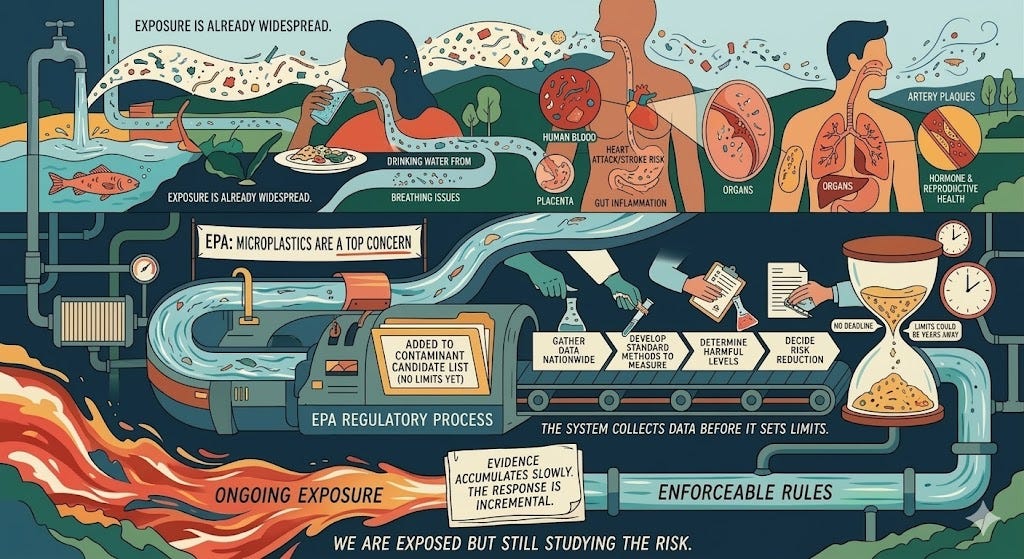
The EPA has added microplastics to the Contaminant Candidate List. This is a list of substances the agency may eventually regulate after more study, better measurement, and further analysis. It shows attention, not limits.
Here’s what happens next:
Scientists need standardized ways to measure microplastics. Right now, labs can produce very different results.
National data is needed to show how much microplastic contamination is in drinking water across the country.
Clearer evidence is needed to link typical exposure levels to specific health harms.
The EPA must decide whether regulating microplastics would meaningfully reduce health risks.
The agency must also run a cost-benefit analysis to decide whether the public health benefits justify the economic and technical costs.
Only after all of this can enforceable limits be proposed. That process can take years. Moving from “emerging contaminant” to an enforceable standard often takes a decade or more. Even then, regulation is not guaranteed. The bar is high.
Exposure is widespread
Microplastics have been found in blood, lungs, placenta, breast milk, and stool.
They are in our drinking water. They are in our food. They are in the air.
Indoor air may be a major source, especially in spaces with synthetic fabrics and dust.
Researchers can detect microplastics in human tissues and see cellular effects like inflammation, oxidative stress, and DNA damage. But linking those findings to real-world health risk is much harder.
What we don’t yet know
There is no agreed-upon exposure threshold at which harm begins.
There is no consensus on whether smaller particles, especially nanoplastics, pose greater risk because they can cross cell membranes and reach organs.
There is no clear dose-response relationship linking typical environmental exposure to specific diseases.
Microplastics are not a single substance. They vary by size, shape, polymer type, and chemical additives, each with different possible biological effects.
The problem is straightforward: We know exposure is widespread. We know there are plausible mechanisms of harm. But we do not yet know how much exposure translates into measurable disease risk.
Until those questions are answered, regulation moves slowly.
Industry incentives
Most plastics are made from oil and natural gas.
As demand for gasoline declines, plastics have become a stable growth area for the fossil fuel industry. The International Energy Agency projects that petrochemicals will account for a large share of future growth in oil demand. The OECD estimates that plastic production could nearly triple by 2060 without stronger policy.
Reducing microplastic exposure ultimately means reducing plastic production, and that directly conflicts with the interests of the fossil fuel industry.
Those incentives shape how policy is framed and what gets prioritized, and this is why plastic policy tends to emphasize waste, recycling, and individual behavior.
It focuses less on production.
This is a stable pattern across U.S. policy discussions and international negotiations, including the UN Global Plastics Treaty.
Production limits are debated, then softened. Recycling is presented as the primary solution, despite low global recycling rates and known technical limits. Waste management becomes the central frame.
At the same time, new plastic production capacity continues to come online.
What actually reduces exposure
As plastic production increases, more material enters the environment and breaks down into microplastics. These particles then accumulate in air, water, and food.
To lower exposure in a meaningful way, plastic production and use have to decrease.
There are a few ways to do that at scale:
Limits or fees on new plastic would slow how much enters the system. Less plastic in, less plastic breaking apart later.
Require companies to pay for the waste they create. That gives them a reason to use less plastic and design better products.
Bans on high-exposure uses, like certain food packaging or products that shed easily, would cut off major sources of what we eat and breathe.
Stronger product design rules could reduce how much plastic sheds during normal use, like from packaging, textiles, and tires.
Reuse systems (refillable containers, return systems) would reduce how much plastic moves through the system overall.
These approaches work because they act upstream, before plastic becomes waste, and before it breaks into microplastics.
What does not reduce exposure
Some widely discussed solutions do little to reduce microplastics overall.
Recycling, as it works today, does not reduce how much plastic is made. Most plastic is never recycled, and new plastic keeps being produced at high levels.
Bioplastics are often marketed as safer, but many still break apart into small particles in similar ways.
Waste management, like landfills and cleanup, deals with plastic after it’s already been made. By that point, some of it has already broken down into microplastics.
These approaches have value, but they mostly work downstream, after the problem has already started.
The fossil fuel industry, which supplies most plastic feedstocks, tends to support these approaches — recycling, cleanup, and new materials — because they do not limit how much plastic is made.
These approaches address waste after production, rather than reducing how much plastic enters the system in the first place.
That matters because as long as production keeps growing, microplastics exposure will keep growing too.
What individuals can do
The uncomfortable truth: we don’t yet know how much individual behavior can meaningfully reduce health risk. But we do have early signals on where exposure is coming from and what might lower it.
Diet appears to play a role, based on early evidence.
In one small study, researchers found microplastics in every stool sample tested, with concentrations up to ~3.5 particles per gram. What stood out wasn’t a single food. It was how food was processed and handled.
Higher microplastic levels were associated with:
Highly processed foods
Food packaged in plastic
Plastic use during cooking and storage
That points to a practical, if imperfect, strategy:
Reduce contact between food and plastic, especially heat + plastic.
What that looks like in practice:
Favor fresh or minimally processed foods over ultra-processed options.
Limit plastic packaging, especially for ready-to-eat meals.
Avoid heating food in plastic containers (e.g. microwave, hot liquids).
Use glass, stainless steel, or ceramic for cooking and storage.
There are also non-diet exposures:
Microplastics shed from textiles and indoor air may contribute to what we ingest.
Food can be contaminated during processing, transport, or preparation.
You can improve indoor air with HEPA filters. But even strict personal changes won’t eliminate your exposure to microplastics.
The limits of individual action
Individual actions can reduce exposure at the margins, but key sources remain:
Food supply chains
Packaging infrastructure
Indoor air
And critically, the study did not find a consistent, predictable drop in exposure across “low plastic” vs “high plastic” scenarios. That’s a warning sign: the signal is real, but the system is noisy and hard to control at the individual level.
Changing the system
Microplastics are in the air, our drinking water, our food, and our soil. You can’t opt out of exposure.
That makes this a systems problem, not a personal one.
Individual choices matter at the margins. But meaningful change happens when exposure pathways — packaging, manufacturing, food systems — are altered upstream.
We’ve seen how quickly norms can shift when organized groups focus attention and create consequences. Parent-led advocacy groups have shown that coordinated pressure can force change faster than formal regulation. By sharing information, mobilizing networks, and targeting companies and school systems, they’ve pushed action on food additives, product safety, and environmental exposures.
Not all of their claims are scientifically grounded. But their effectiveness comes from something else: they change incentives.
When individuals act together, they can:
Pressure companies to change materials and packaging
Push for safer products and packaging
Accelerate policy action by raising the political cost of inaction
Shift what is seen as acceptable or normal
Regulation rarely leads. It responds to pressure.
If microplastics exposure is going to decrease in a meaningful way, it will not come from individual choices alone. It will happen when widespread plastic use becomes harder to justify, economically and politically.