A more convenient option
A new obesity treatment comes as a standard pill.
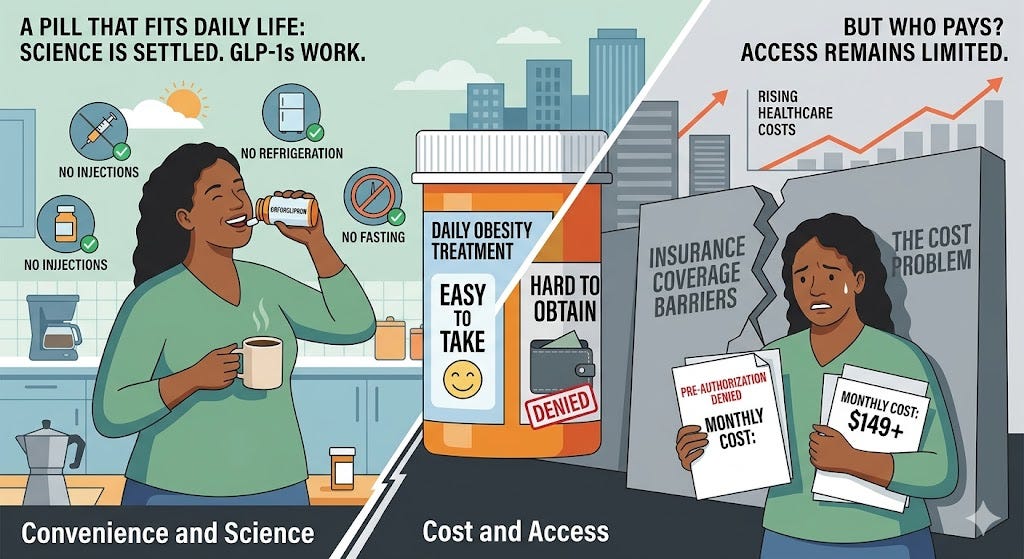
No injections, no refrigeration, no fasting requirements. It fits more easily into daily routines.
GLP-1 drugs work
They reduce appetite, lower blood sugar, and produce meaningful weight loss.
Some, including semaglutide (Ozempic, Wegovy), also reduce the risk of heart attack and stroke.
Foundayo (orforglipron) simplifies dosing: one pill, no timing constraints.
Which GLP-1 pill is better?
Two main options are emerging:
Foundayo: no food restrictions
Wegovy pill (oral semaglutide): must be taken on an empty stomach
Each has advantages.
In type 2 diabetes trials, Foundayo produced greater weight loss and better glucose control than lower-dose oral semaglutide.
In obesity trials, the Wegovy pill showed slightly greater weight loss, and fewer patients stopped treatment due to side effects.
A general pattern:
Cardiovascular outcomes: semaglutide has stronger evidence
Weight loss and glucose control: orforglipron is competitive and sometimes leads
Convenience: orforglipron is simpler to use
Medicare coverage
If you have Medicare, you can get a pharmacy benefit card to buy Foundayo for $50 a month.
Historically, Medicare has not covered GLP-1 drugs for obesity at all. Coverage has been limited to other indications, such as:
Diabetes
Heart disease
Sleep apnea
That is starting to change under a new CMS program called the BALANCE model, which will allow Medicare Part D plans to offer coverage for obesity medications with standardized criteria and negotiated prices.
Starting in July, Medicare will also cover these drugs for more people:
If your body mass index (BMI) is 30 or higher, and you have:
Heart failure
High blood pressure that isn’t controlled
Moderate to severe kidney disease
Or if your BMI is 27 or higher, and you have:
Prediabetes and heart disease

Commercial and employer-sponsored insurance
If you have commercial or employer insurance, you may qualify for a savings card that can lower your cost to about $25 a month. But that’s only if and after your insurance approves the drug, and almost all plans require prior authorization.
To get prior authorization for coverage, your doctor must show that you meet certain criteria, such as your BMI and other health conditions. They often have to submit proof that you’ve tried other approaches and treatments first. And even if you qualify, prior authorization is not guaranteed.
If your insurance does not approve Foundayo, you will likely have to pay the full price, even if your doctor prescribes it.

Many insurance companies are pulling back on GLP-1 coverage
Meanwhile, many insurers, including some state Medicaid programs, are limiting or even dropping coverage for weight-loss drugs because of cost.
The healthcare system is struggling to absorb these costs.
Doctors determine medical need, but insurers determine access.
In practice, that means rationing.
Even if prices go down, the need is still huge. Millions of people on Medicare could qualify for obesity treatment, but at today’s prices, only a small proportion of them could get the drugs without raising total costs.
We’ve turned a medical breakthrough into a financial filter.

Uninsured or if insurance doesn’t cover
If you don’t have insurance or your insurance won’t cover Foundayo, you would have to pay the cash price, which starts at $149 for the first month and rises to between $299 and $349 per month with longer-term use.
That is slightly below the cash price of drugs like Wegovy or Zepbound, which can range from $199 to $449 per month, with the amount you pay largely depending on your prescription drug coverage, if you have it.
This might all sound affordable, but it adds up over the long term.
According to Federal Reserve data, about a third of Americans can’t cover a $400 emergency expense. That tells you even “lower-cost” medications will still be out of reach for many Americans.
A medical breakthrough, trapped behind cost
The science is no longer the issue. Effective weight-loss treatments exist.
Even under optimistic policy scenarios, lower drug prices may expand access to hundreds of thousands or a few million people, but still leave the majority of eligible patients untreated.
Foundayo makes treatment easier to take, but not easier to obtain. A daily pill still depends on insurance approval and the ability to pay.
Polls show cost is the main concern for most Americans, not whether these drugs work, but whether they can afford them.
Breakthroughs tend to arrive first in American healthcare. Access may come later, if it ever comes at all.