


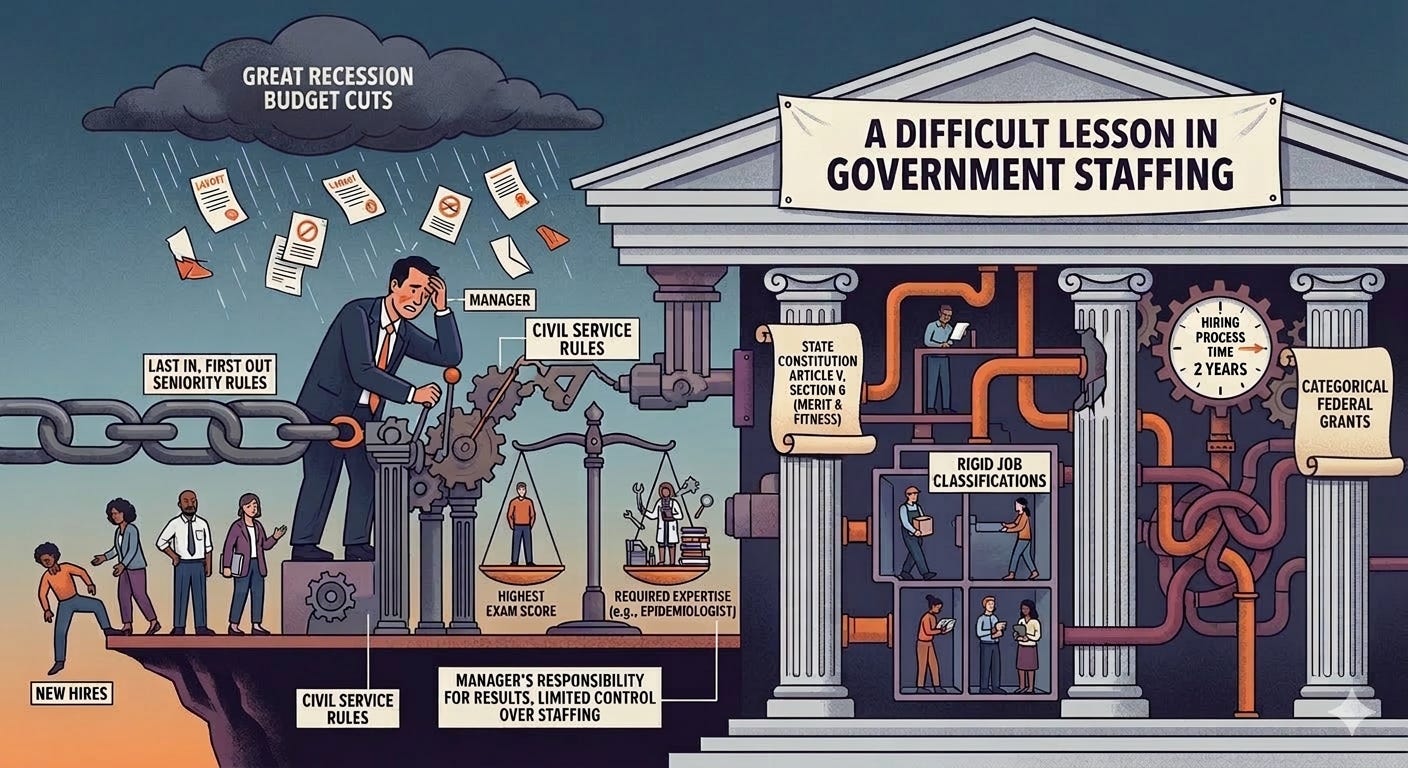
A difficult lesson in government staffing
About 15 years ago, I was an assistant commissioner at the New York City Department of Health and Mental Hygiene. I led a bureau of about 250 people.
The city was facing budget cuts following the 2008-2009 financial crisis. Because of those cuts, my bureau was told we might need to lay off about 20% of our staff, with additional layoffs projected in later years.
Layoffs are difficult under any circumstances. They affect people’s lives and families and can disrupt an organization’s work. But the process was especially challenging because I had limited control over how the layoffs could be carried out.
Civil service rules determined many of the decisions about who could be laid off and who could not.
In many government systems, layoffs follow seniority rules, sometimes called “last in, first out.” Employees who have worked in an agency the longest often have stronger protections, while newer employees are more likely to be laid off first. These rules are meant to make the process consistent and protect workers from favoritism.
However, they can limit managers’ ability to consider job performance, specialized skills, or program needs when deciding which positions to eliminate.
Leadership during budget cuts requires difficult tradeoffs. Leaders must protect an organization’s core mission while operating with fewer resources. In many organizations, managers can restructure teams or shift resources to protect the most important work.
In government, that flexibility is often limited.
Public-sector leaders frequently face a basic paradox: they are responsible for results but have limited control over staffing, structure, and resources.
That experience changed how I think about government hiring and employment systems.
How the Great Recession affected city budgets
The cuts we faced were part of a broader economic downturn. Tax revenues fell sharply beginning in late 2008 as the financial crisis spread through the economy.
Because most states and cities must balance their budgets, many governments responded with spending cuts and hiring freezes.
New York City faced large budget gaps in the years after the financial crisis. City agencies were asked to reduce spending and eliminate positions.
Public health programs were among those affected.
But budget cuts were only part of the challenge.
Another challenge was the structure of the civil service system.
How civil service hiring works
Even when we knew what expertise we needed, hiring the right person could take a long time.
Many government jobs are tied to specific civil service titles. Candidates often must take a civil service exam and be placed on an eligibility list. Agencies then hire from that list.
This process can take months or even longer. In my own case, it took nearly two years to be hired into my position.
Civil service systems also limit how easily managers can reorganize staff. Job classifications are rigid, and employees may not easily move between roles.
As a result, staffing changes during budget cuts can make an organization less efficient rather than more.
When exams and expertise do not match
Civil service exams are meant to measure merit and fitness for government jobs. In theory, they help ensure that hiring is based on merit rather than politics.
In practice, exams do not always measure the skills needed for the job. Written tests may focus on memorization or general knowledge rather than real-world experience or specialized training.
A candidate who scores well on an exam may not necessarily have the strongest background in the specific work required.
Another constraint is that agencies often must hire from the top of an exam list. Even if another applicant has more relevant experience, the agency may not be able to hire that person.
In specialized fields like public health, this can create a gap between the formal hiring process and the expertise agencies need.
In my experience, the rules of the system did not always align with who was contributing the most to the work.
Why civil service rules are hard to change
Civil service hiring rules in New York are not just administrative policies. They are written into the New York State Constitution.
Article V, Section 6 states that government jobs must be filled based on “merit and fitness.” In most cases, this is determined through competitive examinations.
These rules were created in the late nineteenth century to replace the spoils system, in which government jobs were often given to political supporters.
Civil service exams were designed to reduce political favoritism and create a more professional public workforce.
Courts have generally interpreted these requirements strictly.
One example comes from a case involving Long Beach, New York, a city on Long Island. Local officials attempted to fill certain jobs outside the competitive civil service system. The courts rejected that effort, ruling that governments cannot bypass competitive hiring simply because it is faster or easier.
Because these rules are written into the state constitution, major changes would likely require a constitutional amendment. That process involves approval by two successive state legislatures, followed by a vote by the public.
Staffing challenges in modern health departments
Civil service rules shape how government agencies hire and manage their workforce.
Public health agencies also face additional structural constraints.
Many programs are funded through categorical federal grants tied to specific activities, such as immunization programs, disease surveillance, or maternal and child health services. Funding from these programs often cannot be shifted easily to other priorities.
As a result, leaders may have funding for one program but not for the staff needed elsewhere.
Many public health positions are also supported by time-limited grants. When funding ends, programs and positions can disappear quickly, and experienced staff may leave.
At the same time, public health programs often cannot simply pause. Surveillance systems, laboratory networks, and vaccination programs depend on continuous staffing and infrastructure.
When hiring systems move slowly, filling specialized roles can take months or years.
During public health emergencies, those delays can affect how quickly departments can expand their response.
What the experience taught me
My experience at the New York City health department gave me a closer view of how these systems work in practice.
Civil service protections serve an important purpose. They were created to prevent political favoritism and ensure that government hiring is fair.
At the same time, the system can create real management challenges, especially during periods of budget cuts.
Public health departments today face complex problems that require specialized expertise and rapid response.
But during the recession, the hardest decisions were not about strategy or policy. They were about people.
As a manager, I was responsible for protecting the bureau's work and the services we provided to the public. Yet many of the decisions that shaped those outcomes were governed by rules I could not change.
Looking back, that experience helped me understand something about public-sector leadership: leaders are often held responsible for results while operating within systems that limit their control over the tools needed to achieve them.
During those layoffs, that reality became very clear.
This is an excellent summary. Based on your personal experience, and from a professional standpoint, you've certainly touched on all the relevant information, concerning that built-in public-service structures, from human resources, legislated policies, program funding & the glaring issues which hinder efficiency, effectiveness & real progress. Essentially, it's a bottleneck for excellent & proficient public-sector leaders, entering the system and coming to that conscious realization.