


When less plaque can still mean more danger for women
For many years, doctors believed that the more a heart artery is blocked, the higher the risk of a heart attack. But new research from the PROMISE trial shows this may not be true for women.
The study found that women can have serious heart problems even when they have less plaque buildup in their arteries than men. This means women may face heart risks earlier and with smaller blockages.
This helps explain why heart disease in women is sometimes missed or diagnosed too late.
Women can be at risk even with smaller blockages
The PROMISE trial studied more than 10,000 people with chest pain who were being checked for heart disease. Women usually had fewer large blockages than men. But they still had heart events, even when their plaque levels were lower.
This shows that doctors cannot rely only on how big a blockage looks. For women, even smaller amounts of plaque can be dangerous.
Heart disease can look different in women
Women are more likely than men to have heart problems without major artery blockages. This condition is called INOCA, or ischemia with no obstructive coronary artery disease.
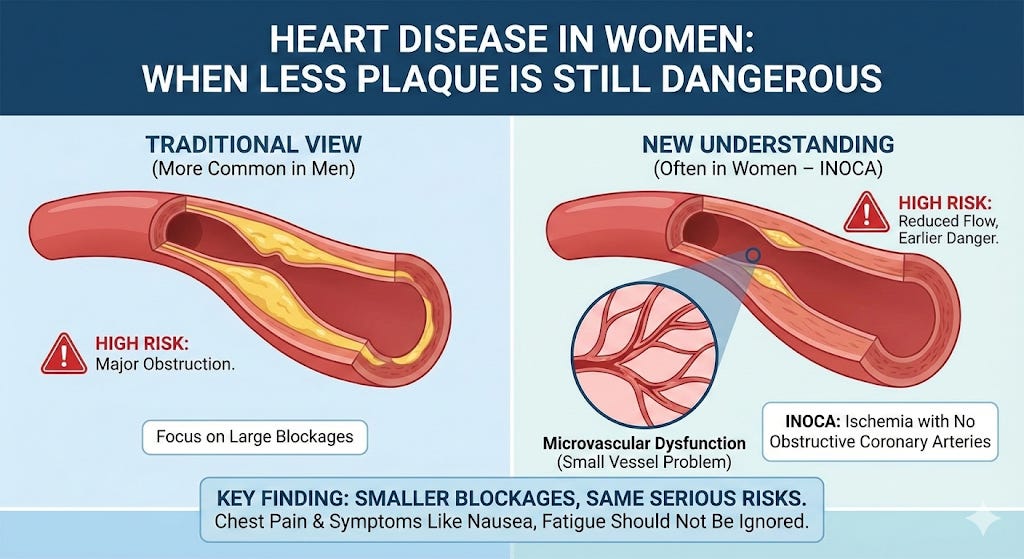
In these cases, the small blood vessels in the heart may not work properly. This is called microvascular dysfunction. Even though the main arteries are not severely blocked, blood flow can still be reduced.
Research shows that women with poor coronary flow reserve, a sign of microvascular problems, have a higher risk of heart events, even when they do not have large blockages.
Chest pain in women is often misunderstood
Many people think women have “atypical” heart attack symptoms. But national heart guidelines say chest pain is still the most common symptom for both women and men.
Women may also have other symptoms like:
Nausea
Shortness of breath
Fatigue
Even so, chest discomfort is still the main warning sign.
However, women’s symptoms are sometimes labeled as non-cardiac or less serious. This can delay testing and treatment.
Younger women face higher risks
Younger women who have massive heart attacks — especially ST-elevation myocardial infarction (STEMI), sometimes called “widow-makers” — are more likely to die in the hospital than men their age.
Less likely to receive certain heart procedures
Less likely to receive fast reperfusion treatment
Less likely to receive recommended heart medications
These treatment gaps may help explain why outcomes are sometimes worse for women.
Why we need to rethink heart care for women
For a long time, doctors believed that big blockages meant high risk and small blockages meant low risk. But research now shows that this thinking doesn’t always work for women.
For women:
Smaller plaque buildup can still be dangerous
Heart disease may involve smaller blood vessels
Chest pain should never be ignored
Heart disease is the leading cause of death in women, but it doesn’t always look the same in women as it does in men.
Less plaque does not always mean less danger.