
Why This Year’s Flu Season May Be Rougher Than Usual
Published by CBS News on December 22, 2025

https://www.cbsnews.com/news/flu-season-2025-experts-pretty-worried/
Doctors and scientists say this year’s influenza season could be tougher than usual. A new version of the flu virus, called H3N2, is spreading quickly. At the same time, fewer people are getting flu shots, and the first human case of a bird flu strain, H5N5, was recently reported in Washington State.
“There’s definitely going to be a seasonal flu season,” said Jesse Bloom, a scientist at the Fred Hutchinson Cancer Center who studies viral evolution. “It’s pretty likely to be an H3N2-dominated flu season… I don’t see any reason to think that this is an unprecedentedly bad one, but current indicators are that it may be substantially more severe than the typical winter flu season.”
Bloom said the H3N2 virus has changed just enough to make it harder for people’s immune systems to recognize. “Getting the vaccine is something that people, particularly those who are in high-risk groups, can do,” he explained. “It’s not going to eliminate their chance of getting infected, but it does mitigate their risk.”
A Changing Virus
Other experts share Bloom’s concern. “I would say pretty worried,” said Dr. Helen Chu, a flu expert at the University of Washington. “Based on the UK and Japan data, it’s looking like it’s causing a lot of cases of flu and hospitalizations.”
She said flu activity “is starting everywhere right now,” overlapping with RSV but coming before a likely winter COVID-19 wave. Early vaccine data from other countries show good protection at first, around 70% in children, but that may not last. “Total season effectiveness is probably going to actually be much, much lower,” Chu warned, because immunity fades over time.
Trevor Bedford, who also studies viral evolution at the Fred Hutchinson Cancer Center, said that H3N2 tends to evolve faster than other influenza strains. “I expect more H3 incidence than the typical year and poorer vaccine effectiveness,” he said. These large “jumps” in how the virus appears to our immune system usually occur every 3 to 4 years, he explained.
Stephen Morse, an infectious disease epidemiologist at Columbia University, noted that influenza’s behavior still defies confident forecasting. “Many excellent scientists have come to grief trying to predict what influenza will do — consider 1976,” he said, emphasizing how frequently the virus surprises even seasoned researchers. He added that the emergence of the H3N2 K subclade was “one of those surprises,” and while surveillance detected it quickly, “the bad news is that we weren’t really prepared for it.”
Why that matters: H3N2 is known for causing tougher flu seasons, especially for seniors. The new strain has changed in ways that make it harder for the immune system to recognize, so more people may get sick and need hospital care.
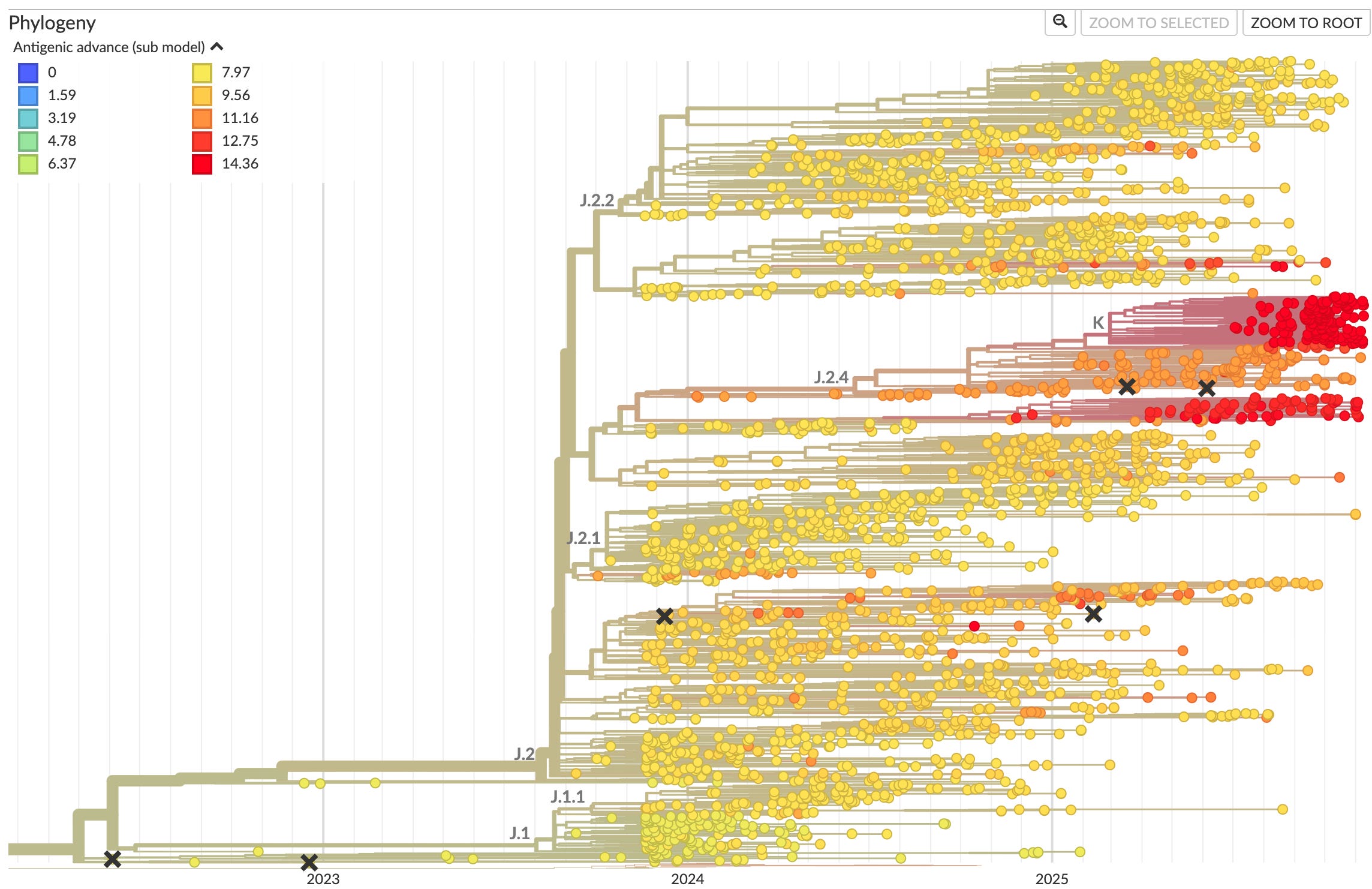
Figure 1. H3N2 evolves more quickly than H1N1 and B. This causes it to often (but not always) predominate over H1N1, where we see generally H3 seasons or generally H1 seasons. We generally see larger influenza seasons in terms of incidence when there’s more drift. The recent K clade of H3N2 looks like such a transition. (Source: Trevor Bedford and NextStrain)
The Vaccine Still Helps
Even with these changes, doctors say the flu shot is still the best protection available. “The match to H1N1 and flu B is expected to be good,” said Richard Webby, Director of the World Health Organization Collaborating Centre for Studies on the Ecology of Influenza in Animals and Birds. “Even though we are expecting a H3N2 mismatch, vaccine effectiveness doesn’t always correlate with vaccine match… Bottom line, still a good idea to get the vaccine.”
Early-season data from the UK suggest the flu vaccine is still helping prevent severe illness, especially in children, even with the H3N2 mismatch. Protection in adults appears more modest and is expected to decline over time. Experts stress that flu vaccines are designed mainly to reduce severe disease, hospitalizations, and deaths — not necessarily to prevent every infection.
Dr. Gregory Gray, a professor of Infectious Disease Epidemiology at the University of Texas Medical Branch, added that people who work with animals should also be vaccinated. “Persons working with cattle, poultry, and pigs should receive their annual influenza vaccine,” he said. That helps stop human viruses from mixing with animal ones and creating new strains that could be dangerous to both.
Morse also underscored the value of vaccination despite the virus’s unpredictability. “I still advocate the annual influenza vaccine… It’s still a good precaution,” he said, pointing out that flu shots help protect against multiple circulating viruses, not just H3N2.
Bird Flu: Still Rare, But Worth Watching
The human H5N5 case in Washington State has not spread to others, but scientists are watching closely. “The risk to the general public from the H5N1 virus is still very low,” Webby said. “But an H5 pandemic could easily make the COVID-19 pandemic look like a cake walk.”
Chu said fall bird migrations make this the time of year when cases in birds, and sometimes in people, tend to rise. “This is the time of year when we see the H5 cases,” she said. “But a lot of the surveillance programs have been defunded, so in Washington State, there’s not been as much as in years past.”
Morse warned that gaps in surveillance, especially in agriculture, leave room for dangerous blind spots. “Surveillance is still crucial. It needs to be sustained… Agriculture especially has to do much more,” he said, noting that past outbreaks in pigs and cattle were missed until they were well underway.
Experts say avian flu remains a low risk for most people right now, but it is a low-probability, high-impact threat that requires close monitoring, especially when surveillance is limited.
What You Can Do
Experts say there’s no need to panic, but it’s important to prepare. “Get your vaccine,” Chu said. “It’s still not too late.” The shot helps protect against severe illness and may even give “some cross protection against H5N1 as well,” she added.
Doctors also stress the importance of early testing and treatment. Antiviral medications like Tamiflu and Xofluza still work against the flu strains circulating this season, including H3N2, but they work best when started within the first couple of days of symptoms — especially for older adults, young children, pregnant people, and those with chronic health conditions.
Gray said the country needs better flu testing and more vaccines for humans and livestock. Webby summed it up simply: “It’s more of the same: vaccination, hygiene, and keeping an eye out for anything unusual.”