


Kingdom, phylum, class, order, family, genus, species — and why it still matters.
A 7th grader could tell you why ivermectin doesn’t work on everything.
Calling all viruses the same is like calling humans and orangutans the same animal.
Kingdom, phylum, class, order, family, genus, species — and why it still matters.
You probably learned it in middle school: kingdom, phylum, class, order, family, genus, species. It’s a filing system for every living thing on Earth, invented by Carl Linnaeus in the 1700s. Most of us memorized it for a test and forgot about it. But this ranking system is also a tool for understanding why infections behave so differently, and why treating them is so complicated.
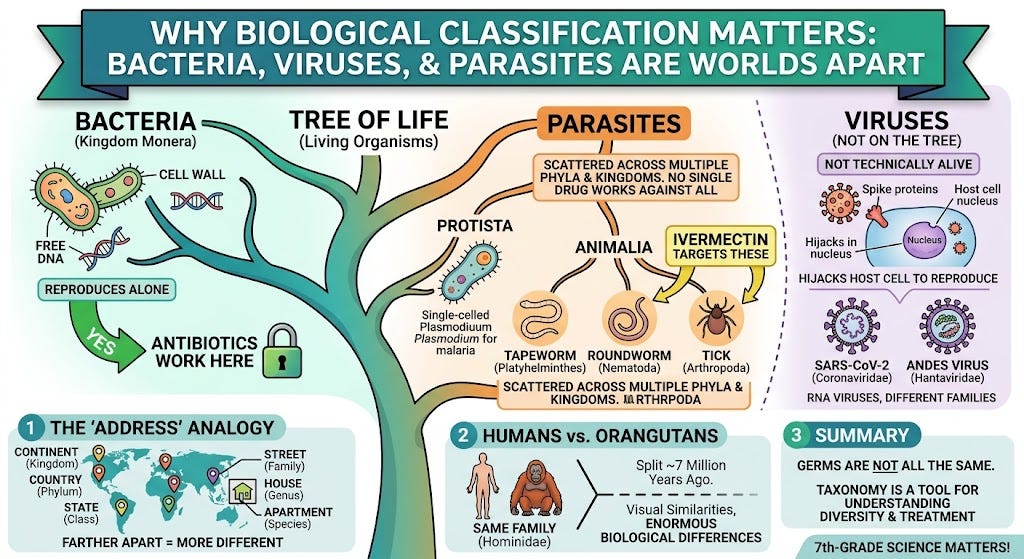
Think of it like an address. Two organisms in the same kingdom live on the same continent. Same phylum? Same country. Same genus? Same street. The further apart two organisms are on this tree, the more different they are — in how they work, how they spread, and how we fight them. That’s why one drug can’t treat every infection. That’s why one vaccine can’t prevent every disease. And that’s why the classification system you learned in 7th grade is more useful than you think. 7th-grade science matters!
What I Can & Can’t Say on TV is a reader-supported publication. To receive new posts and support my work, consider becoming a free or paid subscriber.
Bacteria, viruses, and parasites are nothing alike.
When people say “germs,” they usually lump everything together. But bacteria, viruses, parasites, and prions are as different from each other as a tree is from a human.
Bacteria are single-celled organisms with their own kingdom. They have cell walls, their own DNA, and they reproduce on their own. Antibiotics work by attacking parts of the bacterial cell that human cells don’t have. Antibiotics aren’t effective against viruses.
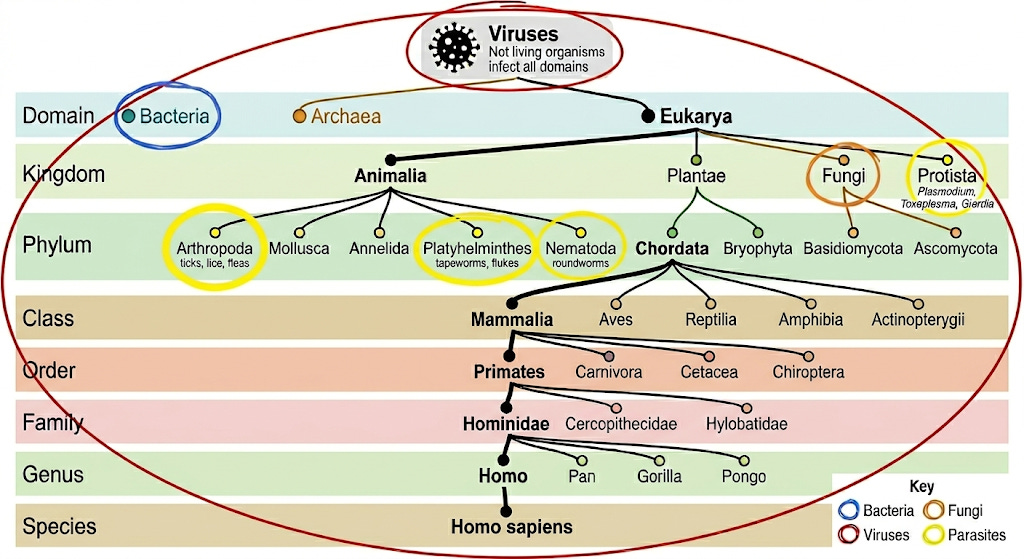
Parasites aren’t even one group. They’re scattered across the tree of life. Some are single-celled organisms in the kingdom Protista, like the Plasmodium species that cause malaria. Others are animals — tapeworms, roundworms, ticks, and fleas — spread across multiple phyla. That’s why no single drug works against all of them.
Viruses aren’t even on the tree. They’re not technically alive. They can’t reproduce without hijacking a host cell. They sit in their own separate classification system entirely.
Even viruses are worlds apart
Here’s where it gets interesting. People sometimes talk about “viruses” as if they were all the same. They’re not. Not even close.
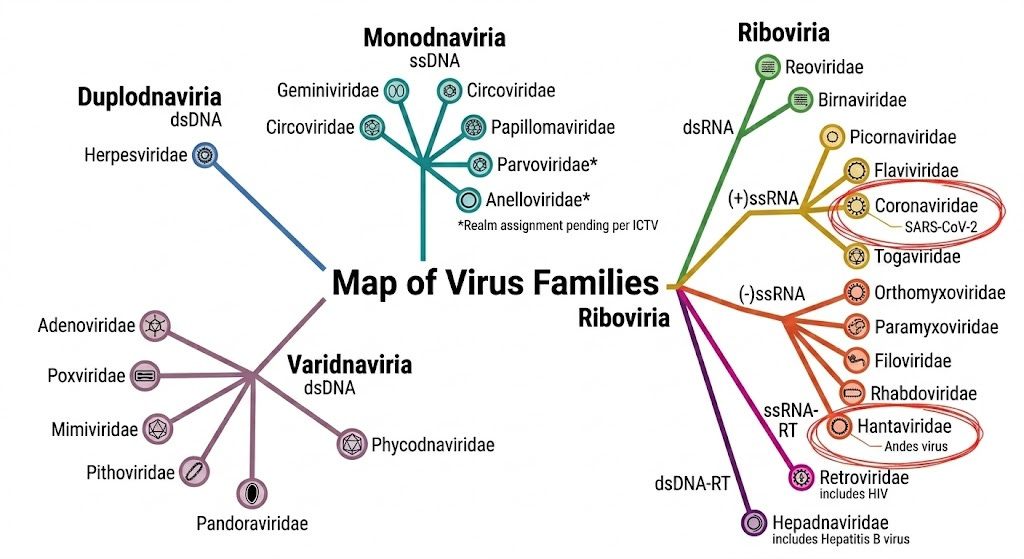
SARS-CoV-2, the virus behind COVID, belongs to the family Coronaviridae. It’s a positive-sense single-stranded RNA virus. The Andes virus, a hantavirus that’s behind the MV Hondius cruise ship outbreak, belongs to the family Hantaviridae. It’s a negative-sense single-stranded RNA virus. They’re both RNA viruses, but they sit in completely different families — like a dog and a dolphin are both mammals but live very different lives.
A 7th grader could tell you why ivermectin doesn’t work on everything.
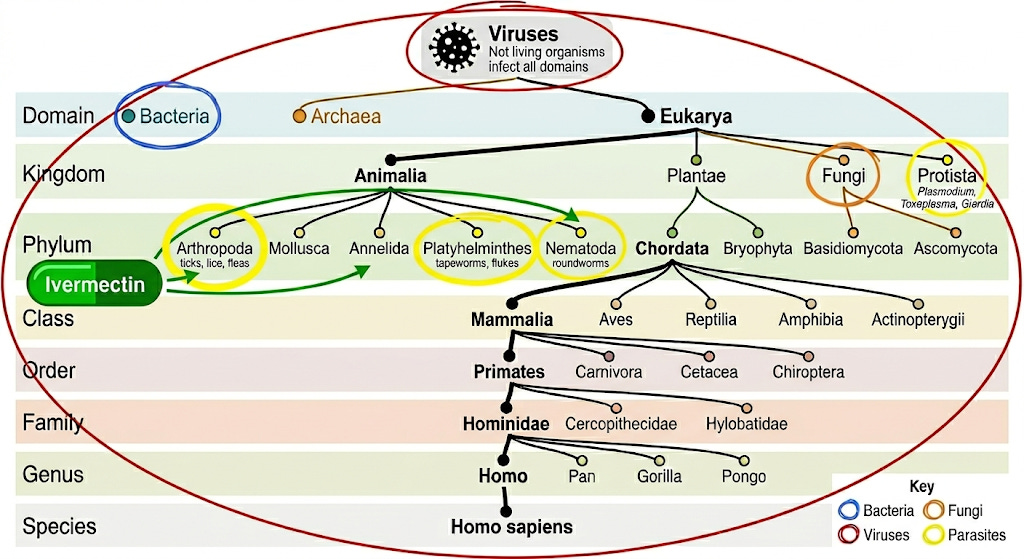
Ivermectin works against parasites in two phyla: Nematoda (roundworms) and Arthropoda (ticks, lice, fleas). It paralyzes their nerve cells. But it doesn’t work against tapeworms (Platyhelminthes) or single-celled parasites like Plasmodium (Protista). And it certainly doesn’t work against viruses, which don’t even have nerve cells.
A 7th grader looking at the tree of life could tell you this. Ivermectin targets organisms in two specific branches. Viruses aren’t on this tree at all. No amount of wishful thinking changes the biology.
Calling all viruses the same is like calling humans and orangutans the same.
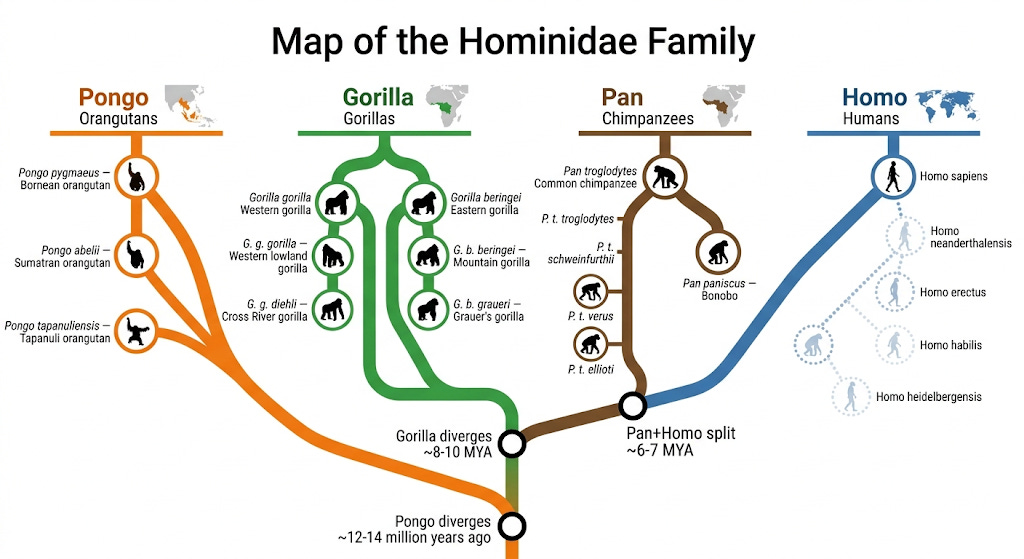
Look at our own place on the tree. Humans share a family, Hominidae, with orangutans, gorillas, and chimpanzees. But our lineage split from chimps roughly 6 to 7 million years ago. We look similar, but the differences are enormous. The same is true for viruses. SARS-CoV-2 and Andes virus are both RNA viruses, but they belong to different families, infect different cells, and cause completely different diseases. Calling them both “viruses” is like calling humans and orangutans the same animal.
The next time someone tells you all germs are the same, or that one drug can treat every infection, remember the tree of life. The answers were there all along, right there in 7th-grade science class.