


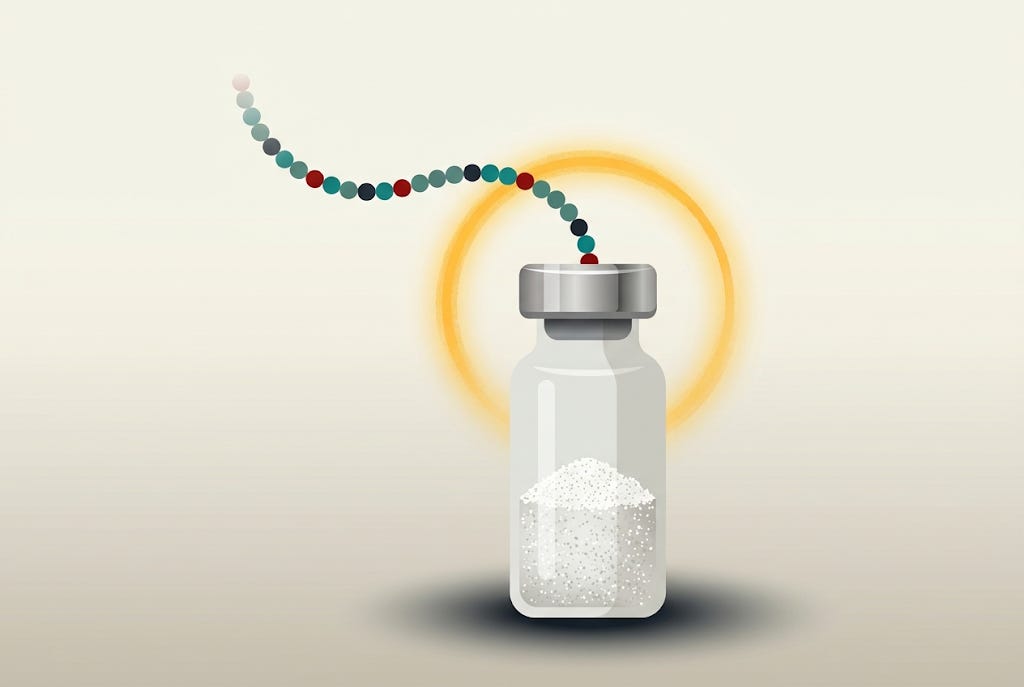
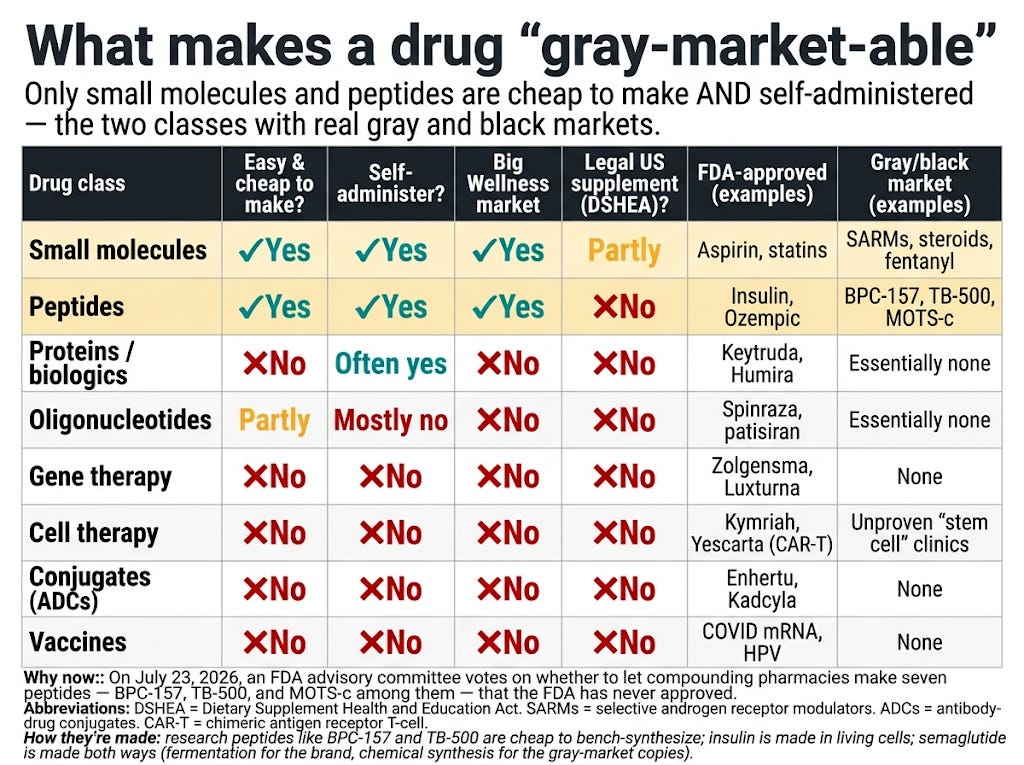
On July 23rd, a federal advisory committee votes on whether to recommend that compounding pharmacies be allowed to make seven peptides, BPC-157, TB-500, and MOTS-c among them, that the FDA has never approved and that carry almost no human trial data. If it goes their way, compounds now sold online in vials stamped “for research only” could move onto pharmacy shelves. They’re up for that vote because they’ve gotten popular and because there’s pressure in Washington to loosen the rules on them. What ties an untested powder to insulin and Ozempic is just the word they share: “peptide.” That’s the marketing. It makes an untested freeze-dried powder in a vial sound like a proven drug.
What a peptide actually is.
A peptide is a short chain of amino acids. A longer chain of amino acids is called a protein. Proteins are long enough to fold into a stable, specific three-dimensional shape, and that shape is usually what does the work: an enzyme’s pocket or an antibody’s binding site. Most peptides are too short to hold a fixed 3D structure. They tend to act as signals or hormones rather than as folded machines.
Short peptides can be built chemically, one amino acid at a time at a lab bench. Proteins are generally too big and too dependent on correct folding to synthesize that way, so you have to grow them in living cells. That’s the whole reason peptides are cheap to make, and antibodies and other biologics need the living-cell factories.
“Peptide” is a description of chemistry, the way “carbohydrate” is. It tells you how a molecule is built, not what it does to you. Insulin is a peptide. So is oxytocin. So is α-amanitin, the toxin in death-cap mushrooms (Amanita phalloides) that can cause fatal liver and kidney failure, and so are the main toxins in bee and scorpion venom. “Carbohydrate” is just as broad: kale and cake are both carbohydrates, and so is laetrile, a sugar compound from apricot pits that was sold for years as a cancer cure and released cyanide in the body. Nobody accepts “it’s a carbohydrate” as a reason to trust something. But “it’s a peptide” has become a reason to inject something, and now a reason to consider selling it at a pharmacy.
The Ozempic halo effect.
So why does “peptide” sell when a word like “oligonucleotide” never could? Ozempic. Semaglutide and other GLP-1 drugs are peptides, and they have become the biggest medical story in a decade. Peptide started to sound like the future, the way "blockchain" did in 2017, when adding the word to a company's name could send its stock up. But that reputation came from a handful of specific drugs, tested for years in real phase III placebo-controlled, randomized clinical trials. It doesn't transfer to a powder in a vial just because it’s a peptide.
Not testing the drug is the business model.
Cheap to make is only half of why this became a business. The other half is that the seller skips the step that costs the most. China is now the world’s peptide manufacturing hub, and U.S. imports of peptide and hormone compounds from there roughly doubled last year, to about $328 million in the first three quarters of 2025, according to customs data reported by The New York Times. The NYT also named the reason drug companies never ran trials on most of these: they’re easy to manufacture and don’t clearly target a disease. There’s no patent to defend and no single illness to run a trial against, so no company spent a decade proving one works. The gray market filled the gap.
A prescription GLP-1 ran more than $1,000 a month until recently. The “research use” version goes for roughly a fifth of that and is still enormously profitable, because bringing a real drug through trials to FDA approval is often estimated in the hundreds of millions of dollars, and by some counts well over a billion once you count the failures. A gray-market peptide skips every bit of that. Not testing the drug is the business model.
Selling it is just as cheap. The “for research only” label is regulatory cosplay. The powders ship from a Chinese factory or a U.S. importer, get promoted by affiliates on TikTok with a discount code, and are often paid for in cryptocurrency because ordinary payment processors flag the sales. None of that needs a sales force, an FDA marketing review, or a single published trial. And the clinics are cashing in too: peptides like BPC-157 have become a booming offering at anti-aging and wellness practices, a business Bloomberg has called a peptide “gold rush.”
The same trade route that ships fentanyl.
Peptides are only the newest product in a trade that China has run for years. The same exporters and the same "research only" labels move selective androgen receptor modulators (SARMs) and raw steroid powder for muscle, compounds like tianeptine that the FDA calls "gas station heroin," and fat-loss chemicals like 2,4-Dinitrophenol (DNP) that have killed people. Some of it gets spiked into "natural" supplements sold on Amazon. At the far end of the same pipeline sit fentanyl and its precursor chemicals, which China ships to the Mexican cartels. The supply chain isn't new. What peptides have that SARMs and DNP never did is a word that sounds like medicine, which is why it may make the jump from the biohacker forums to the pharmacy counter.
When the anti-establishment movement becomes the establishment.
The peptide trade isn’t fringe. It’s the leading edge of a movement, and the movement makes a promise: conventional medicine is captured by profit, so you should be free to route around it. On the facts, the grievance is earned. Drug pricing really is predatory. The company that made OxyContin buried what it knew. Dr. Tom Frieden, the former CDC director, granted as much to STAT News: the Make America Healthy Again movement is right that chronic disease and corporate influence are real problems. A person who concludes the system has lied to them for money isn’t crazy.
The trouble is what the movement sells as the cure. It sells distrust itself as a product. Spend time in the wellness feeds, and the pitch becomes clear: they’re selling products, yes, but also the anxiety that you can’t trust your doctor. And the people making that pitch aren’t neutral. Calley Means, a top adviser to the health secretary, held a financial stake of up to tens of millions of dollars in a wellness-payments company while advising the government, and his sister, Casey, who was nominated for surgeon general, made her name in the wellness industry. The business model isn’t new. Joseph Mercola, one of the most influential anti-vaccine voices online, built a supplement fortune on the audience his misinformation created. At RFK Jr.’s HHS, the industry with the vested interest and the influence muscle is Big Wellness, not Big Pharma.
In 1994, Congress passed the Dietary Supplement Health and Education Act, which allowed supplements to be sold without proving to the FDA that they’re safe or that they work. Peptides are the next product trying to slip through an even wider version of that same opening. Big Wellness, a movement that built its name attacking the establishment, now runs the establishment, and it’s using the FDA’s own machinery to help specific sellers. Kennedy has been candid about the tradeoff. On the alternatives he wants to open up, Kennedy said on a podcast, “You’re going to get a lot of charlatans, and you’re going to get people who have bad results.” He added, “You can’t prevent that either way.”
You can, though, at least some of it. That’s what the FDA and clinical trials are for. What we have on BPC-157, the headliner of the July hearing, is animal and cell studies, as well as testimonials. It was discovered more than 30 years ago, and in all that time, not one controlled human trial of it has been published. Most of the promising research comes from a single lab whose lead scientist holds patents on the compound. It promotes new blood-vessel growth, which is not something to switch on blindly, given how many cancers depend on it.
The fix is more scrutiny, not less.
Call it the “peptide = proven” loophole. The category becomes the proof. Nobody has to show it works, because the word already sounds like it does. And the fix for what Big Pharma gets wrong is not less scrutiny. It’s more: independent trials that aren’t paid for by the company being reviewed and real penalties for hiding data. And drug prices need to be affordable for people not to seek out alternatives on a gray or black market. The peptide market takes a real complaint, that medicine is captured and overpriced, and answers it by selling you something nobody’s checked at all.