


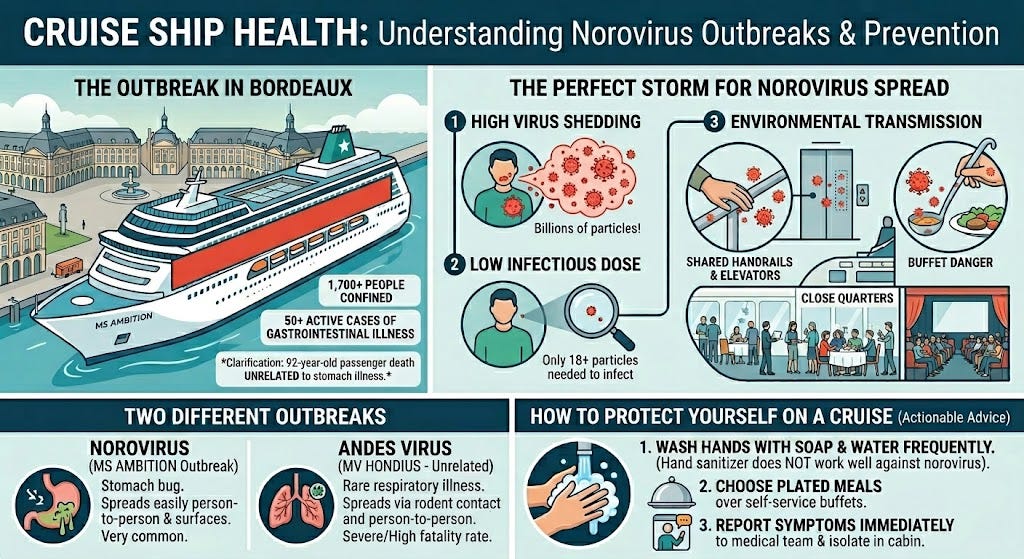
A perfect storm for a stomach bug
Two outbreaks, two very different viruses
How to protect yourself on a cruise
A cruise ship locked down in Bordeaux
On Tuesday, French health authorities confined more than 1,700 people on the cruise ship Ambition after a stomach illness spread among passengers. The ship, operated by the British company Ambassador Cruise Line, had docked in the port city of Bordeaux with about 50 active cases of gastrointestinal illness on board.
The Ambition left the Shetland Islands on May 6 and stopped in Belfast, Liverpool, and Brest before reaching Bordeaux. Most of the 1,187 passengers are from Britain and Ireland. There are also 514 crew members on board.
A 92-year-old male passenger died on May 10th, but Ambassador Cruise Line confirmed that the guest had not reported symptoms of gastrointestinal illness before his death. The cause of death has not yet been established.
After laboratory testing in Bordeaux, French authorities confirmed the illness is viral gastroenteritis caused by norovirus, spreading person-to-person or through the environment. No serious cases have been reported. The ship has since been cleared to continue normal operations, and passengers are now free to disembark.
A perfect storm for a stomach bug
Norovirus is the leading cause of acute gastroenteritis worldwide, responsible for roughly 19 to 21 million illnesses per year in the United States alone. It’s not a cruise ship disease. It’s everywhere. But cruise ships create near-perfect conditions for it to spread.
Start with the numbers. An infected person can shed up to 100 billion viral copies per gram of stool. Meanwhile, it takes as few as 18 viral particles to make someone sick. That gap between how much virus comes out and how little it takes to cause infection is enormous.
Now put that virus on a ship where thousands of people share dining rooms, elevators, railings, pool decks, and buffet serving utensils. Every shared surface is a potential point of transmission. Norovirus can survive on surfaces for days to weeks and resists many common cleaning products. Alcohol-based hand sanitizer, the go-to for many travelers, does not work well against norovirus because the virus lacks a lipid envelope that alcohol can break down.
Buffet-style dining makes it worse. Shared serving utensils mean one sick person touching a ladle can expose dozens of passengers in a single meal.
And then there’s turnover. New passengers board every week, potentially reintroducing the virus to a ship where it may already be lingering on surfaces from the previous voyage. Crew members who stay aboard for months can become bridges between one group of passengers and the next.
The CDC’s Vessel Sanitation Program tracked an average of 12 norovirus outbreaks per year on cruise ships between 2006 and 2019. That number has been rising: 14 outbreaks in 2023, 18 in 2024, and 16 already reported as of mid-2025. These are only outbreaks on ships that visit U.S. ports and meet specific reporting thresholds. The true number worldwide is higher.
That said, millions of people cruise every year. The odds of being on a ship during an active outbreak are low. But when an outbreak does happen, the conditions on a ship can make it spread fast.
Two outbreaks, two very different viruses
The timing of the Ambition outbreak has people understandably confused. Just days earlier, a very different cruise ship crisis was unfolding: a hantavirus outbreak on the Dutch ship MV Hondius that killed three passengers and sickened at least 11.
These are completely different situations.
Hantavirus is a respiratory illness. It spreads through contact with infected rodents or their urine, droppings, or saliva, not through person-to-person contact. (The one exception is the Andes virus, which can spread person-to-person was the strain involved in the MV Hondius outbreak.) Hantavirus is rare but very dangerous, with a fatality rate of 35% to 50%.
Norovirus is a stomach bug. It spreads easily from person to person and through contaminated food and surfaces. It causes vomiting and diarrhea, usually starts within 12 to 48 hours of exposure, and typically resolves in one to three days. It can be serious for very young children, older adults, and people with weakened immune systems, but for most people it is unpleasant, not dangerous.
The MV Hondius picked up hantavirus during a voyage from Argentina through Antarctica and across the South Atlantic. The index case was a Dutch passenger who had spent four months traveling through Chile, Uruguay, and Argentina before boarding. The Ambition, by contrast, sailed a routine route through the British Isles and the coast of France. The two outbreaks have no connection.
How to protect yourself on a cruise
If you’re planning a cruise, there are practical steps you can take to reduce your risk.
Wash your hands with soap and water. This is the single most important thing you can do. Alcohol-based hand sanitizer is not effective against norovirus. The virus lacks the lipid coating that alcohol is designed to destroy. Soap and water physically wash the virus off your hands. Research shows that soap achieves a significantly greater reduction in norovirus on hands than hand sanitizer. Wash before eating, after using the bathroom, and after touching shared surfaces.
Be cautious at the buffet. Shared serving utensils are a common source of transmission. When you can, choose plated meals over self-service options.
Report symptoms immediately. If you develop vomiting or diarrhea, contact the ship’s medical team and stay in your cabin. Early isolation is one of the most effective tools for slowing an outbreak. One modeling study found that a 72-hour isolation protocol averted 71% of potential cases compared to doing nothing.
Don’t assume you’re safe because you feel fine. Infected people can shed norovirus even when they don’t have symptoms. Continue washing your hands frequently throughout the voyage.
There is no vaccine for norovirus yet. Several candidates are in development, including an mRNA vaccine from Moderna and an oral vaccine tablet from Vaxart, but none have been approved.