


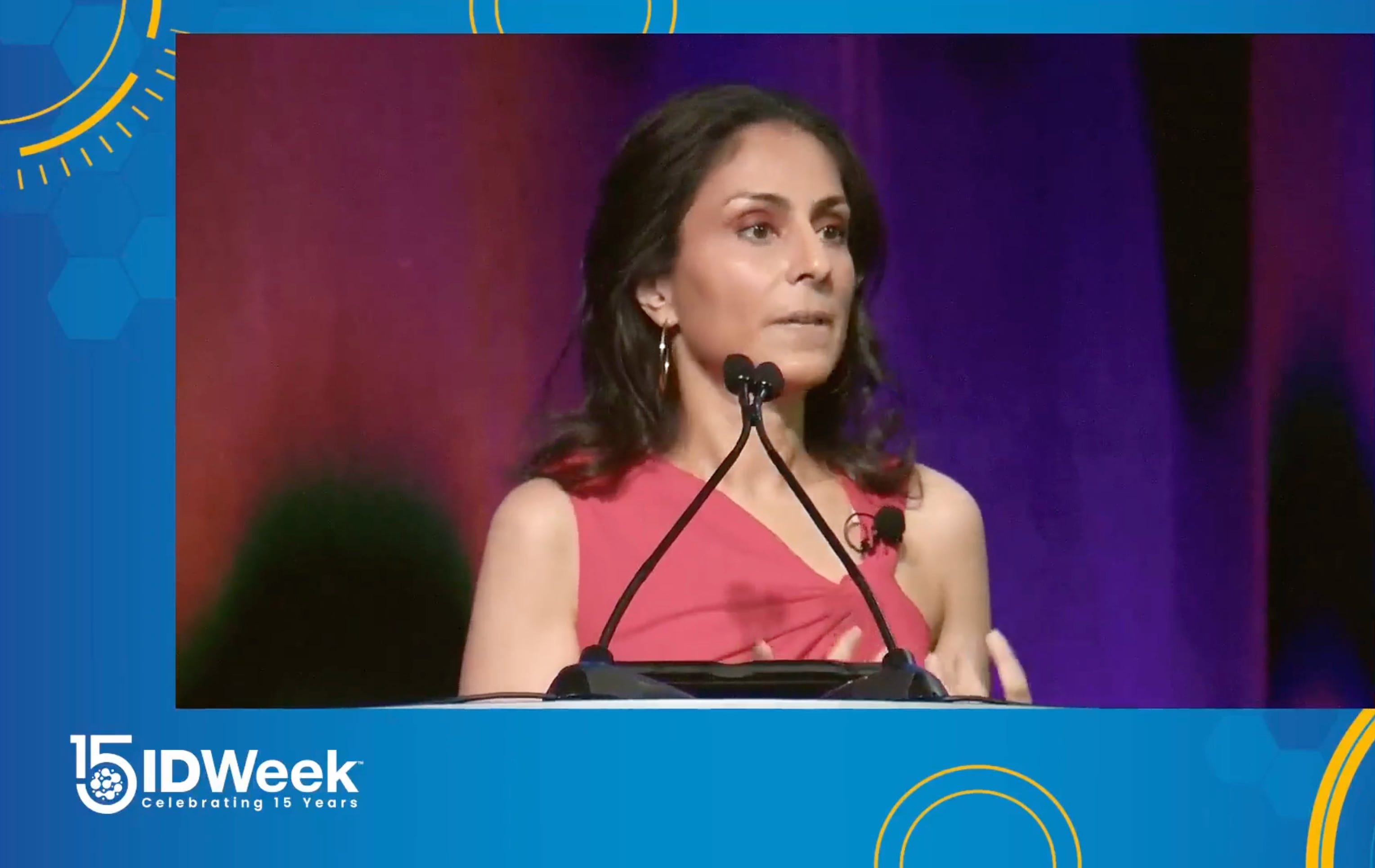
Watch here (jump to 13:50): https://www.idweek.org/joseph-e.-smadel-lecture
Transcript:
The letter that fired the director of the National Institute of Allergy and Infectious Diseases is two paragraphs long.
It’s dated September 26, 2025. The reason? The HHS secretary’s constitutional authority.
Twenty-two days earlier, she had filed a whistleblower complaint with the Office of Special Counsel, the channel federal law gives employees who report wrongdoing. She described grants and clinical trials canceled without peer review, vaccine research pushed aside, and HIV and TB studies abroad cut off. She says she was fired for it. Her lawsuit is still pending.
Many of you know her. Some of you trained with her, and more of you were mentored by her.
Today she runs the society that hosts this meeting.
She’s Jeanne Marrazzo. Who in this field can afford to speak up? Who has already paid for it? And what do the rest of us owe them?
This lecture is named for Joseph Smadel. IDSA describes his work as “a bridge between the basic laboratory and the physician caring for infected patients.” In 1948, he took chloramphenicol into the field in Malaya and showed it worked against scrub typhus and typhoid. He worked at the Rockefeller Institute, Walter Reed, and NIH: academic, military, and government science in one career. He crossed lines this field often keeps separate. He crossed them by choice. Today, defending the work means crossing into politics. Few of us trained for that. Some who crossed lost their jobs.
Thank you to Ron Nahass, for that introduction, to Ron and Ruth Lynfield for the invitation, and Giulia DeMello and the IDWeek program team. And thank you, Jeanne, for letting me share your story.
I’m here as a physician and fellow of the IDSA. I am here speaking for myself, not representing any other organization. I have no disclosures.
Most of us signed the same deal. You train for a decade or more. You make a lot less money than your classmates. In return, you get to choose what you study. The public paid for the work, and peer review and the civil service were supposed to keep politics out of it. And we owe the people who paid for that work an explanation of what we did with their money.
The sociologists Gil Eyal and Ilana Löwy describe basic science as “a social arrangement, dating from the end of World War II, which gives scientists relative autonomy to fund esoteric research that does not have immediate applications.” That arrangement was conditional.
Between February and August of 2025, NIH grant terminations disrupted 383 clinical trials with more than 74,000 enrolled patients. This year, NIH stopped funding grants by score cutoff. NIAID’s policy now says it “will no longer use a score cutoff as the basis for funding.” A proposed rule would have a political appointee screen grant applications. In June, about 8,000 federal science and program jobs were reclassified as at-will, with no independent appeal.
Economists surveyed over 900 young biomedical scientists for the National Bureau of Economic Research. The share planning to stay in academic research fell from 66% to 44%. The share planning to stay in the United States fell from 93% to 72%. Other countries are now recruiting the scientists American taxpayers paid to train.
The old system wasn’t perfect, and we didn’t get everything right during the pandemic. Some of our messaging claimed more certainty than the evidence had. People noticed, and they remember. None of that justifies canceling trials while patients are still enrolled.
Many of us built our careers on federal money and Washington’s goodwill. In 2025, Washington started taking both away.
Under Commissioner Tom Farley, I served at the New York City Health Department. After the 2008-2009 recession, public health suffered big budget cuts. I realized I could only do so much from within when the public didn’t understand what public health was. And that’s how I ended up on the path I’m on now. I added another job. Bearing witness. And it’s come at a cost.
After my husband, Grant Wahl, died in December 2022, strangers told me I’d killed him with COVID vaccines. A local TV news van parked outside my apartment. People tried to break into my building. My protection was my neighbors. That’s not a policy. I reported some of the calls to the FBI.
Every path in this field comes with a trade.
Clinical medicine gives you stability and patients who need you, but you take the work home, and your patients need you at all hours.
Academic medicine lets you choose your questions, as long as the grants keep coming.
Public health and government let you reach whole populations, and in the past two years, some of our best people lost their jobs there.
Global health does the most good per dollar, but when USAID was eliminated, much of the funding evaporated. Meanwhile, NIH stopped allowing foreign subawards.
None of those paths is safe anymore.
One skill I’ve taken from job to job is explaining science to people who aren’t scientists. Taxpayers fund this work. That makes them our bosses, and most of us have never reported to them. We all need that skill, now more than ever. The next time there’s a measles case in your hospital, a reporter might call you. I’ve spent years on the other end of that call, so here are a couple of things I’d want you to know.
Most of you don’t call back, for seemingly good reasons. You don’t have time, or your institution sends every call through its press office. You’re afraid of being misquoted or attacked online. In a 2021 survey of over 460 physicians on Twitter, nearly one in four said they’d been personally attacked on social media. And talking to reporters doesn’t count toward promotion.
Talk to them anyway, because the public still trusts you. The public still trusts you. In KFF’s polling this summer, 86% of adults said they trust their own doctor or healthcare provider for reliable health information, and about half said the same about the CDC. In a Pew survey released in January, 77% said they have confidence in scientists to act in the public’s best interests. When I send questions to CDC now, two HHS press secretaries answer them. I can’t get a CDC scientist on the record. The scientists reporters can still reach… work outside government, and many of them are in this room.
Over the past two years, many people in our field have asked me to cover one story or another. But a story for the general public needs someone the audience can care about, someone willing to be named and say what happened to them. When nobody will be that person, it’s hard for me to tell the story.
Some of you may have fears about engaging with the media. Here’s some advice on how to navigate those conversations.
Settle the terms before you say anything. On the record, your name goes next to your words. On background, the reporter can use what you say but credits it to something like “an infectious disease physician at a large academic medical center.” Off the record, they can’t use it at all.
All three are legitimate, as long as you agree on them at the start, out loud. And if your institution limits what you can say, you can still correct the record on background.
Many reporters call to confirm a story they’ve mostly already written. They’re on deadline, so the time to shape the story is before the interview. Get to know the health reporters in your city before you need them, or they need you. Call back even when the story is small. When something big happens, reporters call the people who explained things clearly and picked up the phone last time.
The rest, you can’t fix alone, but you can ask for help. Ask your chair for protected time, and get the answer in writing. Put your public work in your promotion packet, so the committee has to decide whether it counts. Ask your institution what it will do if you’re harassed or someone tries to get you fired: who pays for a lawyer, who gets your home address offline, who calls security. Ask before you need the answer, because people who’ve spoken up… have lost their jobs.
Jeanne isn’t the only one who’s paid.
Susan Monarez. She was director of CDC for about a month. They asked her to commit in advance to approving every recommendation from the vaccine advisory committee, whatever the evidence, and to fire career staff without cause. She refused, and they fired her. She told the Senate, “I could have stayed silent, agreed to demands, and no one would have known… But I would have lost the one thing that cannot be replaced: my integrity.”
Fiona Havers. She led CDC’s network for tracking respiratory virus hospitalizations. When the secretary removed every member of the vaccine committee in June 2025, she resigned. She wrote that she no longer had confidence the data would “be used objectively.”
Tony Fauci. He ran NIAID for 38 years, and Jeanne succeeded him. Four days after his January 2025 pardon, President Trump canceled Tony’s federal security detail. The president told reporters, “They can hire their own security, too.” President Biden had renewed that detail year after year because of threats on Tony’s life.
Several of the people who lost their jobs have applied for positions for which they were well-qualified, but they didn’t get them, Jeanne told me. Some, she was told, were “too hot to handle.” A chair won’t take on that association, not when federal grants fund their department’s or division’s salaries.
Deb Houry, Demetre Daskalakis, and Dan Jernigan resigned from CDC the same week Susan was fired.
Kathleen Neuzil, who ran the Fogarty International Center, filed the whistleblower complaint alongside Jeanne, then resigned.
Paul Offit was dropped from the FDA’s vaccine advisory committee by email, with no reason given.
Peter Hotez has lived with threats for years and keeps talking anyway.
Most of the people who paid were leaders and career scientists in government, where job protections are weakest, and the June reclassification weakened them further. Of the people he left behind, Demetre said: “Not all people at CDC have the luxury to do so. They have families and financial circumstances to consider.”
Trainees are the ones organizing, writing, and showing up. Senior faculty have tenure and standing. Asking the most exposed people to take the most risk gets it backward.
But senior people in this field have too often been the quietest. And, yes, they have the most to protect: the department’s federal grants, the dean’s relationships, the next study section.
IDSA hears from members who keep their heads down because of their patients, too. They run clinics for people who can’t afford attention. That’s one reason I can’t argue with.
During the AIDS crisis, infectious disease doctors and scientists learned to fight in public, alongside activists.
Right now, a group of HIV researchers and clinicians is organizing again. They call themselves SPEAK UP and include Judy Auerbach, Ken Mayer, Tom Coates, Judith Feinberg, Gregg Gonsalves, and Steve Shoptaw. Judy told me they formed to speak up “as elders where other, younger colleagues cannot.” Several of them came up through the AIDS activist years, so they’ve done this before. But they’re not sure how they can have impact this time around.
Former FDA Commissioner Rob Califf is executive chair of a new group called Coethia. Health professions students run campus chapters that answer health misinformation online. Thirteen chapters are up, and several dozen schools have asked to join.
The people best protected to speak up are sitting in this room. The public still trusts you.
This summer I reported on an AI system that does discovery work. Anthropic said that the system, running hundreds of agents at once, sorted through more than 200,000 proteins in about a day and flagged a new CRISPR-like enzyme system. The company’s lab then made the protein and characterized it. But no one has shown it works as an editing tool in human cells, and finding out… could take years.
A team at Stanford and the Arc Institute went further. They trained a model on millions of genomes, asked it to write new bacteriophages, viruses that infect bacteria, from scratch, and built the designs. Sixteen of the genomes worked. A cocktail of them beat E. coli that had evolved resistance to a natural phage. That’s a new tool against resistant bacteria. It’s also the first time a model has written a working genome.
Private companies are building the capacity to do discovery science, fast, at the same moment Washington is cutting the public pipeline that trains scientists. They’re also making new organisms, and this field is who has to answer for them. Our assays have to detect a sequence nobody has seen before. Somebody has to say whether an existing antiviral or vaccine platform covers it, and run the trial that proves it. Health departments need a case definition, and the surveillance to know whether one case is an outbreak. Companies that print DNA to order screen those against a list of dangerous germs, but that screening is voluntary. The Biosecurity Modernization and Innovation Act, a bipartisan bill, would make it mandatory, but it has sat in the Senate since February and leaves the list of covered organisms to the Commerce Department. This field knows which organisms belong on that list. People in this field belong on the committees that decide what gets screened, approved, and paid for. Your institution’s biosafety committee. The FDA advisory panels. Your state lab’s advisory board. You can file a comment when Commerce publishes the screening rule. Those seats go to whoever shows up.
FDA approved an mRNA flu vaccine this summer. In August, Merck and Moderna reported that their personalized mRNA melanoma vaccine met its main goal in a phase 3 trial. Meanwhile, HHS canceled about half a billion dollars in mRNA projects, including pandemic flu work. Pandemic flu vaccines have no market until the day we need them. Much of infectious disease work is something the market won’t pay for: antibiotics, outbreak response, surveillance, vaccines for the next pandemic. That’s why the public has to.
Do both. Go where the science is moving, and fight for the public pipeline at the same time. And ask the companies that draw on that pipeline to help pay for it.
The companies whose products depend on publicly trained scientists and publicly funded discovery have a stake in this pipeline. NIH funding contributed to the research behind every one of the 210 new drugs FDA approved from 2010 through 2016. You can ask those companies to endow fellowships and bridge positions, held by universities or societies rather than by the companies themselves. If you do, create guardrails to protect against influence over who’s chosen, what the fellows study, or what they publish. But that money can never replace public funding. The moment “industry will cover it” becomes the excuse for the next cut, we’ve traded one conditional patron for another.
The rest is up to the institutions in this room. The public still trusts you.
At the University of Minnesota, CIDRAP’s Vaccine Integrity Project did the evidence review the federal government stopped doing. JAMA published it in September, and the IDSA used it for this season’s recommendations for immunocompromised patients.
At Yale, Anne Zink and Dan Weinberger built PopHIVE, a free public health data platform. It pulls hospital records, immunization surveys, and search data into one place. Anne was Alaska’s chief medical officer through COVID. CDC’s dashboards stopped updating during last year’s shutdown. PopHIVE was one of the few places left to watch RSV.
Jono Mermin ran CDC’s HIV and STI center until April 2025. He’s now dean at Columbia Mailman School of Public Health. He’s building a health policy initiative: research, issue briefs, and people working alongside the officials who write the laws. He says it’s to have the country ready for big changes ahead.
The University of Michigan recently launched a Center for American Dialogue to address polarization and declining public trust. One initiative brings public health faculty and students together with communities across Michigan, in partnership with local health departments. Rather than arriving with a predetermined agenda, these town halls will focus on each community’s health concerns and priorities, creating opportunities for genuine dialogue between residents and public health experts.
Craig Spencer at Brown has a proposal called In Health We Trust. He would hold three sessions in each of sixteen communities: residents, then local leaders, then the health department. Each group would hear recordings from the previous group. Health officials would go on the record first, sharing their understanding of what people need. The idea is to measure the distance between their answer and what residents say.
Universities are building places to do this work. But few reward it or protect the people who do it.
Credit. Most medical schools’ promotion guidelines now mention social media somewhere, but very few state that public work counts as scholarship. Nobody has measured whether promotion committees actually count it. Some of you sit on those committees, so you know the answer better than I do.
Protection. Most universities protect faculty with a list of phone numbers. When people tried to get into my building, it was my neighbors who stopped them.
Here’s a cautionary tale: Stanford’s Internet Observatory studied online misinformation. Lawsuits and congressional subpoenas followed. By 2023, legal fees approached seven figures. Its election project didn’t run in 2024. This July, two years after the project shut down, a judge dismissed the last lawsuit against its researchers.
Some of you may know the virologist Angela Rasmussen. She worked at a vaccine research institute whose leadership kept pressuring her to stop talking about vaccines. She’s received a continuous stream of death threats after an anti-vaccine podcaster pointed his audience at her. Her university offered her wellness resources. Then last November, her university’s administration called her in. They said it wasn’t Angela’s fault, but asked whether she wanted to say something to the colleagues who had gotten hate mail… because of her. One said they were worried about her. They asked, as her friend, whether it wasn’t time to stop talking.
A university’s job is to manage the university’s exposure. The cheapest way to cut exposure is to cut the speech. Your academic medical center will do the same math. They will tell you to stop talking.
In 2011, the American Tradition Institute demanded climate scientist Michael Mann’s emails from the University of Virginia. The university fought it alongside him and won in the Virginia Supreme Court in 2014. His colleagues still raised more than $100,000 for his legal bills. Scott Mandia and Joshua Wolfe turned that fundraising into the Climate Science Legal Defense Fund. The fund is free to scientists, and it has assisted hundreds since. It runs on about half a million dollars a year, which pays for legal advice and lawyer referrals. Journalists have the Reporters Committee for Freedom of the Press, which runs a free legal hotline. Meanwhile, we have no fund. Forty dollars from each of our over 13,000 members would pay for one.
Build the fund. Ask IDSA to advocate for it and to publish model institutional policies, work the society says it already does. But keep the money and the lawyers to defend you outside the universities.
Meanwhile, the people who decide whether this work counts are sitting in this room.
If you chair a department or sit on a promotions committee: count public and policy work as scholarship. Put it in writing, with criteria. The public pays for this work, so explaining it is part of the job, not a favor your faculty do on their own time.
If you train fellows: most of them won’t stay in academic medicine. Don’t treat that as failure. Treat it as sending your people out into the world as ambassadors for your institution. Help them network, and encourage them to consider different career paths.
If you control a budget: fund protected time for that work, and bridge fellowships for the trainees whose grants were cut.
If you lead an institution or a society: put in writing that talking to the public is part of the job, and that you defend the people who do it. Tell them who to call. Don’t tell them to stop talking.
If you’re senior and secure: write the letters, take the reporters’ calls, and put your name down where a younger colleague can’t yet put theirs.
Count it. Fund it. Protect it. Because the public trusts you.
Smadel connected the laboratory to the bedside. This generation needs people who connect the lab to the newsroom, the clinic to the statehouse, and the university to the communities that pay for the science. Those of us with tenure and standing can do that work now. Our job is to make it safe for the people coming up behind us.
The secretary fired Jeanne 22 days after she filed a whistleblower complaint.
This room has tenure, standing, promotion committees, budgets, and a society of over 13,000 members. We decide what counts in this field and who we protect.
The people best protected to speak up are sitting in this room.