


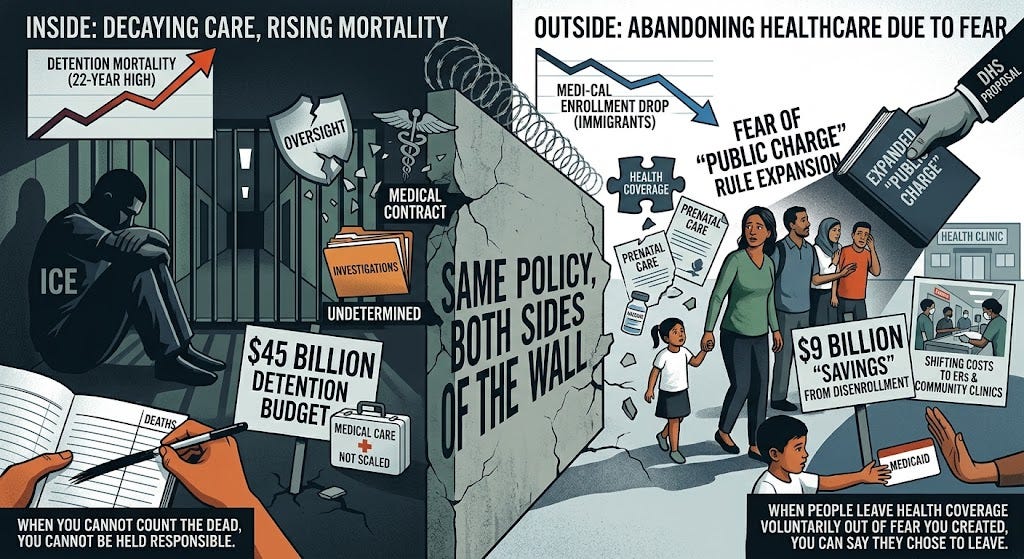
The highest mortality rate in 22 years
The mortality rate in Immigration and Customs Enforcement detention has reached its highest point in 22 years. According to a new study published in JAMA, the rate hit 89 deaths per 100,000 person-years in partial fiscal year 2026. That is higher than it was during COVID.
The people in custody are not more dangerous. There are simply more of them, and less of everything else.
The detained population grew 84% in a single year, reaching roughly 73,000 people. The number of facilities expanded 91%. The proposed detention budget is $45 billion. By any measure, ICE detention is scaling fast.
Medical care did not scale. Inspections did not scale. The offices responsible for investigating when someone dies did not scale.
Who ICE is actually detaining
As of February 2026, 74% of people in ICE custody had no criminal conviction. At-large arrests — meaning ICE picked them up in the community, not at the border — increased 600%. The system is filling up mostly with people who were living ordinary lives.
The VA contract that kept detainees alive is gone
This matters for health because the federal government had specific systems in place to care for people it detained. In October 2025, the Department of Homeland Security terminated its contract with the Veterans Health Administration. That contract provided specialty medical care — oncology, dialysis, prenatal care, tuberculosis screening — to people in ICE custody who needed treatment beyond what detention facilities could offer.
The contract is gone. No replacement has been announced.
300 oversight staff, eliminated
The oversight infrastructure has been gutted. In March 2025, DHS issued layoff notices to the majority of staff in three offices: the Office for Civil Rights and Civil Liberties, the Immigration Detention Ombudsman, and the Citizenship and Immigration Services Ombudsman. Together, these offices had employed more than 300 people whose job was to investigate complaints, monitor conditions, and report problems. A federal judge ordered DHS to clarify that it was not abolishing the offices entirely. DHS complied on paper. It kept them open with skeleton crews — roughly 20 staff at Civil Rights and Civil Liberties, five to seven at each of the other two. The FY2026 spending bill would zero out funding for the Immigration Detention Ombudsman altogether and cut the civil rights office's budget from $42.9 million to $10 million. The offices exist. They are not staffed to function. In 2025, no ICE detention facility received more than one inspection. The facility network nearly doubled that same year.
What “undetermined” actually means
The system is growing in size. It is shrinking in accountability. Both are happening at once. The JAMA study, led by Dr. Sanjay Basu and colleagues, documented 272 deaths in ICE custody between fiscal years 2004 and 2026. The median age at death was 45. Nearly half of recent deaths were classified as “undetermined” — a category that tells you the system has stopped trying to understand why people are dying.
This is worth pausing on. “Undetermined” does not mean the cause of death is mysterious. It means no one with the authority and resources to investigate did so. When you gut the offices that investigate, you do not reduce the deaths. You reduce the record.
Standards on paper, nothing behind them
The JAMA editorial accompanying the study, by Michele Heisler and Katherine Peeler, lays out what this looks like in practice. The Performance-Based National Detention Standards require a medical evaluation within 12 hours of intake. But those standards assume functioning medical infrastructure — staff, supplies, referral pathways, and external specialists. Remove the VA contract. Cut the oversight offices. Double the number of facilities without doubling medical capacity. The standards remain on paper. The care does not.
Outside detention, fear is doing the same thing
The consequences extend beyond detention walls. As reported by KFF Health News, approximately 100,000 immigrants without legal status disenrolled from Medi-Cal between June and December 2025 — roughly 25% of all disenrollments during that period, even though this group made up only 11% of enrollees. The drop reversed steady enrollment growth that began when California opened Medi-Cal to all low-income residents regardless of immigration status in January 2024.
The driving force, according to KFF polling, is fear. Immigration raids in Southern California. Plans to share Medicaid data with ICE. And a November 2025 proposal from the Department of Homeland Security to expand the “public charge” rule — the policy that can block immigrants from getting permanent residency if they or their family members used public benefits. The proposed expansion would include Medicaid and other non-cash programs for the first time.
$9 billion in "savings" from people too scared to use their coverage
DHS itself projected $9 billion in annual savings from the resulting disenrollment. KFF estimated the rule could push 1.3 to 4 million people off Medicaid, including up to 1.8 million citizen children. Nationwide, Medicaid and CHIP enrollment dropped nearly 3% in the first ten months of 2025. Among California’s children, it dropped 6%.
Two systems, one outcome
So there are now two parallel systems producing the same outcome. Inside detention, the government expanded custody while stripping away medical care and the offices that track what happens when care fails. Outside detention, it created conditions where immigrants and their U.S. citizen children leave the health coverage they are entitled to, because using it might make them a target.
The $9 billion accounting trick
The $9 billion the government expects to save from people leaving Medicaid will not reduce health care costs. It will move those costs to emergency rooms, community clinics, and food banks that are already stretched. It will show up later in worse outcomes for children who missed vaccinations, pregnant women who skipped prenatal care, and chronic disease patients who stopped filling prescriptions. The savings are an accounting trick. The costs are real. They are just harder to count, which, at this point, appears to be the design principle.
What you cannot count, you cannot be held responsible for
Inside detention, the system that was supposed to investigate deaths has been gutted to a handful of staff. Outside detention, the system that was supposed to keep people healthy is being abandoned under threat. In both cases, the government has arranged things so that the consequences of its own policies become difficult to measure. When you cannot count the dead, you cannot be held responsible for them. When people leave health coverage voluntarily, out of fear you created, you can say they chose to leave.
A 22-year high in detention mortality. A classification system where nearly half of the deaths are “undetermined.” "Three hundred oversight employees laid off, the offices kept open with skeleton crews. A specialty care contract terminated with no replacement. A hundred thousand people off Medi-Cal in six months. Up to 1.8 million citizen children projected to lose coverage.
These are not separate policy failures. They are the same policy, operating on both sides of a wall.