


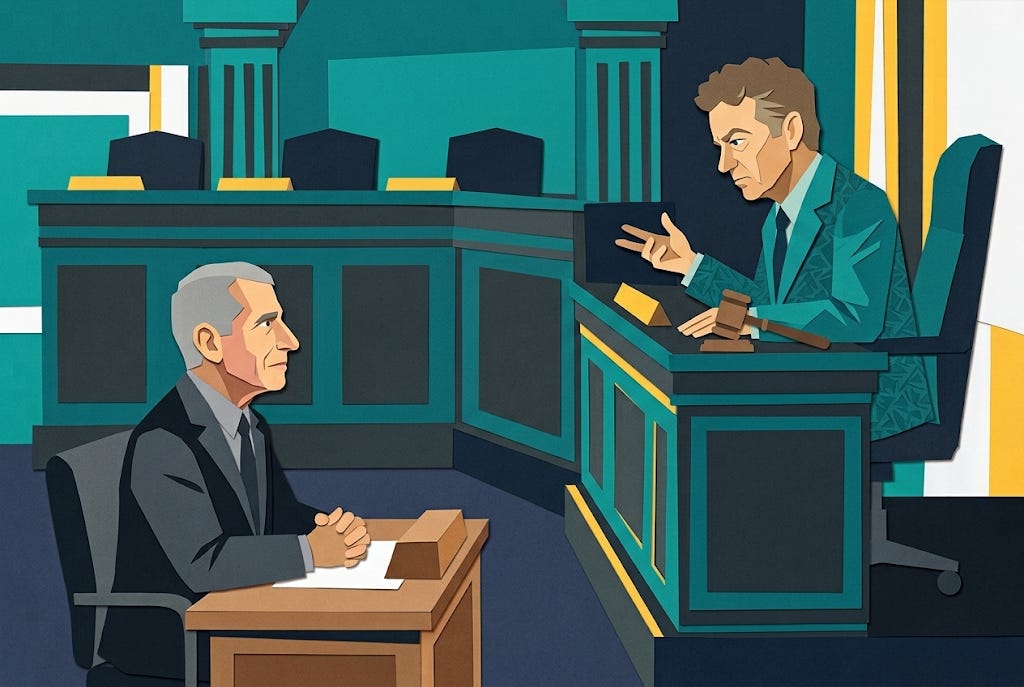
What Sen. Rand Paul released, and what he didn’t.
Sen. Rand Paul has spent five years trying to get Dr. Anthony Fauci charged with a crime. The criminal referral he’d been pushing since 2021 timed out this May with no indictment. What he released now, four days before Dr. Fauci testifies under subpoena, is his diary.
On Saturday, the Senate Homeland Security Committee posted 1,141 pages of Dr. Anthony Fauci’s personal diary. That drop opened in the middle of a sentence with the first 669 pages cut off. And then this morning Sen. Paul posted a second file, “Tony’s Diary: The Prequel”, 465 pages covering April 2001 to July 2015.1
But still missing are roughly 200 pages between mid-2015 and late December 2019. And Part 5, an entire volume, is missing from the middle of the pandemic release even though Part 6 opens with the header “Continued from Part 5.” That gap runs from December 1, 2021 to May 30, 2022, about six months, covering the Omicron surge.
Sen. Paul's case is that these pages catch Dr. Fauci saying one thing in private and the opposite in public.
Did Dr. Fauci privately think COVID came from a lab?
Sen. Paul’s clearest example of Dr. Fauci saying one thing privately and another publicly is the entry for January 26, 2020 (p. 676):

That was the field’s view at the time. It came from the epidemiological and genomic data available at the time.
On January 31, 2020, Dr. Jeremy Farrar called Dr. Fauci and put Kristian Andersen on the line (p. 681):
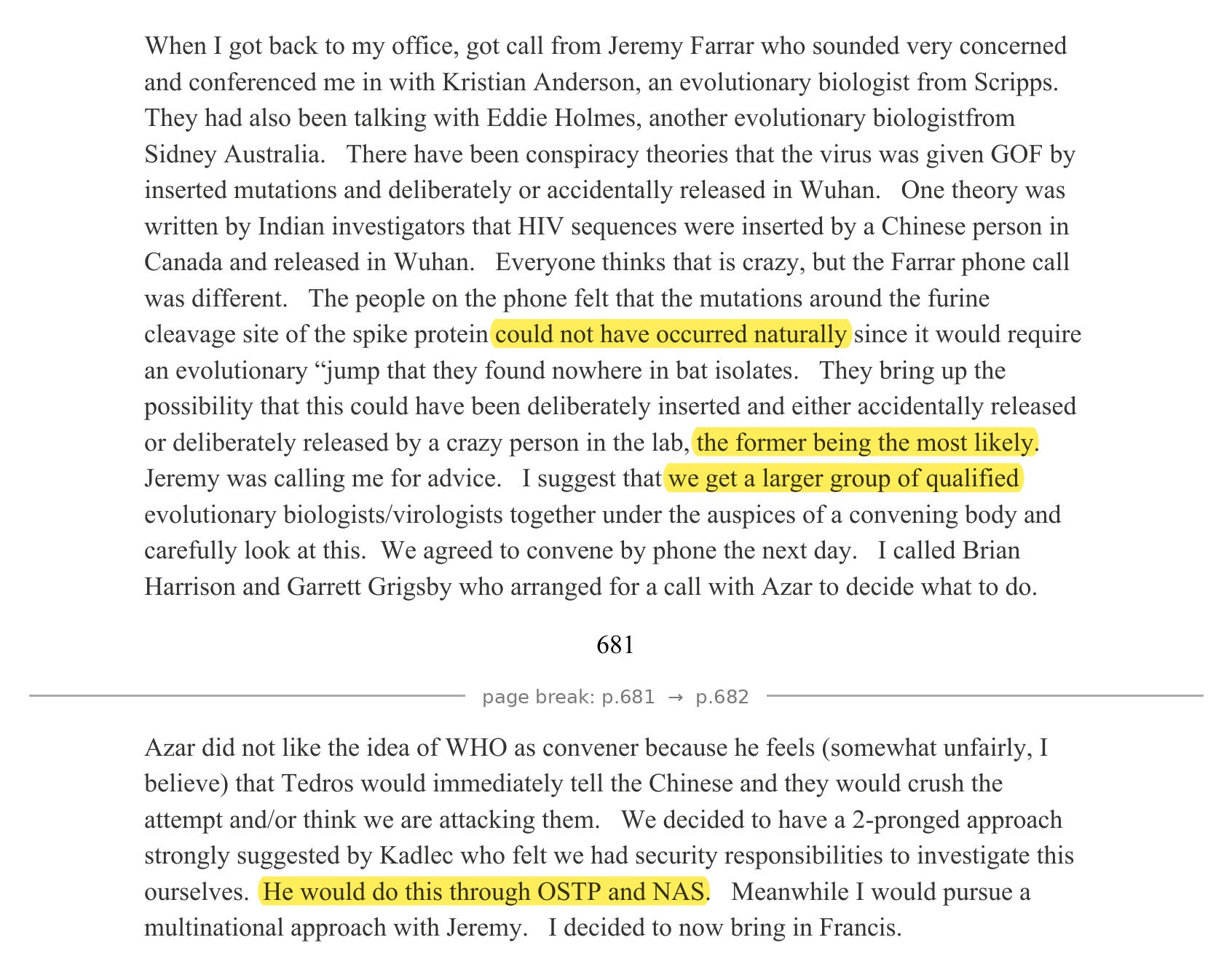
Dr. Fauci suggested “we get a larger group of qualified evolutionary biologists/virologists together under the auspices of a convening body and carefully look at this” (p. 681). That call happened the next day. Dr. Fauci’s stated reason for not dropping it:
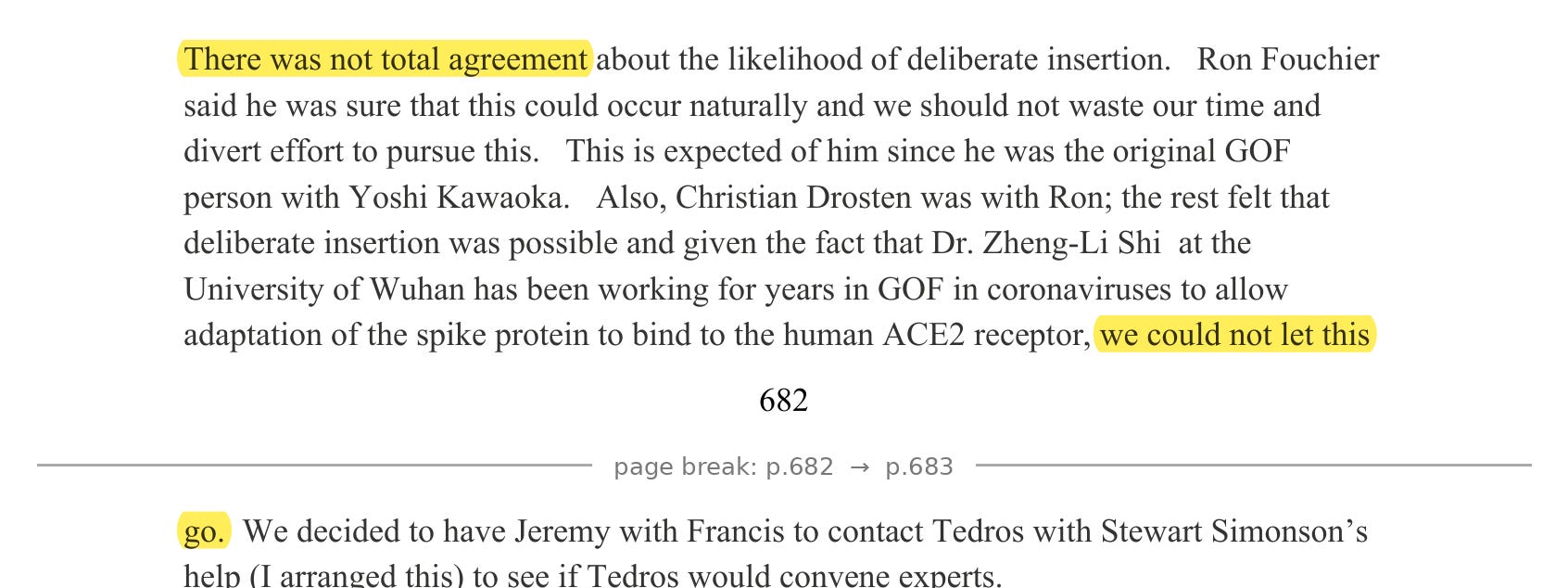
Dr. Fauci admittedly contradicts himself in his diary about that first call. The contemporaneous February 1, 2020 entry (p. 682) has only Fouchier and Dr. Drosten arguing for natural origin (see screenshot above), but on June 7, 2021 (PDF p. 767), in his retrospective entry sixteen months later:

Then in July 2022, a group of scientists published two papers in Science putting the Huanan market back at the center, as the early epicenter, with at least two separate jumps from animals to people there. The authors included evolutionary biologists and virologists Michael Worobey, Kristian Andersen, Eddie Holmes, Andrew Rambaut and Bob Garry.
Note that Andersen, Holmes, Rambaut, and Garry were all on the February 1, 2020 call telling Dr. Fauci the virus might have been built.
So the sequence is: the scientists said engineering was possible, others told them it wasn’t necessarily, they revised, and two years later they published data moving the origin back to the market.
That’s the scientific process working. Formulate hypotheses, then collect evidence to test them. It’s also why five years of this fight hasn’t moved anyone. Both sides are arguing about what a dozen people said on a phone call in 2020, and the evidence that would settle it isn’t in the diary or in anyone’s inbox. It was in Wuhan. Chinese authorities cleared the live animals out of the Huanan market in the first days of January 2020. Hundreds of environmental samples were taken. The animals themselves mostly weren’t tested, and no serious independent investigation of the market has been permitted since.
Who’s responsible for closing schools?
In a January 2024 transcribed interview with the House, he said “that is the big misperception, when people are out there saying, ‘Fauci closed the schools.’ Fauci did not close the schools.” He later added, “I did not close the schools. And it became the widespread situation where I became a political target.” He also confirmed that he had no authority to decide when schools resumed, that the process “was largely decided at the State and local levels of government,” and that the federal role was “largely an advisory and support function.”
Dr. Fauci ran a research funding institute and had no legal power over classrooms. But in his diary, Dr. Fauci acknowledged that his advice was influential:
March 9, 2020 (p. 712):

March 15, 2020 (p. 724):

But the districts moved even before the governors. By March 18, 2020, the day before Governor Newsom’s statewide stay-at-home order, districts serving more than 99% of California’s 6.2 million public school students had already closed or announced closure on their own.
So if Dr. Fauci didn’t have the power, who did? The authority sat with about 13,349 regular public school districts, their boards, their governors, and in 34 states, their teachers’ unions at the bargaining table. Education is a state function in every state constitution. There is no federal authority to close a classroom, and federal law goes out of its way to bar federal officials from controlling a school’s program of instruction.
By July 2020, President Trump was pushing hard to reopen schools. On July 8, 2020 (p. 909), Dr. Fauci wrote:

On July 8, 2020, CDC Director Dr. Robert Redfield said, “Remember it’s guidance. It’s not requirements.” He added that CDC’s guidance was not meant to provide a rationale for keeping schools closed.
On July 9, 2020 (p. 911), Dr. Fauci wrote:

On July 31, 2020, Dr. Fauci testified under oath before the House. He said, “a default position, despite the fact that we have to have flexibility, would be to try and, as best as we possibly can, in the context of the safety of the children and the teachers, to open the schools… because of the negative consequences on children from a psychological standpoint as well as the downstream unintended consequences on families.”
Later in his diary on August 9, 2020, he wrote:
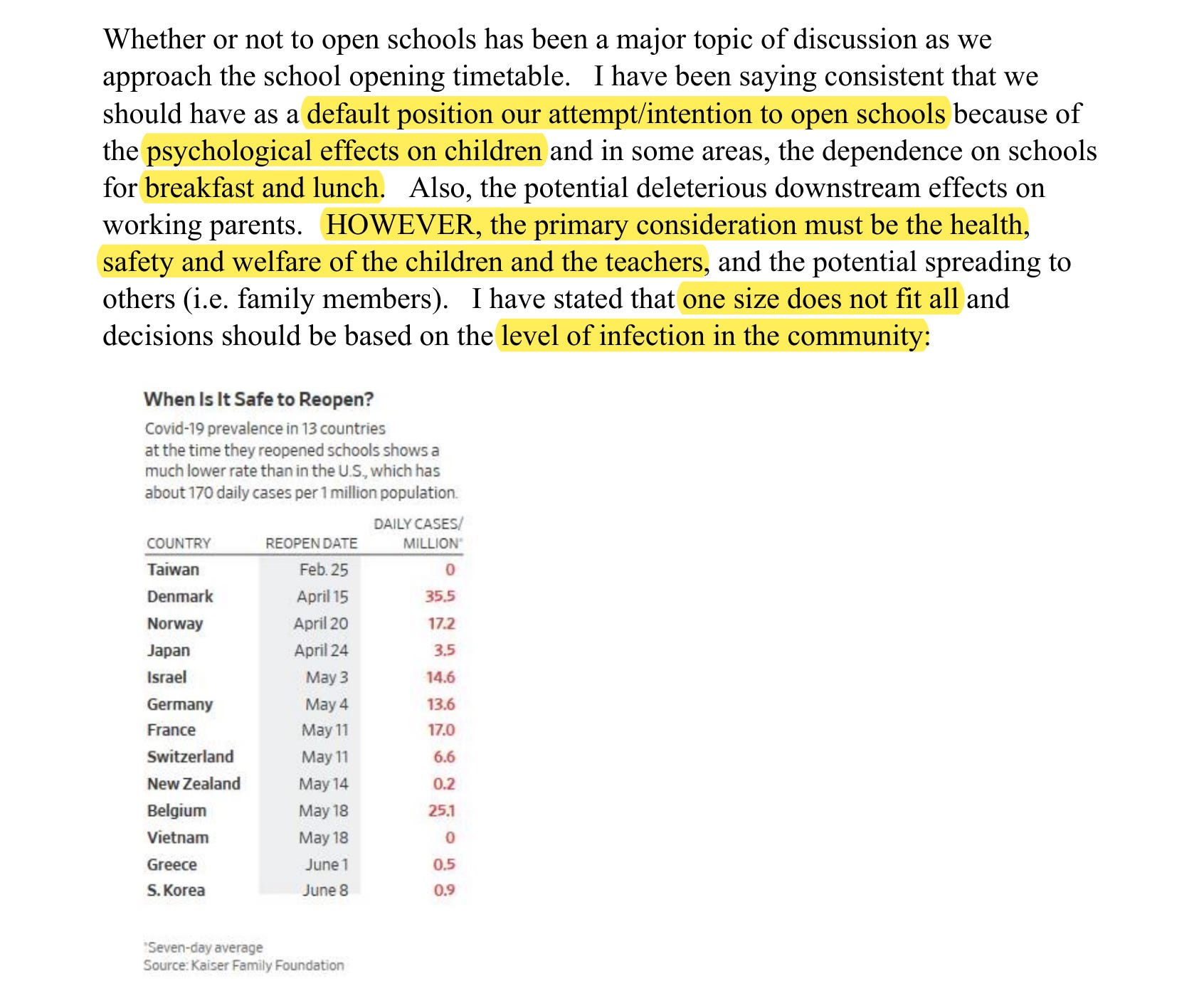
On November 29, 2020, on ABC Dr. Fauci said, “close the bars and keep the schools open is what we really say.” Then in March 2021, Dr. Fauci endorsed three feet of distancing on CNN days before CDC adopted it. That single change is what made it possible for a lot of districts to physically fit kids back in buildings.
What the diary says about the booster timeline.
On September 2, 2021, regarding the eight-month wait for a COVID booster (PDF p. 866), Dr. Fauci wrote:
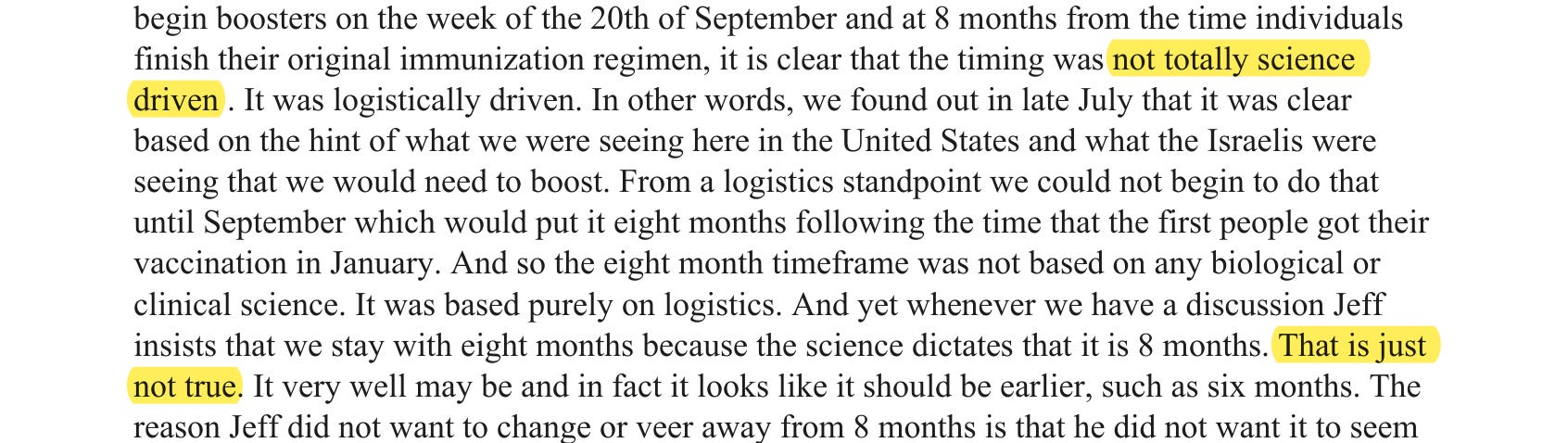
He signed the joint statement announcing boosters starting eight months after an individual’s second dose, but five weeks later, the CDC recommended boosters at least six months after their primary series.
Scientists were saying in public at the time that the decisions weren’t evidence-based, and I was one of them. In early August 2021, in The New York Times with Dr. Carlos del Rio and John Moore, I argued that the dosing question was unsettled and that extra shots for the vaccinated shouldn't come out of the supply for the unvaccinated.
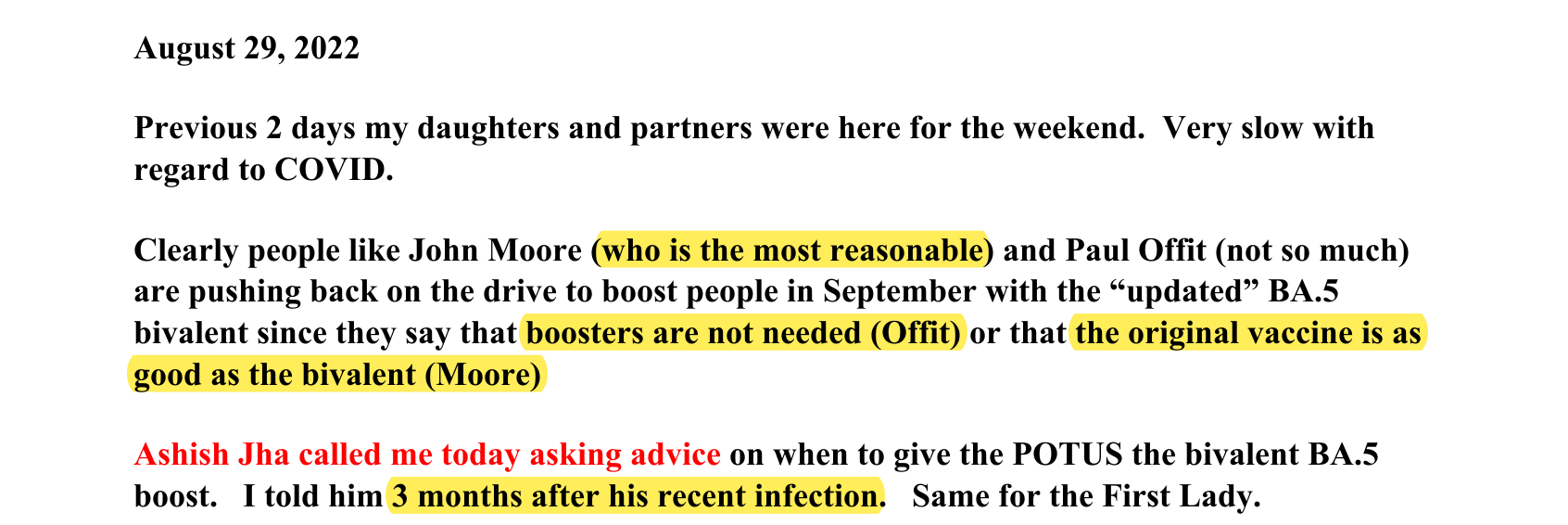
Four days after signing, Dr. Fauci logged the pushback in his diary:

A year later, he would name Moore in his diary as the most reasonable of the critics (PDF p. 1046).
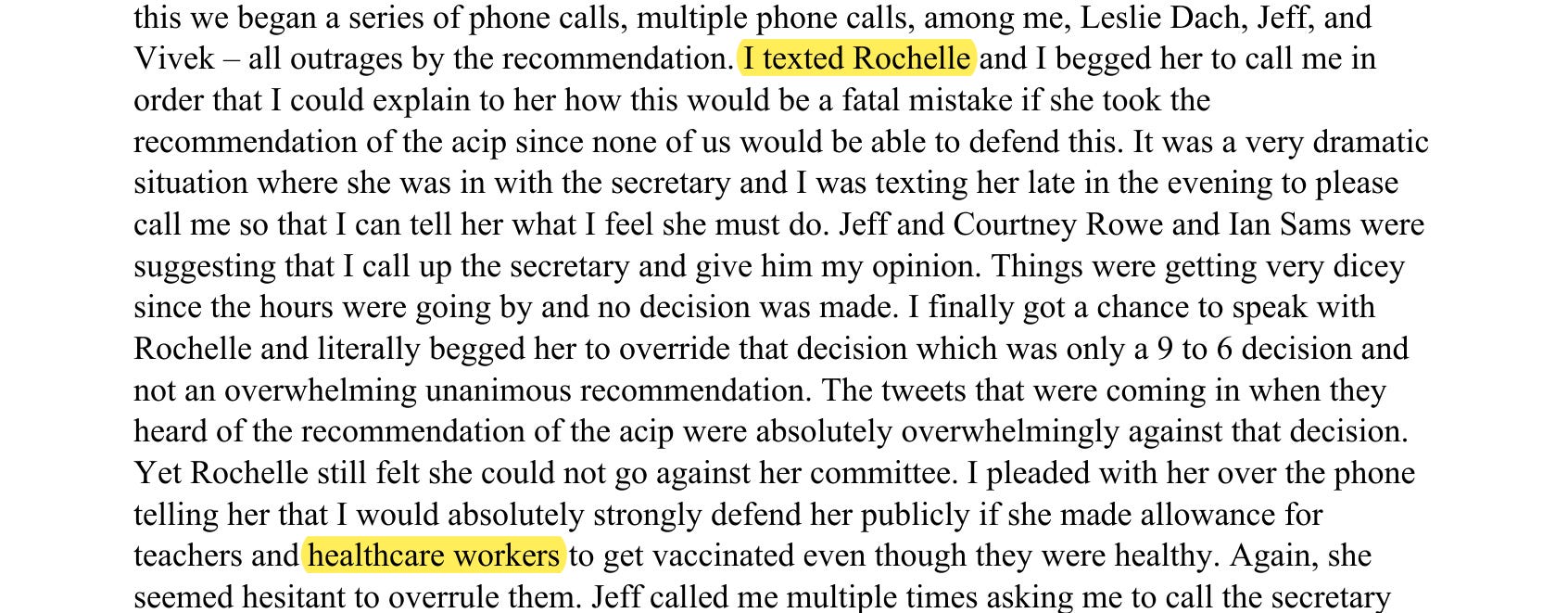
On September 23, 2021, after CDC’s advisory committee voted 9 to 6 against boosters for people whose jobs put them at risk, he pushed Dr. Rochelle Walensky to override her own committee (PDF p. 883):
What they agreed to say about the J&J vaccine.
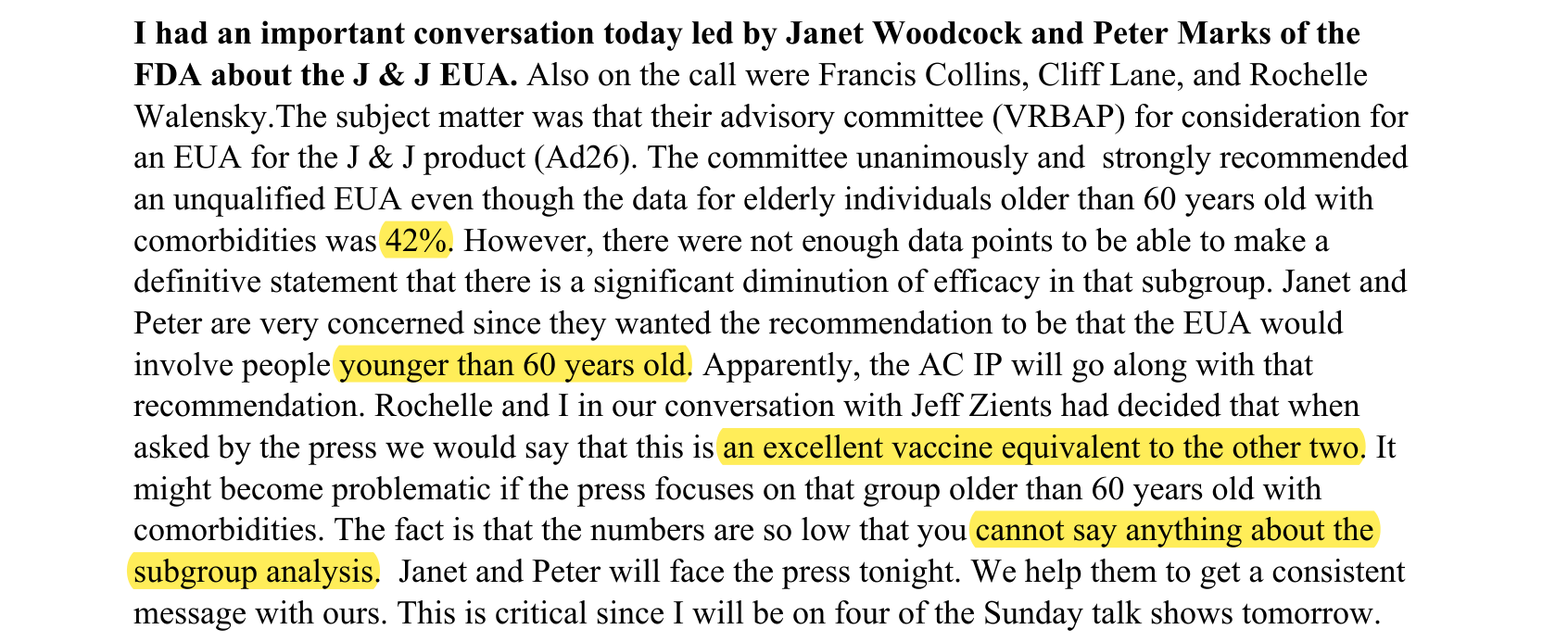
On February 25, 2021 (PDF p. 631), the night before the J&J vaccine went to FDA’s advisory committee, Dr. Fauci and five others agreed to recommend authorizing it only for people under 60:

The committee voted the next day unanimously for an unrestricted authorization.
On February 27, 2021 (PDF p. 634), Dr. Fauci wrote:
But none of what I’ve covered to this point is what led the news coverage of the diary thus far.
What being the face of the pandemic did to him
Fox News led its coverage of the Fauci diary release with the vanity entries, and they’re real. He tracked his own fame closely. Here’s the passage everyone’s quoting:
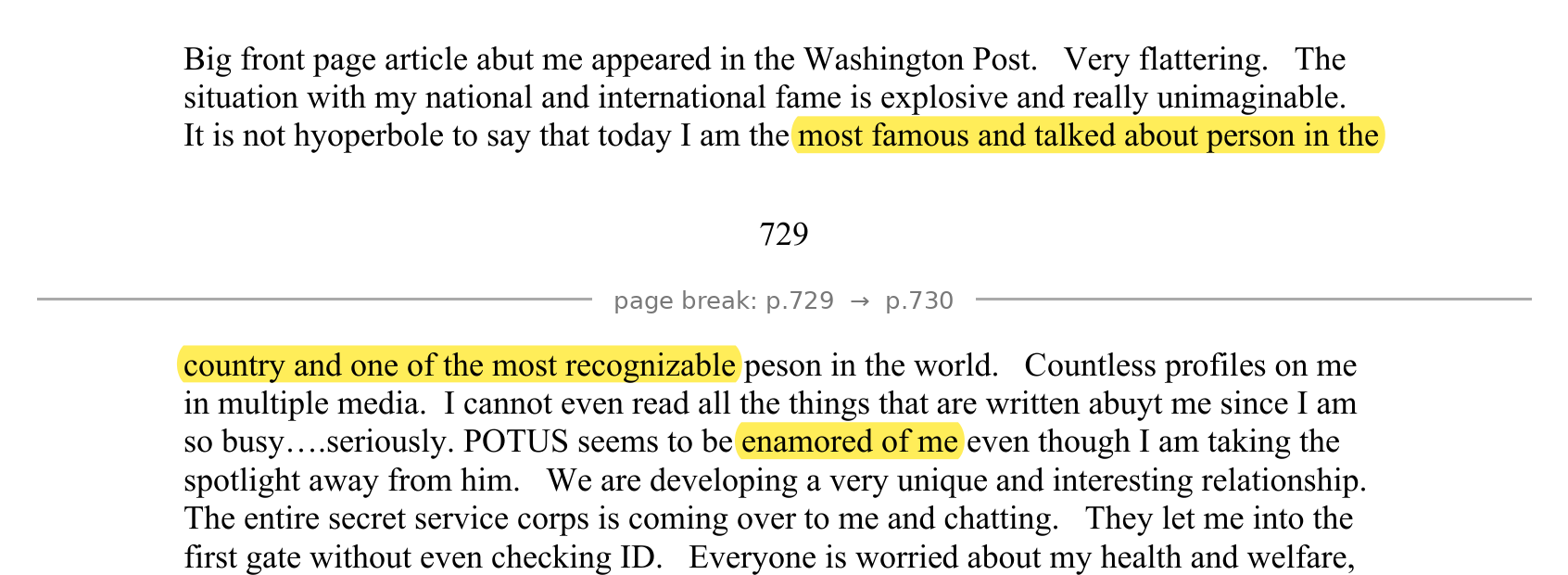
But many of his diary entries also expressed embarrassment and discomfort with the newfound fame:
On January 29, 2020 (p. 678):

February 8, 2020 (p. 686):

On March 27, 2020, at the relief-bill signing, President Trump said, “I cannot sign this without you being here (p. 742):

April 3, 2020 (p. 752):

The public attention also led to harassments and threats. On April 15, 2020, in the same entry where he logs a Laura Ingraham appearance and a needling text from Jake Tapper about it, Dr. Fauci wrote (p. 781):

On April 17, 2020, after a fabricated sexual-assault allegation went out to reporters from a law firm that turned out not to exist, Dr. Fauci wrote (p. 790):
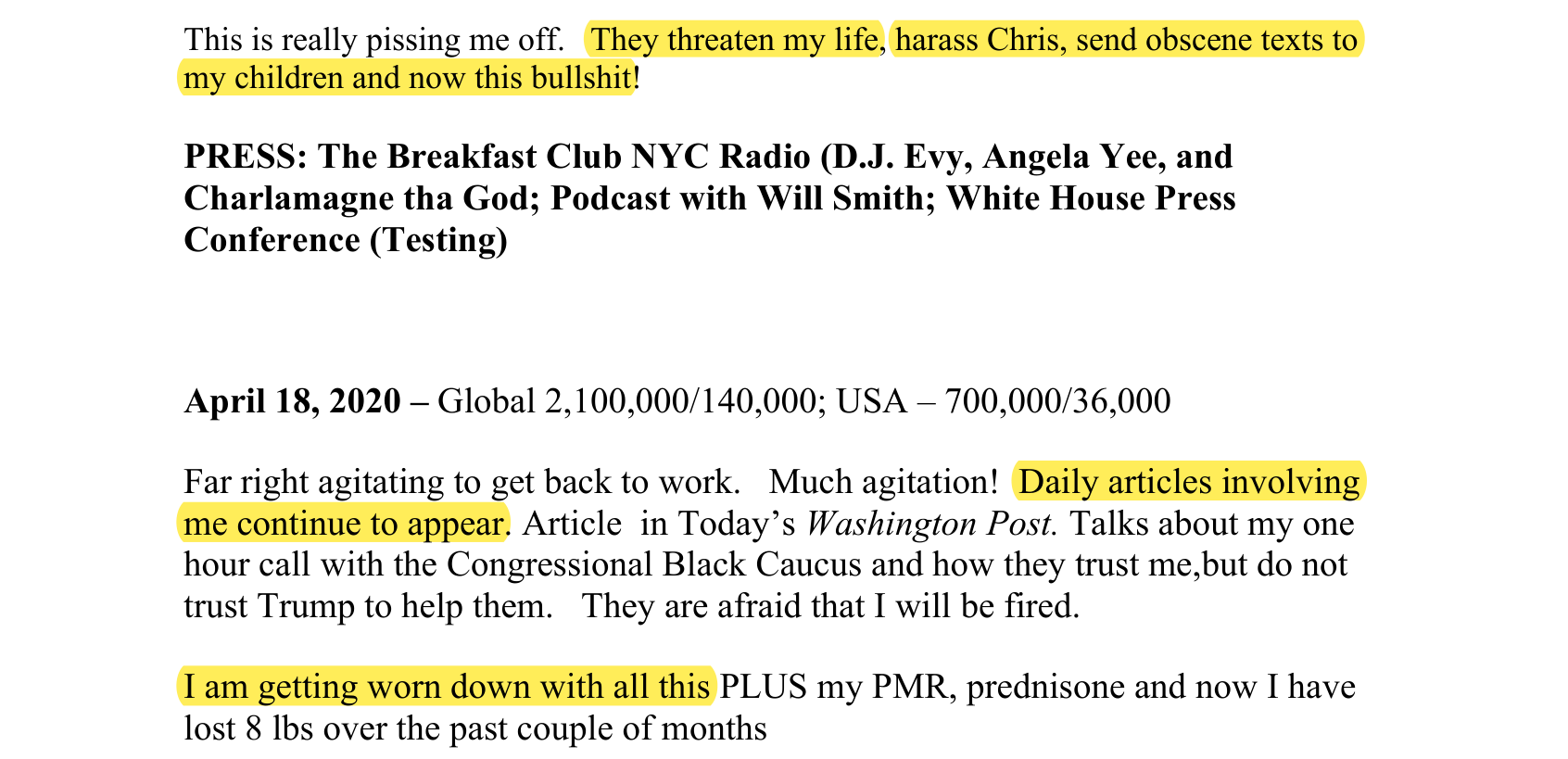
President Trump ended Dr. Fauci’s federal protection on January 23, 2025. Since then, Dr. Fauci has had to pay for security.
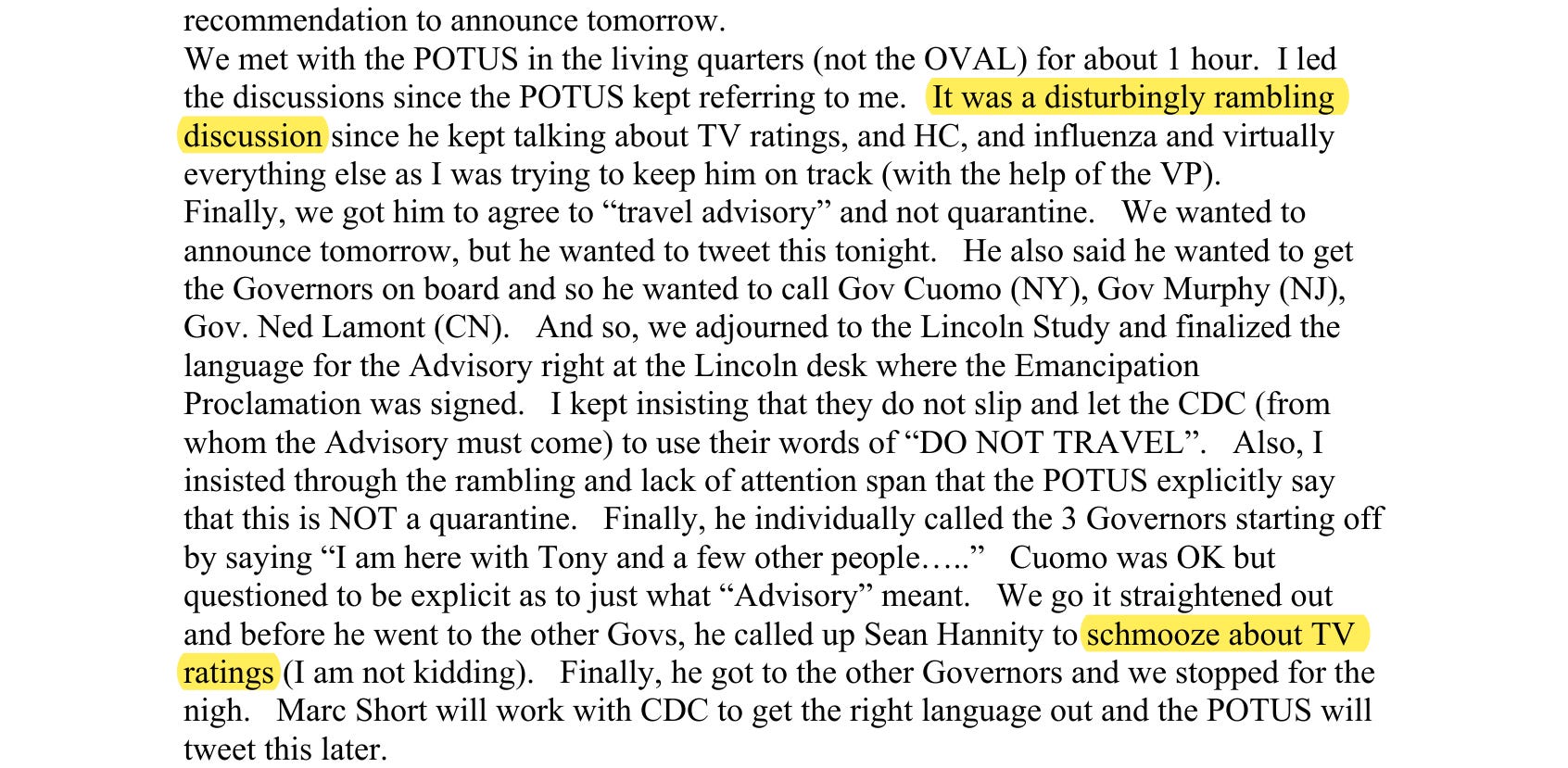
Meanwhile, President Trump’s talk of ratings was constant, and Dr. Fauci described that, too. On March 28, 2020 (p. 743), during the hour in the residence where the team talked President Trump out of quarantining New York, New Jersey and Connecticut, the president broke off between calls to the three governors to phone Sean Hannity:
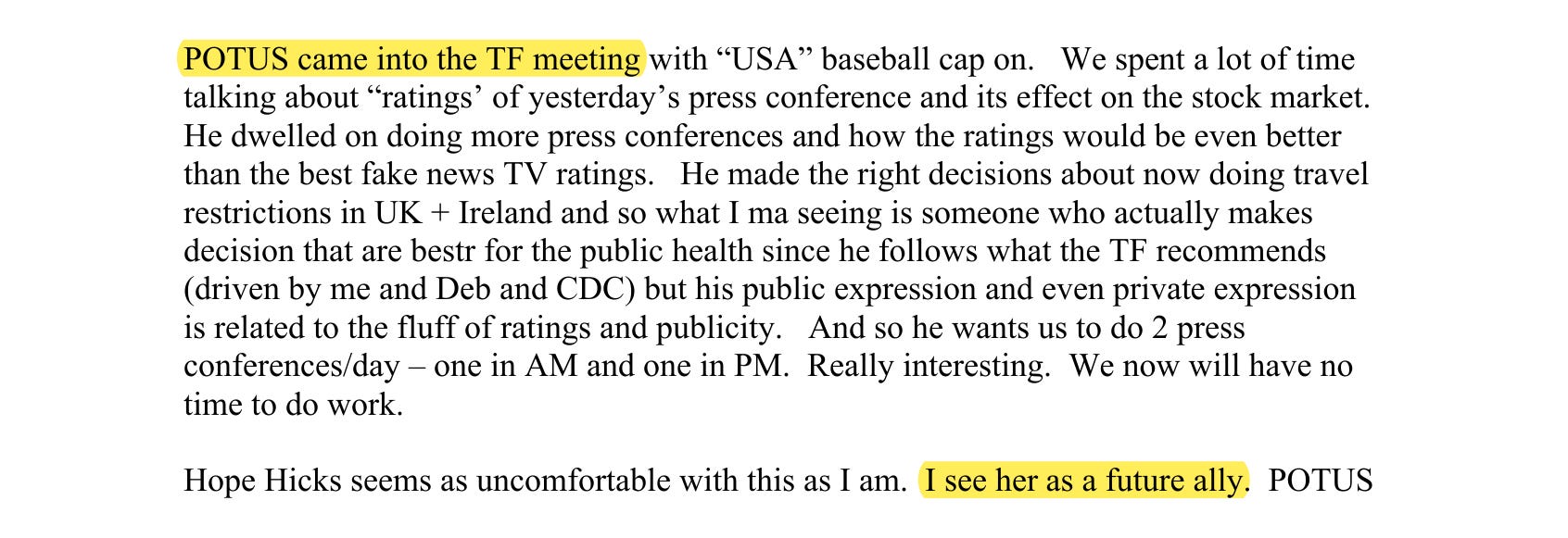
On March 13, 2020, Dr. Fauci expressed frustration that the media attention was pulling him away from the job at hand (p. 719):
And then, May 23, 2020, Dr. Fauci described doing what he could to protect his working relationship with President Trump (p. 731):

By July 29, 2020 he was writing (p. 932):

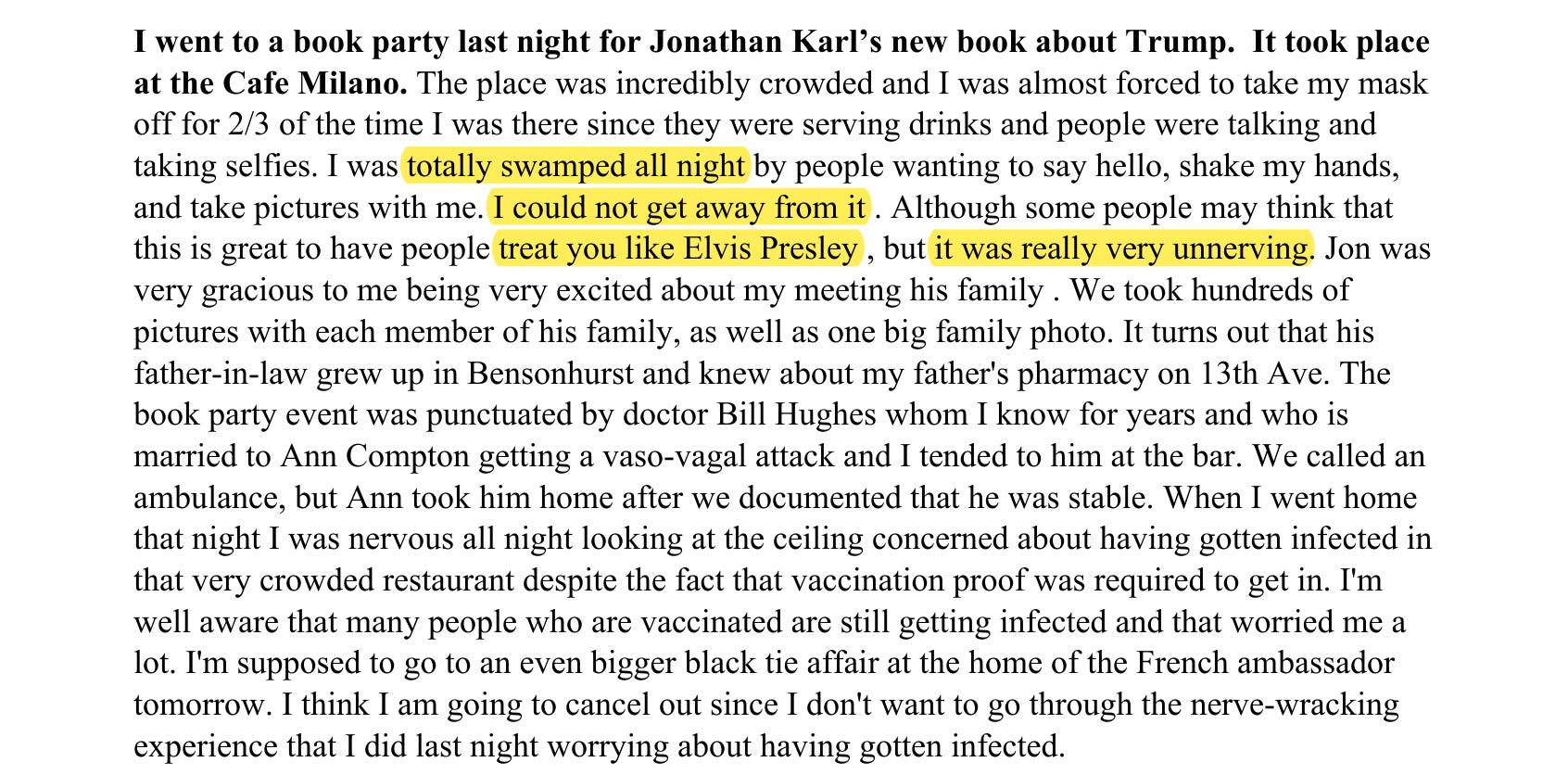
Dr. Fauci continued to express uneasiness with the attention for years. At Jonathan Karl’s book party on November 17, 2021 (PDF p. 923):
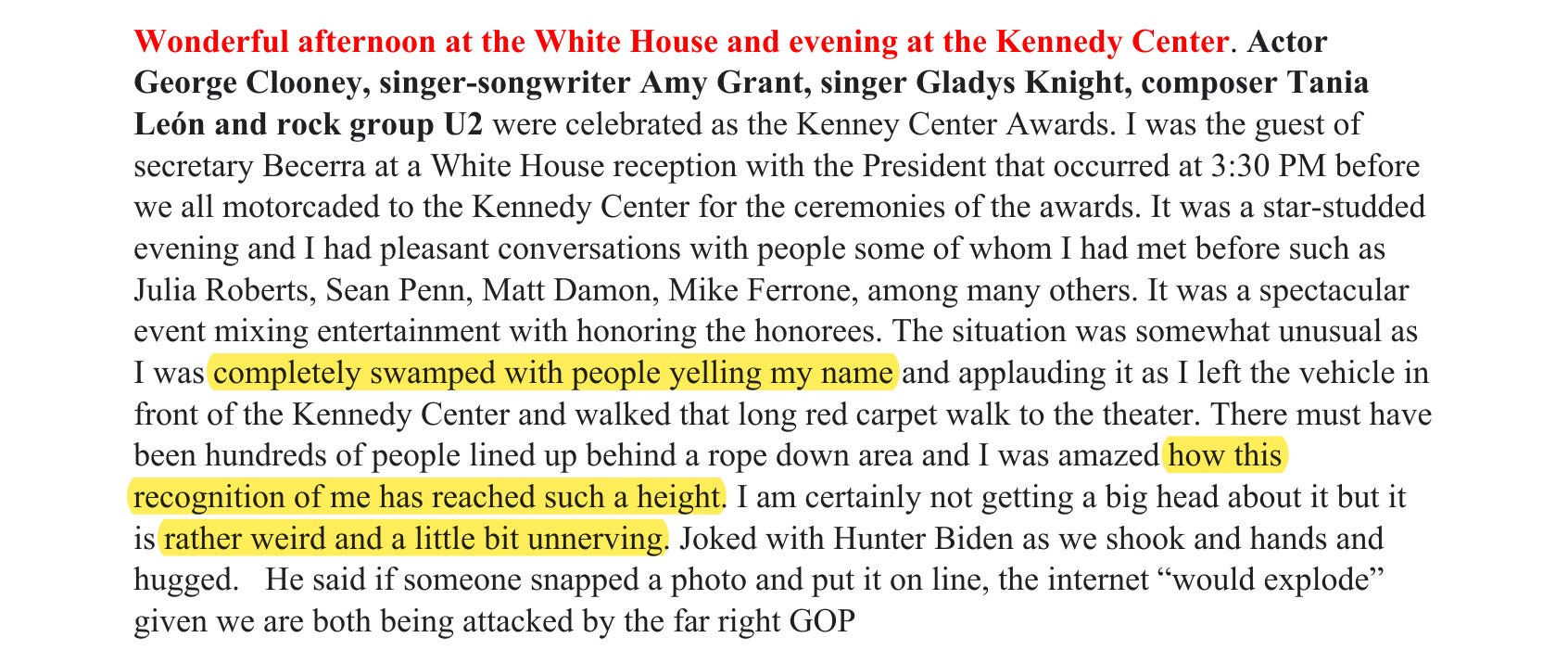
On December 4, 2022 at the Kennedy Center (PDF p. 1132):
Wednesday’s hearing
Dr. Fauci testifies Wednesday under subpoena. Most of the questions will be about COVID’s origins, which is the fight Sen. Paul has been having since 2020 and the one these pages do the least to settle.
A note on the page numbers. Dr. Fauci paginated his own document, but only part of it. The printed numbers run 670 to 938 for the first stretch, Dec 2019 to Aug 4, 2020, then restart at 1 for the volume covering Aug 5, 2020 to Jan 9, 2021. Everything from January 2021 forward carries no page numbers at all. So citations here give his printed page where one exists (p. 681, p. 909) and the PDF page where one doesn’t (PDF p. 866). To convert: add 668 to a PDF page in the first stretch, subtract 270 in the second. In the prequel, subtract 2. Every quote is also dated, which works in either system.