


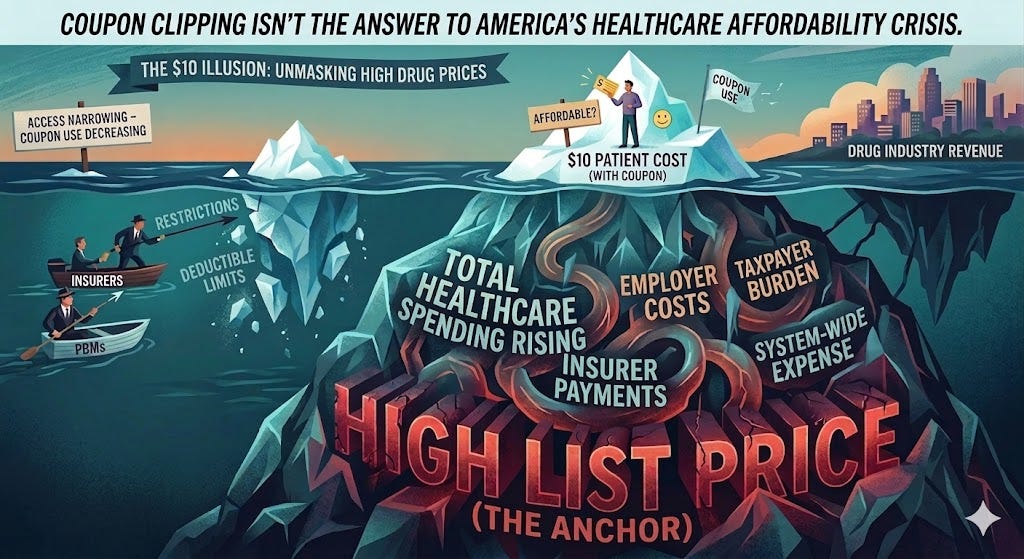
A drug can cost you $10 and still be expensive.
Drug companies say coupons help patients afford medicine. They lower out-of-pocket pharmacy costs and make it easier to start and stay on treatment.
That is partly true.
The Trump administration's new drug pricing program, TrumpRx, is the latest version of this logic. It is, at its core, a coupon aggregator — a federal clearinghouse that compiles manufacturer discounts and directs patients to them. It lowers what patients pay at the counter. It does not lower what drugs cost.
But the big picture is different.
According to a study published today in JAMA, fewer people are using coupons now. In 2017, about 18% of patients used them. By 2024, that fell to about 14%. Some drugs saw much steeper drops. For obesity drugs, coupon use went from more than half of patients to almost none.
At the same time, the remaining coupons are larger. The average value has increased. Some free trials now cover hundreds of dollars.
Patients still pay roughly the same amount: around $10.
So the price at the counter looks stable, even as the system behind it shifts.
Coupons are built to protect high prices.
In the US, drug prices are anchored to a “list price.” That figure shapes what insurers pay, what companies earn, and even prices in other countries.
Lowering the list price cuts revenue across multiple channels.
Coupons avoid that outcome.
They let companies offer discounts to some patients without changing the official price.
Coupons don’t lower prices. They decide who pays them.
Coupon aggregators like TrumpRx make this dynamic easier to scale. By centralizing access to manufacturer discounts, they expand coupon reach without touching list prices — insulating drug companies from pressure to reduce what they actually charge.
Insurers are trying to control costs.
They rely on higher copays, prior authorization, and step therapy to steer patients toward cheaper options.
Coupons undercut those tools.
A drug with a high copay can still cost $10 with a coupon, removing any incentive to switch.
Insurers have started to push back. Some plans no longer count coupons toward deductibles, which reduces their value.
That is one reason fewer patients use them.
Affordability is becoming something you qualify for, not something you expect.
When cheap gets expensive.
When patients are shielded from the full price, they are more likely to use expensive drugs. Insurers still cover most of the cost, with employers and taxpayers absorbing the rest.
Over time, total spending rises.
This is how coupons drive up overall healthcare costs: not by raising what any one patient pays, but by removing the price signals that might otherwise redirect demand. A program that makes a $400-a-month drug feel like a $10 drug does not make the drug cheaper. It redistributes the cost to insurers, employers, and ultimately to premiums and taxpayers.
Coupons are not disappearing. They are being used more selectively. Fewer patients receive them, but the discounts are larger.
This is a shift in strategy.
Access is narrowing.
Insurers are tightening access. Drug companies are targeting their discounts. Patients have fewer ways to reduce costs.
The system is not getting cheaper.
It is becoming more selective.
A federal coupon aggregator like TrumpRx fits squarely inside this system. It does not restructure drug pricing. It routes existing discounts more efficiently — to patients, and away from any reckoning with list prices.
Coupons exist to preserve high prices, not reduce them.
The $10 price was never the real one.
There's nothing that I can add to this report, other than an affirmation that this report serves as a comprehensive resource, which hopefully will empower consumers/patients to fully grasp and understand the marketing landscape, as it relates to drugs, pricing & a strategic system which doesn't make its access any cheaper.
Hopefully, this report will offer clarity that will transform simple awareness of "drug coupons," and its marketing landscape & strategies into an enlightened decision-making to actively & effectively compare safety, quality and value.🍀