


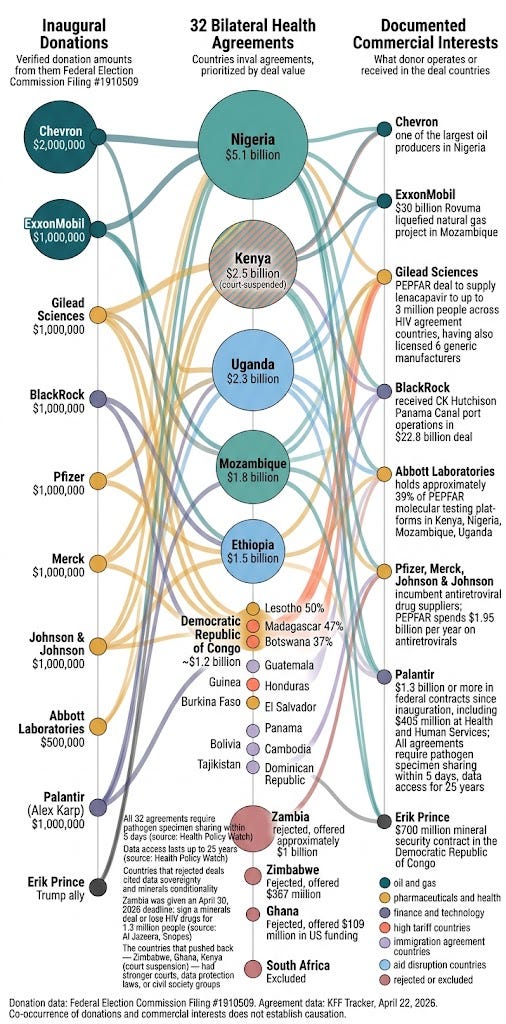
A $2.5 billion deal and its consequences.
Last week, two people were killed in Kenya during protests over a US Ebola quarantine facility being built at Laikipia Air Base. The plan: fly Americans exposed to Ebola in the DRC to a 50-bed unit on Kenyan soil. Kenyan doctors opposed it. A court blocked it. The government pushed ahead anyway.
Kenyan President William Ruto said he agreed because President Trump asked and because it fit inside their bilateral health deal. That deal, signed in December 2025, is worth $2.5 billion in total. The US share is a 22% cut from its previous spending. And it comes with strings: data-sharing access up to 25 years, pathogen specimen sharing within five days, and now, an Ebola quarantine facility Kenya didn't ask for. Dr. Jean Kaseya, Director-General of the Africa CDC, has said publicly: “There are huge concerns regarding data, regarding pathogen sharing.”
Kenya is one of 32 countries that signed bilateral health agreements with the Trump administration. These deals, worth $20.3 billion total, restructured the delivery of the President’s Emergency Plan for AIDS Relief (PEPFAR), launched by President George W. Bush in 2003, which channeled billions through both bilateral country programs and the multilateral Global Fund. Now each country negotiates alone, one-on-one, with the US.
According to the Center for Strategic and International Studies, the administration’s trade architect Robert Lighthizer prefers bilateral deals because they are “easier to negotiate (only one country, usually smaller than us, to push around).” In a group, small countries can team up and push back. Alone, they can’t, especially when what’s on the table is medicine their people need to survive.
Tariffs, deportations, and mineral deals came first.
The three figures below show what I could find based on public records:
Table 1. Countries and documented actions.
Table 1 maps the more than 30 countries that signed bilateral health agreements with what the US did before or during each deal. Some patterns show up. Countries that got the highest tariffs — Lesotho at 50%, Madagascar at 47%, Botswana at 37% — signed health deals within months. In Latin America, countries that signed deportation agreements — Guatemala, Honduras, El Salvador — got health deals afterward. That doesn’t prove the health deals were rewards. But the timing is consistent.
In some cases, the link is on the record.
In Guinea, the US signed a critical minerals partnership on February 5, followed by the health deal on February 27 — [a sequence the Observer Research Foundation noted](https://www.orfonline.org/expert-speak/critical-minerals-pathogen-data-and-the-new-turn-in-us-global-health-engagement) "underscores how critical minerals have emerged as a focal point in health assistance negotiations."
Al Jazeera reported Guinea’s health deal was “conditional on signing agreements granting the US access to critical minerals.” In the DRC, the US signed a mining partnership in December 2025, giving American companies preferential access to cobalt and lithium. The health deal came about three months later. In Zambia, the State Department set a deadline: sign a minerals deal by April 30th or lose HIV drugs for 1.3 million people. Zambia’s foreign affairs minister pushed back, objecting to “the coupling of the proposed agreements.” Hospitals there are now reporting more AIDS cases.
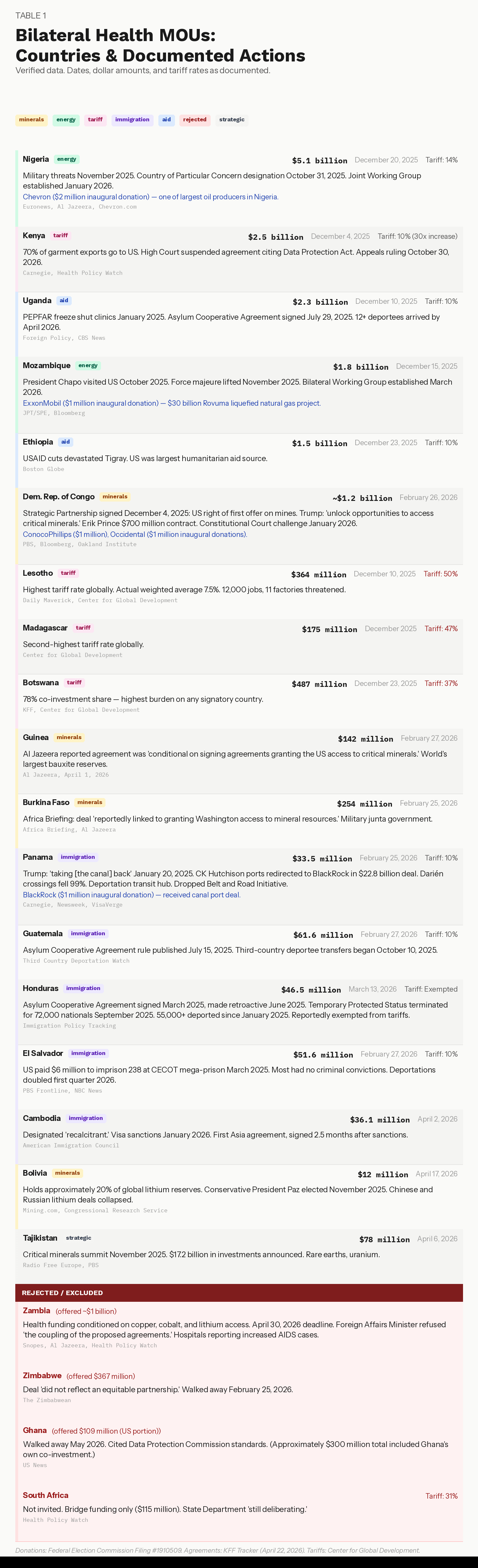
Table 2. Inaugural donors with commercial operations in MOU countries
Table 2 adds another layer: Trump inaugural donors who have business in the countries getting these deals. Chevron gave $2 million to the inauguration. It is one of the biggest oil producers in Nigeria, which got the single largest health deal at $5.1 billion. ExxonMobil gave $1 million. It has a $30 billion gas project in Mozambique, which got up $1.8 billion in US health funding. Gilead Sciences, another $1 million donor, secured a deal to supply its HIV prevention drug lenacapavir to up to 3 million people across nearly all of these countries through PEPFAR and the Global Fund.
Correlation isn’t causation. This doesn’t prove these donations resulted in those outcomes. Chevron was in Nigeria long before this deal. Gilead’s drug lenacapravir is a real medical advance, and the company has also licensed generic manufacturers. But the pattern — give money to the inauguration, then benefit from policy in countries getting health deals — shows up across many donors and many sectors.
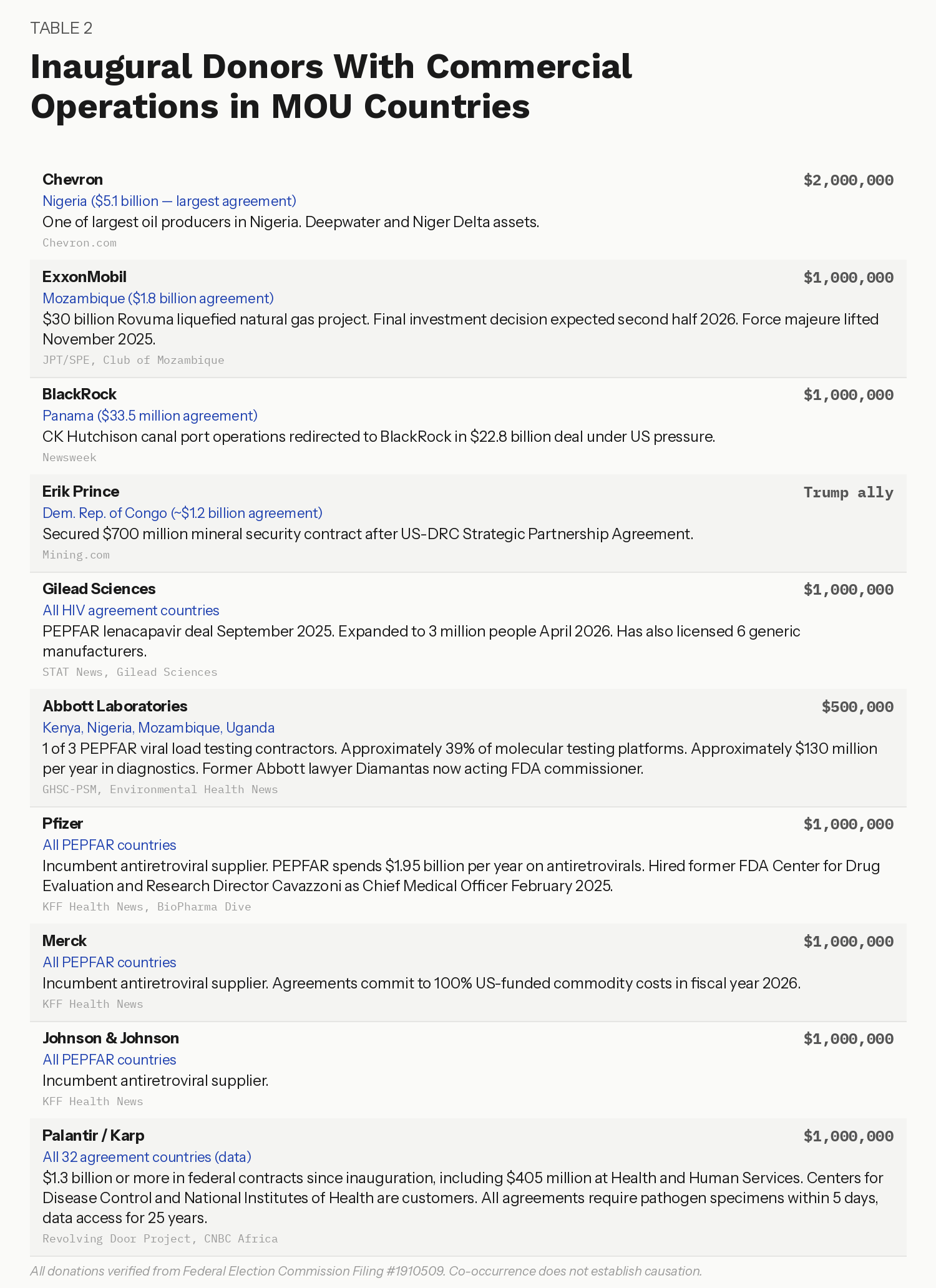
Table 3. Countries that rejected or challenged MOUs.
Table 3 shows what happened to the countries that said no. Zimbabwe walked away from $367 million, calling the terms “inequitable.” Ghana turned down $109 million in US funding over data privacy concerns. Kenya signed the deal, but its High Court suspended it, citing violations of the country’s Data Protection Act and other laws. The countries that pushed back had something in common: stronger courts, data protection laws, or civil society groups.
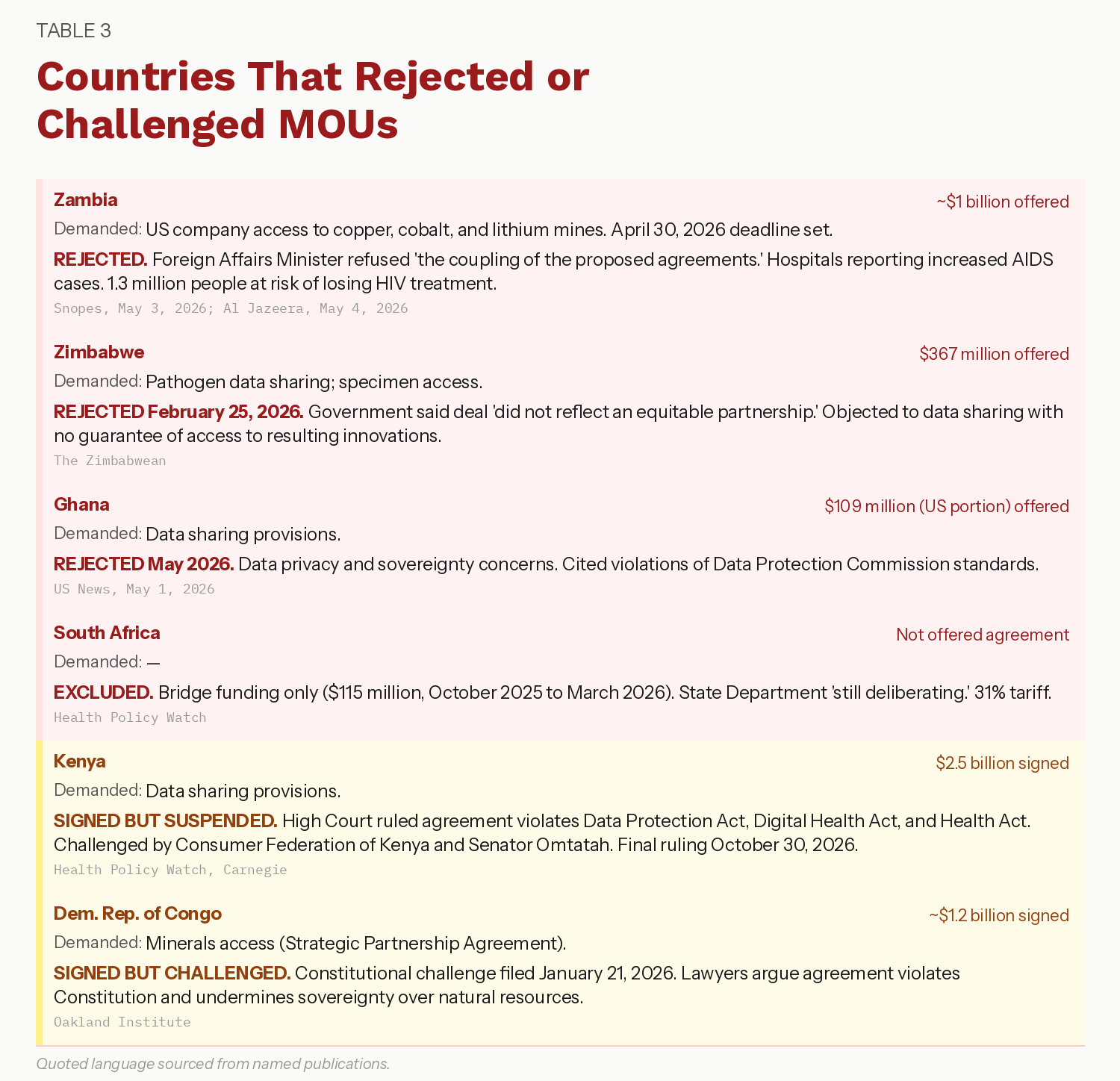
Table Sources
KFF Tracker: America First MOU Bilateral Global Health Agreements, KFF, updated April 27, 2026
Trump Vance Inaugural Committee filings, Federal Election Commission, Filing #1910509
US Tariff Tyranny and Africa: An Update, Center for Global Development, August 13, 2025
Trump threatens Nigeria with military action, Euronews, November 3, 2025
Kenyans protest planned US Ebola quarantine facility, Al Jazeera, June 1, 2026
Minerals for aid: Are new US health deals exploiting African countries? Al Jazeera, April 1, 2026
Zambia delaying US deals over minerals and data demands, Al Jazeera, May 4, 2026
Is Trump demanding Zambia hand over mineral rights or lose access to lifesaving HIV/AIDS meds? Snopes, May 3, 2026
Kenya’s High Court suspends US health deal, Health Policy Watch, December 11, 2025
Ghana rebuffs US health deal; South Africa and Zambia struggle without aid, Health Policy Watch, May 2026
PEPFAR freeze shuts clinics in Uganda, Foreign Policy, March 14, 2025
US deportation agreements: Honduras, Uganda, CBS News, August 21, 2025
ExxonMobil Rovuma LNG project, ExxonMobil
Mozambique: ExxonMobil final investment decision on LNG project expected in second half, Club of Mozambique
Trump’s health-aid overhaul faces a critical test in Mozambique, Bloomberg, May 29, 2026
USAID cuts and Tigray HIV crisis, Boston Globe, March 26, 2025
US-DRC Strategic Partnership Agreement, US State Department, December 4, 2025
US-DRC Strategic Partnership Agreement faces constitutional challenge, Oakland Institute, February 4, 2026
Trump hosts Congo and Rwanda leaders to sign deal on peace, critical minerals, PBS, December 4, 2025
Lesotho scrambles to save vital textile industry from Trump tariff tantrum, Daily Maverick, April 9, 2025
Burkina Faso signs Trump health deal, Africa Briefing, March 2026
Trump’s Panama Canal threats, Carnegie Endowment, February 19, 2025
Trump’s Panama threats paying off, Newsweek, February 3, 2025
Darién Gap crossings fall 99 percent, VisaVerge, April 11, 2025
Third Country Deportation Watch, Refugees International and Human Rights First
Honduras Asylum Cooperative Agreement, Immigration Policy Tracking, July 8, 2025
US paid $6 million for CECOT prison deal with El Salvador, PBS Frontline, April 7, 2026
US deportations to El Salvador double, NBC News, May 13, 2026
Trump visa sanctions targeting Cambodia, American Immigration Council
Bolivia’s shift to the right renews ambition to mine vast lithium reserves, Climate Change News, October 28, 2025
Bolivia country report, Congressional Research Service, September 14, 2017
Central Asia critical minerals diplomatic deals summit, Radio Free Europe/Radio Liberty, November 7, 2025
Trump hosts Central Asian leaders as US seeks to circumvent China on rare earth metals, PBS, November 7, 2025
Chevron in Nigeria, Chevron
Expanding faith-based healthcare in Nigeria through the America First Global Health Strategy, US State Department, December 20, 2025
Empowering resilience in Mozambique under the America First Global Health Strategy, US State Department, December 15, 2025
Erik Prince strikes mineral security deal with Congo, Mining.com, April 17, 2025
PEPFAR and the Global Fund expand investment in Gilead’s lenacapavir, Gilead Sciences, April 14, 2026
PEPFAR viral load diagnostics contracts, Global Health Supply Chain Program, October 27, 2020
FDA’s new food chief previously defended infant formula company in lawsuits, Environmental Health News, March 6, 2025
Pfizer names Cavazzoni Chief Medical Officer, BioPharma Dive, February 24, 2025
Peter Marks joins Eli Lilly, STAT News, October 7, 2025
Billionaires and the Trump administration: Peter Thiel, Revolving Door Project, April 8, 2025
Africa CDC head cites major concerns over data, pathogen sharing in US health deals, CNBC Africa, February 27, 2026
US winds down health programmes after Mnangagwa rejects $367 million deal, The Zimbabwean, February 25, 2026
Ghana becomes the latest African country to reject a US health deal, citing data sharing concerns, US News / Associated Press, May 1, 2026
US ties global health aid to data sharing on pathogens, Health Policy Watch, July 11, 2025
Africa stuck between global pathogen-sharing talks and conflicting US bilateral agreements, Health Policy Watch, January 12, 2025