


A shock to the drug trade
The killing of one of Mexico’s most powerful drug bosses has sent shockwaves through the global drug trade.
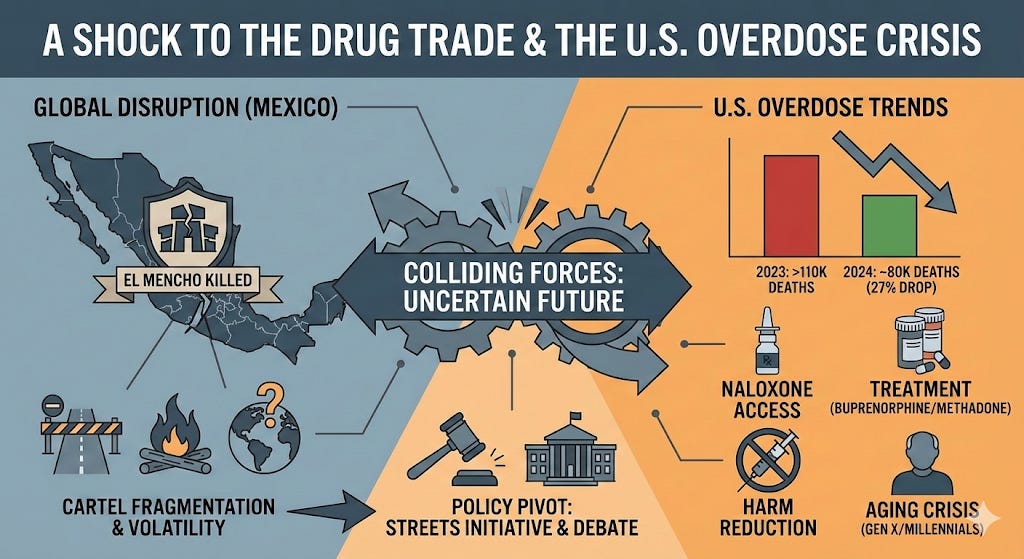
Over the weekend, Mexican security forces killed Nemesio Oseguera Cervantes, known as “El Mencho,” the longtime leader of the Jalisco New Generation Cartel. The operation left scores dead and triggered road blockades, fires, and chaos across parts of Mexico. Analysts are calling it one of the most significant blows to organized crime in decades. But few believe the cartel will simply disappear.
For the United States, the timing is striking.
Ask Dr. Gounder is a reader-supported publication. To receive new posts and support my work, consider becoming a free or paid subscriber.
Just weeks before the raid in Mexico, new federal data showed something rare in America’s overdose crisis: a sharp and historic drop in deaths.
Over 80 thousand Americans died of drug overdoses in 2024, down from over 110 thousand in 2023. The decline, 27% percent in a single year, is the largest percentage drop recorded in the past decade.
Still, the numbers remain staggering, and now two big forces are colliding: a major disruption in the drug supply abroad, and a fragile but real improvement in deaths at home.
A historic drop with limits
The new CDC data show overdose deaths fell across age groups, sexes, and racial and ethnic categories. Deaths involving synthetic opioids like fentanyl, the main driver of the crisis for years, declined sharply. Deaths involving cocaine and methamphetamine also dropped.
But context matters.
Even after the decline, overdose remains one of the leading causes of death for working-age Americans. The country still lost nearly 80,000 people in one year, roughly the equivalent of a large passenger jet crashing every day.
To understand whether it will last, you have to understand what appears to be driving it.
What’s driving the decline
There is no single explanation for the drop. Instead, experts point to several forces acting simultaneously.
Naloxone, the medication that reverses opioid overdoses, is more widely available than ever. It can now be purchased over the counter. Community groups distribute it in large numbers. Many families keep it at home. A friend recently had to administer it to a teen during a sleepover. I carry it in my purse.
Access to treatment has improved in some places. Medications like buprenorphine and methadone, proven to reduce overdose risk, became easier to prescribe after pandemic-era rule changes. Telehealth expanded access in rural and underserved areas.
Harm reduction programs have grown. Syringe exchange services, overdose education, and drug-checking programs operate in more communities than they did five years ago, even amid political pushback.
None of these steps alone would likely produce a 27% drop in deaths. Together, they may be enough to shift the trend.
But policy is only part of the story.
The crisis is aging
Another major shift is demographic.
“Seventy percent of deaths are in Gen X and millennials,” said Nabarun Dasgupta, a street drug scientist at the University of North Carolina Opioid Data Lab. “Gen Z’s overdose death rates, compared to their parents’ and grandparents’ generation at the same age, are many-fold lower.”
In Maine, one overdose data expert reported that in 2025, there were no suspected overdose deaths among people younger than 20, and only two under 25 for more than a year.
That does not mean young people are immune. There are warning signs among some teenagers, especially those who were in middle school during COVID. But overall, fewer young people appear to be entering opioid use compared with earlier waves of the crisis.
That generational shift changes the shape of the epidemic. Instead of constantly recruiting new young users, the crisis is increasingly concentrated among middle-aged adults, many of whom have struggled with addiction for years, often alongside homelessness, poverty, or serious health problems. That concentration changes what effective solutions look like.
And if fewer new people are entering the market, that alone can help bend the curve.
A volatile drug supply
The drugs themselves are also changing.
Researchers analyzing thousands of street drug samples report that today’s supply is highly unpredictable. What is sold as “fentanyl” may contain fentanyl, or it may be mixed with sedatives like xylazine or medetomidine, or numbing agents such as lidocaine.
In some cities, only about 60% of samples sold as fentanyl actually contain fentanyl.
That volatility can alter behavior. When the product is inconsistent or produces unwanted side effects, some people use less often, use smaller amounts, or switch substances.
Some experts initially argued that falling fentanyl “purity” explained the drop in deaths. But more detailed regional analyses indicate that supply changes alone cannot account for the decline across most of the country.
The pattern appears to reflect a mix of factors, including behavior, access to treatment, and the broader generational shift.
“We replicated that analysis from scratch,” said Dasgupta. “It does hold for the West Coast. But it doesn’t hold for the Midwest, the South, or the Northeast. For the rest of the country, there’s no correlation at all between the purity and the drop in overdose deaths.”
In other words, supply shifts may matter in some regions, but they don’t explain the national picture.
“The pattern appears to reflect a mix of factors,” Dasgupta said, including changes in treatment access, behavior, and who is most at risk.
And the drug market has never been static. It adapts to enforcement, consumer demand, and international supply chains.
And that is where the killing of El Mencho enters the picture.
When cartels fragment
The Jalisco New Generation Cartel is one of the world’s most powerful trafficking organizations. It has moved cocaine, methamphetamine, and fentanyl into U.S. markets and built alliances across continents.
History shows that when cartel leaders are killed, the market doesn’t disappear. The demand is still there. It reshapes the market. Sometimes the supply is temporarily disrupted. Sometimes rival factions fight for control. Routes change. New players enter. Adulteration increases as smaller groups compete and experiment.
In other words, the cartel disruption could either reinforce the decline or destabilize it.
There is no guarantee which path it will take.
A policy pivot and a debate
As these market forces play out, federal policy is also shifting.
On February 2nd, Health and Human Services Secretary Robert F. Kennedy Jr. announced a $100 million plan called the STREETS Initiative (Safety Through Recovery, Engagement, and Evidence-based Treatment and Supports). The administration described it as a break from what it called “Biden-era” policies, arguing that harm reduction and Housing First strategies failed to curb addiction and, in some cases, enabled continued drug use. The new plan emphasizes psychiatric care, crisis stabilization, recovery housing, and long-term self-sufficiency.
Supporters say the approach centers accountability and recovery at a time when homelessness and street disorder remain visible in many cities.
Dasgupta worries that some of the rhetoric risks missing the current reality. He argues that policy should focus intensely on the narrow age band where most deaths are happening. “If 70% of overdose deaths are in Gen X and millennials, that’s where the problem is,” he said. “We need specific solutions to the current situation.”
Other critics argue the framing overlooks a large body of evidence. Harm-reduction tools such as naloxone distribution and syringe services are strongly associated with lower overdose deaths and reduced infectious disease transmission. Housing First programs have consistently improved housing stability and reduced emergency room use. Public health experts warn that dismissing those approaches outright could weaken strategies that keep people alive long enough to enter treatment.
The administration also announced a $10 million Assisted Outpatient Treatment program, allowing courts to order community-based mental health treatment for certain adults who have not engaged voluntarily. Supporters say it can reduce repeated crises. Civil liberties advocates caution that court-mandated treatment risks coercion if not carefully applied.
At the same time, the federal government continues funding treatment through block grants and has expanded support for medications such as buprenorphine, methadone, and naltrexone for parents at risk of losing custody of their children. Medications for opioid use disorder are strongly associated with reduced overdose risk and mortality.
“The biggest federal thing I worry about is Medicaid policy,” Dasgupta said. “If we make it any iota harder for people to get drug treatment, especially Gen X and millennials, then we risk re-accelerating the problem when we’re already in a decline.”
“I honestly feel like we do have this opportunity,” he said. “I don’t think I would have said that at any point in the last 25 years.”
IMO - If the approach towards the drug epidemic isn't on a wholistic basis, I'm afraid, it's like a dog chasing its tail.
In other words, the focus on overdose death data isn't an indicator that we are addressing the real problem of addiction & demands vs supply.
There's a common theme or message, "jails, institutions & deaths," that remains inevitable amongst recovered addicts & recovering addicts, on account of programs developed, similar to Alcholics Anonymous, with an emphasis on treatment of addiction.
In other words, saving lives without transition towards treatment of addiction - through established centers & in-house programs, as an effort in changing behaviors, habits, and addressing past & present psychological/mental issues, we'll not achieve any reasonable or desired reduction of this epidemic, which affects family members, friends & communities.
Although 80,000 deaths is a significant number in public health concern, it remains devastating & preventable with the combined effort of addressing the addiction, through treatment centers & programs, not only saving the lives from overdose deaths.
Finally, there were other drug cartels, either as sugnificant or more significant as El Mencho; therefore, it's a disruption not an eradication of suppliers. There is always someone waiting in the wings. It doesn't matter the quality of the drug or not, addiction is impartial, once the obsessive-compultion for the "fix" is triggered, which could be tainted/ substance.
Therefore, unless there's a drastic decline in demands, suppliers & supply are imminent.